As far as theatrics go, there’s not much that can match what I got to witness in St. Peter’s Square on Thursday, May 8, 2025.
The black smoke in the morning, then the white smoke in the evening. The sounds of those enormous bells and the jovial marching bands echoing through the square. The Habemus Papam! and the astonished stares among journalists when we heard Cardinal Robert Prevost’s name. The roar of the crowd and the sight of the first American pope introducing himself to the world in Italian and Spanish.
As Cardinal Timothy Dolan of New York told journalists the next day: “Nobody does drama like the holy Roman Catholic Church.”
On the anniversary of that day, I find myself thinking less about papal politics and intrigue, and more about four women from the LA area that I met that day — seemingly by chance — and their accidental front-row seat to history.
When the drama was done and the square began to empty, I walked down the stairs from the designated press area atop Bernini’s famous columns. I needed witnesses to interview. At the top of my wish list: anyone from Southern California.
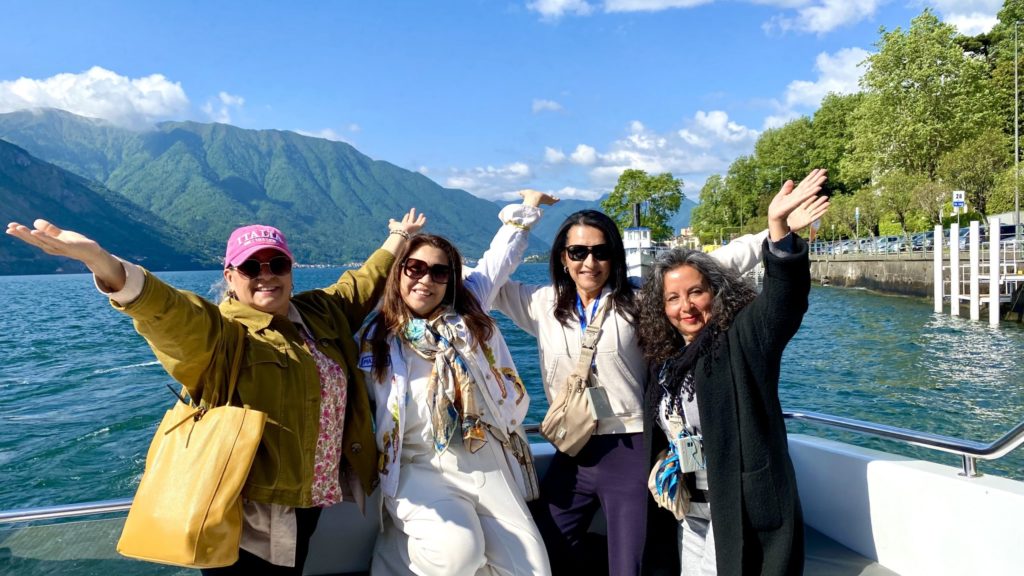
As I came out of the stairwell, waiting for me between the columns were four middle-aged women. One of them was singing to herself in Spanish: “We have a pope, Leo XIV. We love Leo!”
I soon learned I’d run into a group of four friends — all from Southern California — on a “girls trip” to Italy.
The women had quite a story to tell. Months earlier, they had planned a trip to Italy to celebrate one of their birthdays that included a weekly audience with Pope Francis in St. Peter’s Square. His death on April 21 changed those plans.
They had gone to Rome hoping to see one pope, but wound up witnessing the election of another one.
View this post on Instagram
After nearly 40 years of friendship, something like this was bound to happen. Two of them, Maria Lafarga and Patricia Soto, were friends since childhood in Mexico. Maria met the other two, Gladys Heraldez and Martha Torres, working as designers in the garment industry after immigrating to Southern California in the 1980s. The four raised their kids together, with plenty of baptisms, first Communions, and graduations in between. They took regular vacations to Mexico. One even helped introduce another to her future husband.
All these years later, the women found themselves among the thousands packed into St. Peter’s Square on May 7 waiting for hours into the evening before the first smoke signal from the Sistine Chapel after 9 p.m.
“It was black, but we were like, ‘OK, we got to see black smoke,’ ” said Torres, who lives in San Bernardino.
The next day, they woke up early to visit the Colosseum. Then they returned to St. Peter’s Square, where they learned there had been more black smoke in the morning. It was their last day in Rome before heading to Florence, and having no idea when the conclave might finish, they decided to get in line to enter St. Peter’s Basilica.
Inside, the friends prayed in front of the tomb of St. Pope John Paul II. They visited the tombs of other popes in the basilica’s crypt. Upstairs, they stopped to pray as a Mass was being celebrated behind Bernini’s baldachino.
Then they heard a “big noise.”
“We were just hearing people screaming,” said Maria Lafarga, a parishioner of Our Lady of Guadalupe Church in Chino, California.
Lafarga started recording with her cellphone as the crowd inside began walking — then running — toward the entrance of the basilica. Murmurs of “Papa!” and “Oh my God!” could be heard.
They came out from under the immense columns that form the façade of St. Peter’s and looked up. White smoke.
“It was just magical,” said Lafarga a few hours later. “People were screaming that we have a new pope, and we see all the faces. People were so happy!”
Another one of the friends, Gladys Heraldez, said that when Pope Francis had gotten seriously ill earlier that year, she’d been praying that they’d still get to see him on their trip. But once in Rome, she had a different prayer.
“I’m not gonna lie, I was praying, I was praying real hard that we’d get to see a new pope,” Heraldez, who attends St. Paul the Apostle Church in Chino Hills, told me.
The women moved into St. Peter’s Square, by then teeming with nervous excitement. When Cardinal Dominique Mamberti stepped onto the balcony for the “Habemus Papam!” announcement, Lafarga watched the face of an American priest next to her turn “bright” as Mamberti pronounced the words “Robertus Franciscus” and the name the new pope had taken. “Who’s Leo? Who’s Leo?” the women frantically asked.
“He’s an American, and he’s from Chicago, and he’s the first American pope!” a man nearby responded in English.
Not only an American, but like them, an American who spoke Spanish. They got the chills as they listened to the new pope address the world from the balcony in both Italian and Spanish.
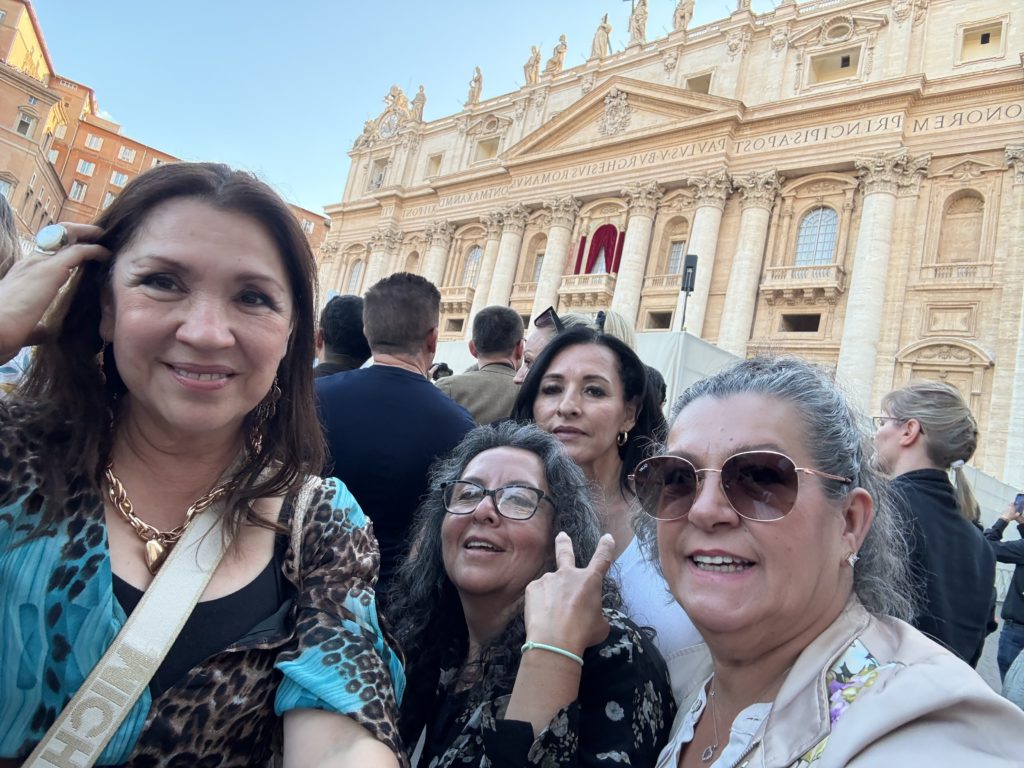
One year later, Lafarga describes the experience as downright “mystical.”
“There is no way I could ever experience something like that, ever,” Lafarga told me in a phone interview (while on another vacation with Soto, of course).
What does Lafarga think of Leo after a year on the job? At a time when the United States — and the Church — seems as divided as ever, she sees signs the College of Cardinals “elected the right person.”
“As an American, he knows what we’re going through,” said Lafarga. “I feel confident that he’s guiding the Catholic Church the right way, and he’s giving the right message to people.”
I asked Lafarga if she ever wonders how — or why — they were in the right place at the right time to witness history.
“It’s funny, because I am very spiritual, but I have friends and family members who are far more religious than me,” said Lafarga. “So I don’t know what I did to deserve that. I think God has his ways to put us in the right place.”