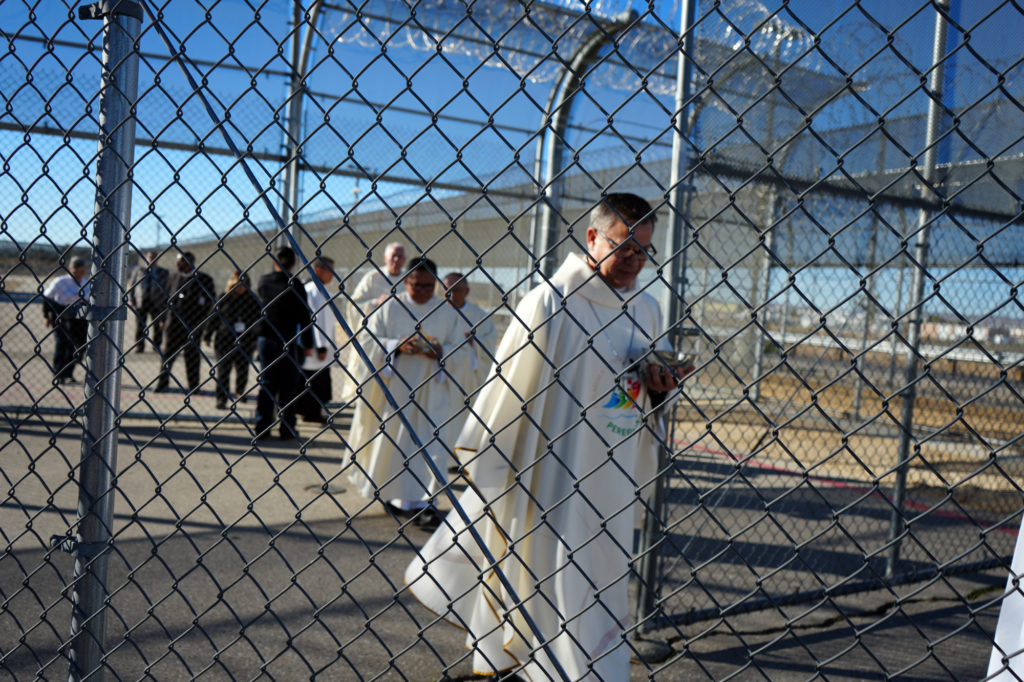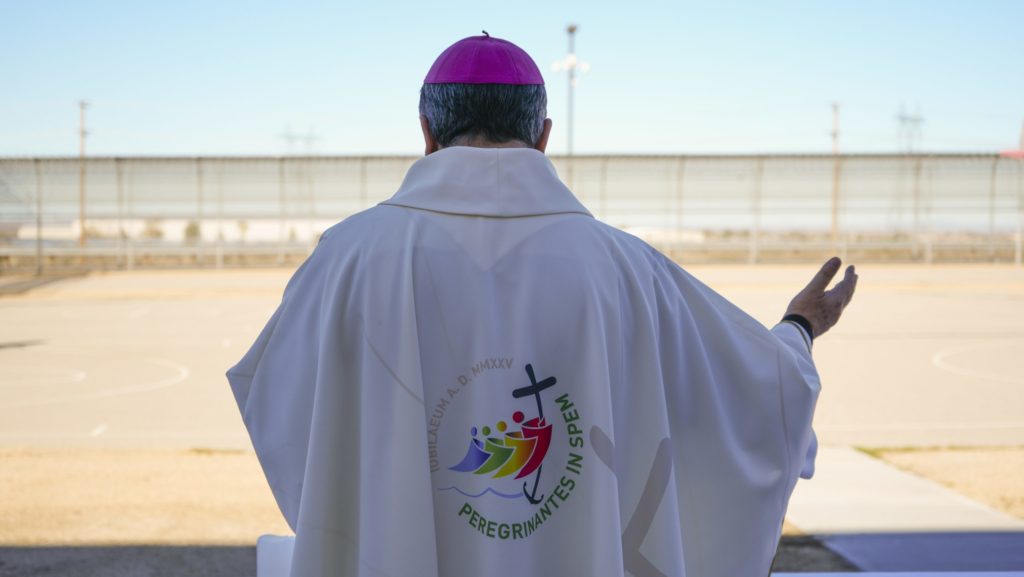
With Communion bowls in hand, a group of California bishops walked through the barbed wire gates of the ICE Processing Center and offered Jesus to the men locked inside.
This moment of the Mass, held Dec. 10 outside the town of Adelanto in the Mojave Desert, was deeply emotional for both the bishops and the roughly 300 detainees present.
“To see their faces, to see how they were impacted, was very powerful for me,” said Los Angeles Auxiliary Bishop Brian Nunes. “So many times we think of migrants, refugees as a category. And a category is very impersonal, but seeing them one by one with faces, with voices, that are very memorable, is something that I’ll take with me.”
A total of seven bishops were on hand to celebrate the Mass, which sought to bring faith and hope to the undocumented immigrants awaiting legal proceedings. The outdoor service, organized by the California Catholic Conference (CCC) and the Diocese of San Bernardino, was the first major religious event at the High Desert facility since the COVID-19 pandemic.
The visit was inspired by the “special message” on immigration issued by the U.S. bishops in November. It criticized the Trump administration’s policy of mass deportations and called for humane treatment at detention facilities, while acknowledging the right of nations to protect their borders.
Main celebrant Bishop Alberto Rojas from the Diocese of San Bernardino, which includes Adelanto, was also joined by emeritus Bishop Gerald Barnes of San Bernardino, Bishop Oscar Cantú of San Jose, and Auxiliary Bishop Rey Bersabal of Sacramento. The other participants from the Archdiocese of Los Angeles were Auxiliary Bishops Matt Elshoff and Marc Trudeau.

Bishop Cantú preached to the detainees as they watched from guarded, fenced recreational areas on either side of the altar. During the homily, given in both English and Spanish, the bishop assured them that God’s grace can reach them even here.
“No matter where we are, if we’re on this side of the fence or on that side of the fence, for God there are no barriers, there are no fences, there are no walls,” proclaimed Cantú, who currently serves as president of the CCC. “His love penetrates everywhere and anywhere in the world where the human heart is open to his love.”
The west wing of the facility houses some 1,600 men who were taken into custody not just locally, but throughout the U.S. Their countries of origin range from Mexico to Turkey to China. At the start of Mass, Rojas told the detainees that the Church had not forgotten them.
“You are not alone,” said Rojas, who was recently appointed to the United States Conference of Catholic Bishops’ (USCCB) Committee on Migration. “We support you, we pray for you and your families. We want to see how you are doing.”
His comments were met with a loud “Muchas gracias!” from one of the detainees. The bishop smiled and shouted back, “De nada!
Throughout the service, detainees continued to be talkative and demonstrative, giving one another and the bishops gestures of peace. But they turned quiet when the bishops crossed the heavy metal barriers and entered their yards, the only time interaction was permitted. The men mostly took Communion on the tongue, and some asked for their Bibles or rosaries to be blessed. After receiving the Eucharist, detainees returned to the fence line and dropped to their knees in prayer, several laying on the ground prostrate.
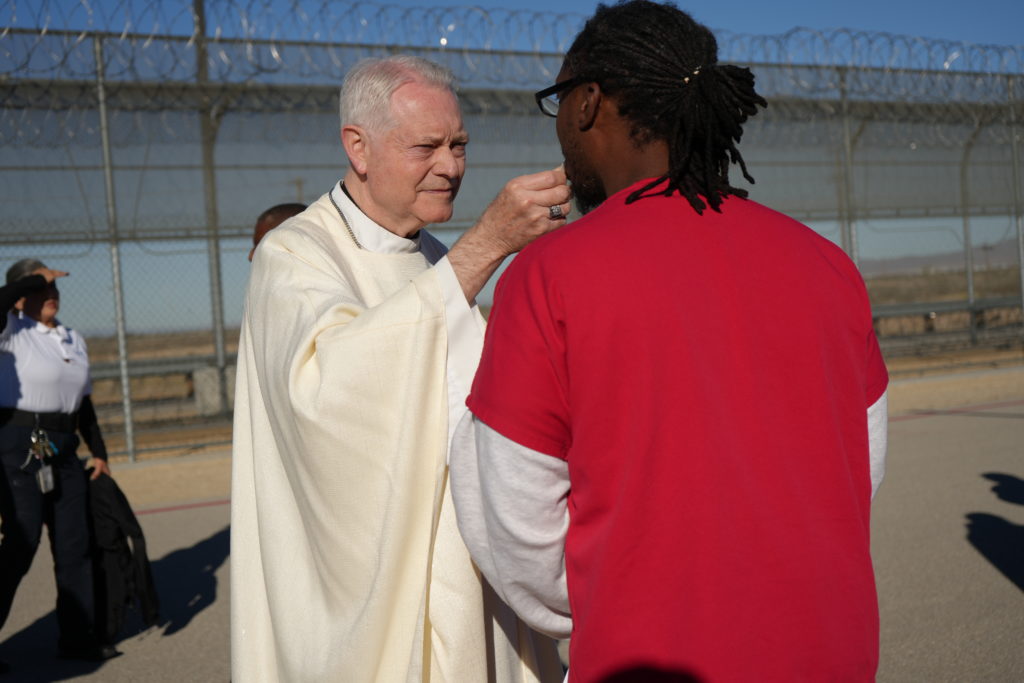
Bersabal said he wanted to be a strong presence for the detainees but struggled to contain his own emotions.
“After looking into the faces of the first five men, I had to take a breath and fight for my composure,” recalled Bersabal. “You could see how much Communion meant to them.”
Barnes, who celebrated Mass here multiple times during his 25 years leading the Diocese of San Bernardino, was touched by the men's gratitude demonstrated by their clapping at both the beginning and end of Mass.
“The applause that they shared with us moved me so much,” said Barnes. “In a sense, it said, ‘We’re not alone, thank you for being here.’ Human beings, brothers, with their own stories.”
The California bishops say they’ll continue to engage with detainees and lead prayers, as they did the night before, when dozens of parishes across the state marked the feast day of St. Juan Diego by holding a special Holy Hour in the presence of the Blessed Sacrament to pray for immigrants affected by recent raids. In Los Angeles, for example, five parishes in each of the archdiocese’s pastoral regions took part.
At a press conference following the Mass at Adelanto’s Christ the Good Shepherd Catholic Church nearby, the bishops said that while the visit was “pastoral” in nature, it was important to insist on comprehensive immigration reform that recognizes the dignity of the human person. Cantú called out both Congressional Republicans and Democrats for not fixing the “broken” system “that fails families.”
“No matter who they are, no matter what their color is, and no matter what mistakes they have made, justice must always be tempered with mercy and mercy must always be tempered with justice,” said Elshoff. “That comes from the heart of our loving God.”
The bishops also fielded questions about detainee treatment since GEO Group, the private company contracted to operate the facility, has been accused of not providing adequate care. Cantú noted that while they did not tour the entire building, what they saw was clean. He also said the new warden and the staff chaplain were welcoming.
Trudeau said the visit reminded him of Pope Leo XIV’s call in his recent Apostolic Exhortation, “Dilexi te” (“I have loved you”), for the Catholic Church to embrace the vulnerable, including migrants.
‘What the world sees as threats, the Church sees [as] God’s children,” said Trudeau, paraphrasing the pontiff. “It’s not a political thing here. It’s about God’s people … they’re our family.”