Saturday afternoons on Olvera Street are rarely quiet, but it’s not every day you see a cow and a goat leading a procession down Main Street.
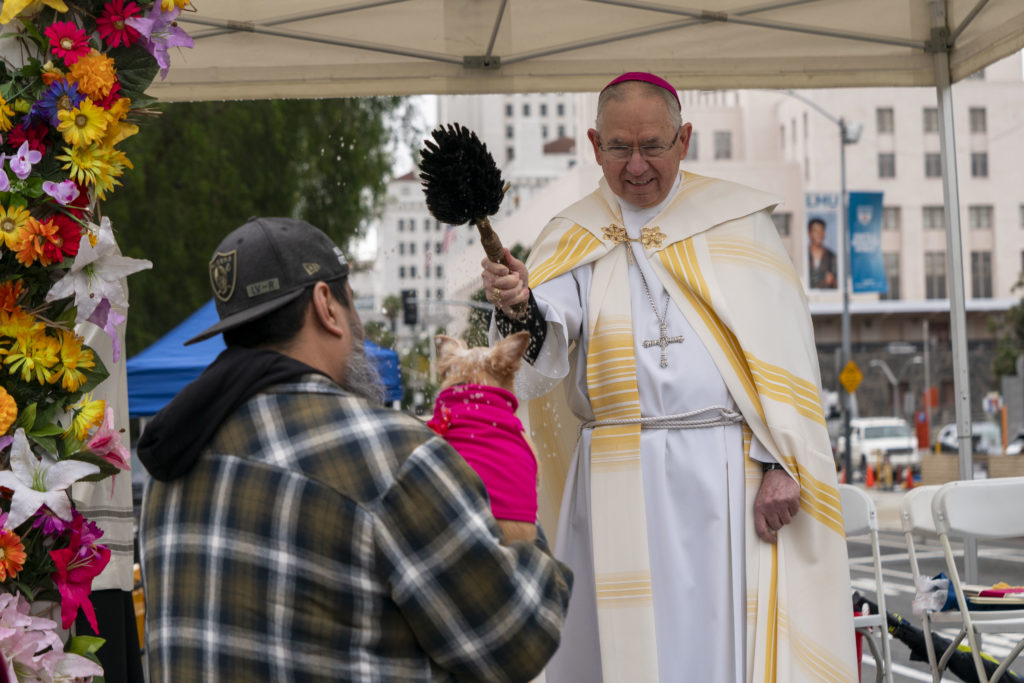
A day before Easter, on Holy Saturday, the historic district in Los Angeles transformed into a chaotic, joyful intersection of daily life and faith as the area hosted the annual Blessing of the Animals led by Archbishop José H. Gomez.
Thousands of families lined the pavement along the historic plaza, holding dogs on short leashes, cats tucked into ventilated backpacks, and brightly colored birds in cages.
“According to ancient traditions, it was the animals who were the first to recognize the resurrection of Christ,” Archbishop Gomez said. “Today we honor that witness by asking God’s blessing, that we may share in the beauty of creation and in the mystery of redemption and worship.”
Back when Los Angeles was still an agricultural pueblo, priests from the nearby La Placita Church would walk out to bless local farmers’ livestock. Those early blessings were a ritual directly tied to the survival, health, and economic well-being of the community.
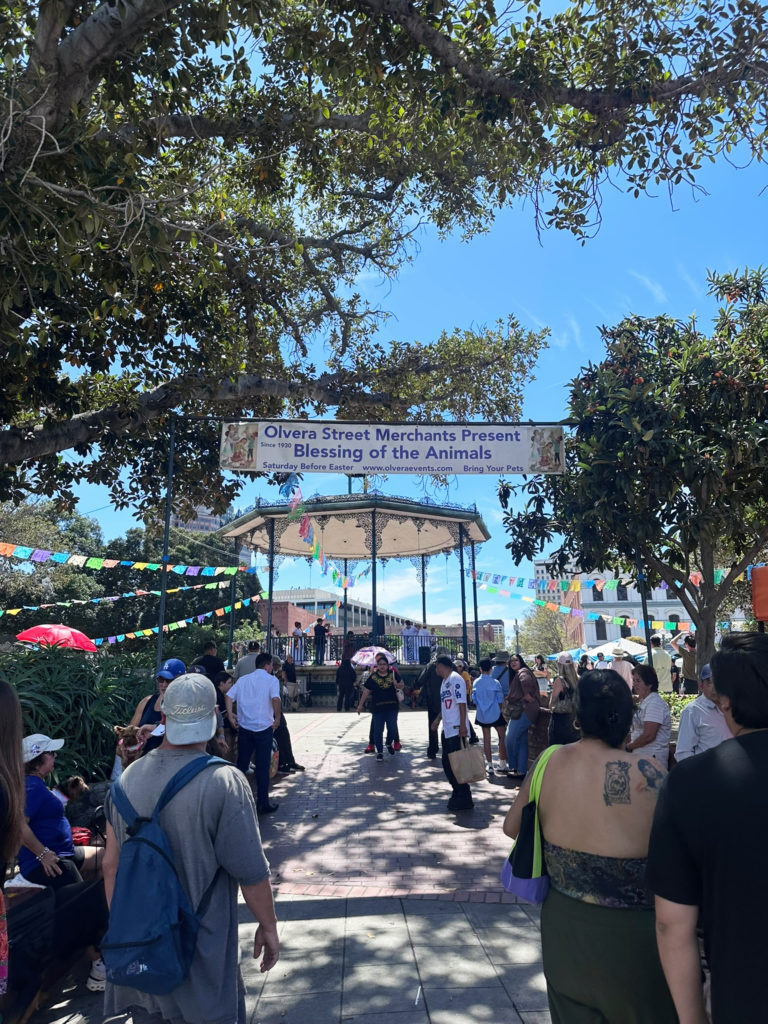
The LA tradition started around the time Olvera Street became a cultural monument in 1930. But its historical origins stretch back to St. Anthony the Abbot, a fourth-century monk considered the patron saint of animals. Even then, animals were considered a valued part of creation to Christians, and people as their caretakers.
Today, livestock has mostly given way to household pets, a sign of modern times. But the intention these days is the same: entrusting what we love to God’s care.
Setting up near the historic Pico House, the archbishop sprinkled holy water over the long line of attendees, who moved steadily in front of him. As he did, the energetic atmosphere of the street shifted to something noticeably quieter and more reverent. Some families bowed their heads; others made the sign of the cross as the water fell.
Near the front of the line, Camilla Diaz of Los Angeles clutched her small dog close to her chest. For her, the afternoon was the perfect bridge between her personal faith and her modern family life.
“They’re part of our family, and they can’t be baptized, so this is the next best thing we can do to include them in our religion,” said Diaz, noting that her family has made the trip downtown for the last two years. “We’re Catholic, and it’s important for us. It’s also become a tradition. Even with the long line, it’s something we get to do together as a family, and that makes it really special.”
But you didn’t have to be Catholic to stand in line. A few paces behind Diaz, a group managing a lively pack of rescue dogs was there simply for the tradition and community of it all.
“I volunteer with a shelter in Los Feliz, and we come every year and bring out all the pets,” one attendee noted, keeping a watchful eye on an eager terrier trying to investigate a neighboring poodle. “More than a religious or faith-based reason, we bring them out of love and tradition.”
That open-arms approach was reflected in the unpredictable variety of the crowd. While dogs of every breed and size dominated the line, they were far from the only participants. Cats peered from the safety of their mesh carriers, parrots chattered from the shoulders of their owners, and a few unexpected guests, including turtles, a brightly colored iguana, and even a few snakes, made appearances to receive a blessing.
For over an hour, event volunteers worked tirelessly to keep the line moving. In a city like Los Angeles that rarely stops, the Blessing of the Animals forced a quiet, collective pause.
As the formal blessing concluded and the crowd finally thinned out into the surrounding plazas, people lingered on the plaza. They snapped photos beneath the shade trees, grabbed a late lunch from the nearby vendors, and simply enjoyed the warmth of the afternoon.
The pets, naturally, were completely oblivious to the spiritual significance of the day, eager only for a treat or to return to their usual routines. But for the people holding their leashes, the afternoon carried forward. On Holy Saturday, a day traditionally marked by waiting and reflection, the event served as a quiet reminder that devotion isn’t always found in grand gestures. Sometimes, it’s just the everyday act of caring for the creatures entrusted to us.