When a history-making event occurs, it can be accompanied by accolades, speeches, or proclamations.
At Youth Day for the Archdiocese of Los Angeles’ annual Religious Education Congress on Feb. 19 at the Anaheim Convention Center, history came in the form of dancing, Jesus chants, and glow-in-the-dark rings.
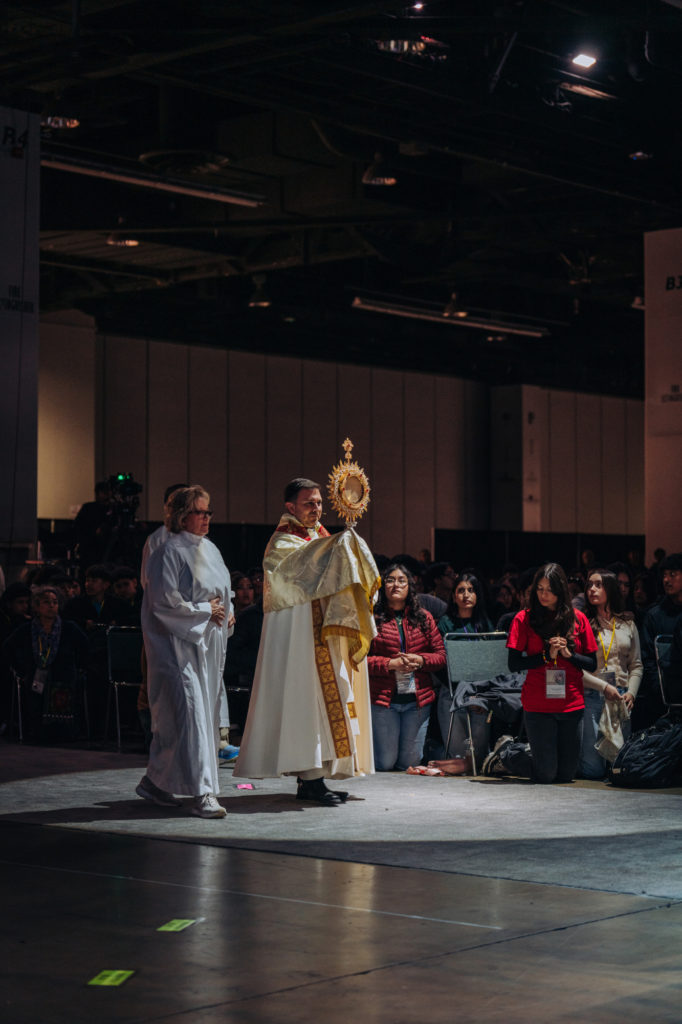
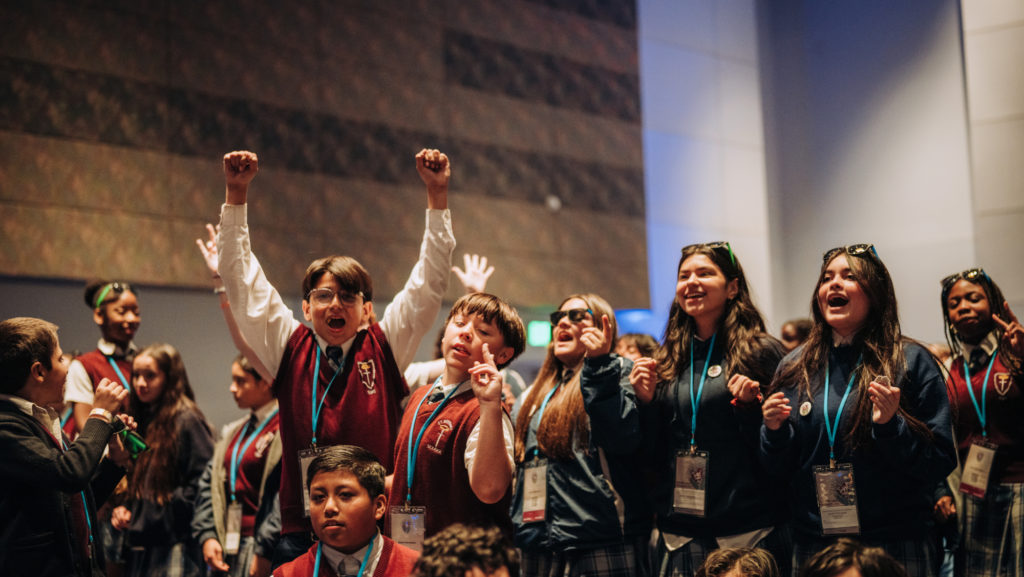
For the first time in the event’s history, middle-schoolers were invited to Youth Day, joining the high school and confirmation students that typically attend the gathering where teens come together for a day of speakers, music, prayer, Mass, adoration, workshops — and playful fun, like in many years.
Dayrin Perez, the lead coordinator of youth ministry for the archdiocese, said they targeted this age group after other successful archdiocesan events like Holy Fire, and because the demographic can often be overlooked.
“It’s one of the age groups that does not, in most parishes, necessarily have a ministry that is running for them,” Perez said. “But there’s a lot of need and desire for use in that age group for participating and especially in the larger Church.”
The response was a success as 1,300 middle-schoolers signed up, maxing out the number organizers could fit into the space, Perez said. Nearly 8,000 high-schoolers also attended Youth Day, bringing the overall event attendance to nearly 10,000.
As the middle-school day kicked off, there was a lot of dancing. Catholic speaker and performer Joe Melendrez hyped up the youth with call-and-response chants — “Ain’t no party like a Jesus party!” — dancing to routines on video screens, and playing interactive games that got kids running around, making friends, high-fiving, and dancing on chairs.
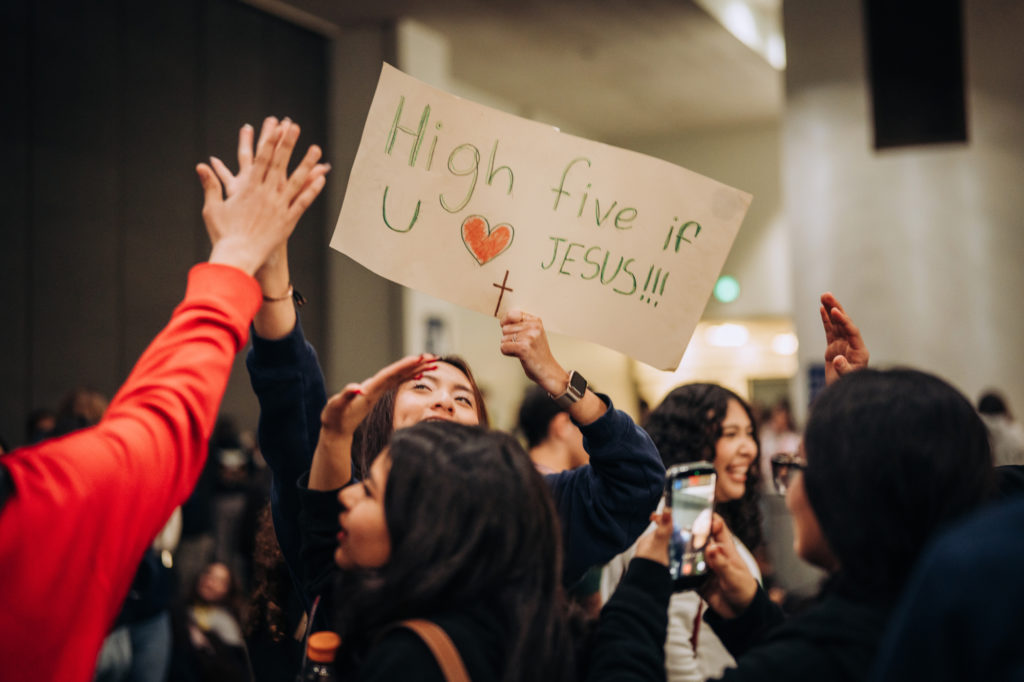
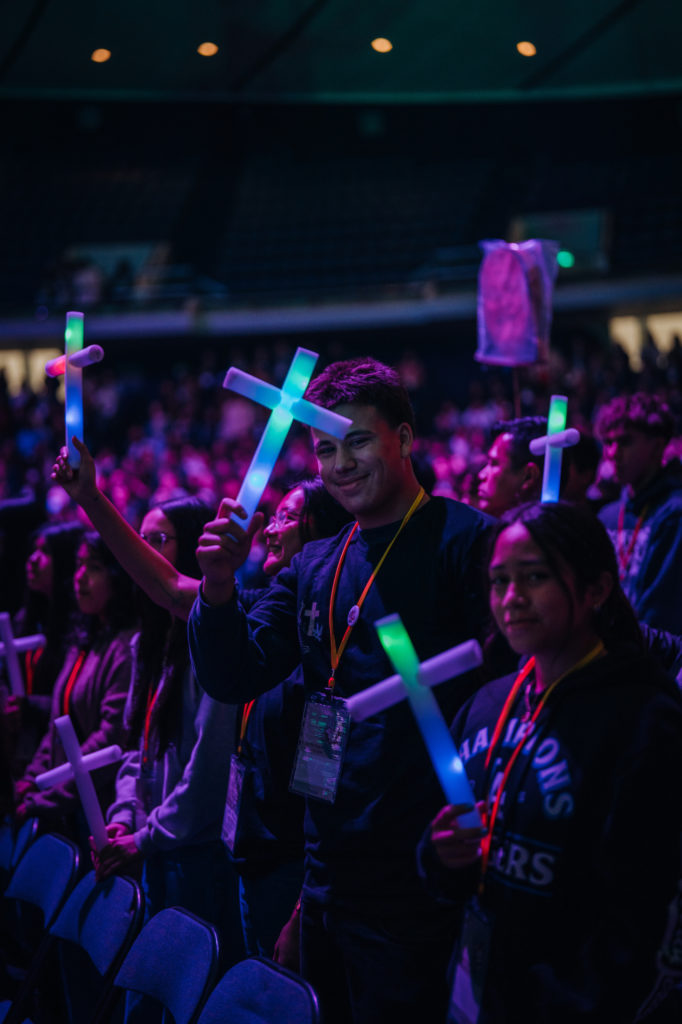
The lights were turned off several times, revealing glow-in-the-dark rings and other “merch” handed out that day. Rafael Cabezas Jr. and his band took the stage to perform several sing-along hits, including “Life is a Highway” and “Happy.”
But the middle school session also offered moments of serious reflection. Melendrez spoke about how God found him during a retreat when he was a teenager in San Antonio, while young people in the crowd told their stories of surviving injuries, loss, and being born.
“Maybe you’re like, ‘Joe, I’m really excited to be here. I love Jesus.’ That’s great,” Melendrez said. “Others are like, ‘Joe, I don’t really have a relationship with God. I don’t really know who he is.’ Guess what? I’m so glad you’re here. You belong even before you believe.
“God has a plan, a mission, and a calling on your life, and you’re exactly where you’re supposed to be right now.”
During his homily for the middle-schoolers’ Mass, Auxiliary Bishop Marc Trudeau talked about the word “sacrifice” and how, with Jesus’ help, Catholics can do more than simply give things up for Lent.
“My prayer for all of you is that you join with Jesus in that sacrifice of love,” Trudeau said. “It’s Jesus in us who is called the sacrifice for the world. We are the world. And today, make our families holy. We need our schools holy, our classrooms holy. We make our communities holy.”
On the high school side, rather than keeping all students together in one big monolith, organizers divided the group into two tracks to give them a more manageable experience, similar to how it was before COVID, Perez said.
The high-schoolers experienced Mass, adoration, music, workshops, speakers, and more as part of their day. The workshops focused on many of the challenges young people are experiencing in the world.
In her workshop, “Stuff Happens: How Do We Embrace Our Cross?”, Mary Bielski detailed to the teens how God meets them in their suffering, but also how the devil’s lies can reconfigure a situation into unhealthy trauma. In Katherine Angulo Valenzuela’s workshop, “How Does Service to Others Impact Our Relationship with Jesus?”, she implored the crowd to use their God-given skills to help their communities.
Some workshops were a little more lighthearted with a deeper message. In “The G.O.A.T.” workshop, Father Tim Anastos compared what some of the “greatest of all time” athletes — Tom Brady, LeBron James, Serena Williams — did in their careers vs. what Jesus did in his lifetime, and beyond.
Joel Stepanek had participants play a “mind reading” game and had the crowd decipher real vs. AI photos before launching into the meat of his workshop, “For God's Glory: Living Real Faith in a Digital World.”
“The goal of living our faith in a digital age where things are increasingly fake and it’s difficult to tell reality from a digital reality is living grounded in our identity as rooted in God,” Stepanek said. “Because a person who walks in faith knows who they are before God and before others and before themselves.”
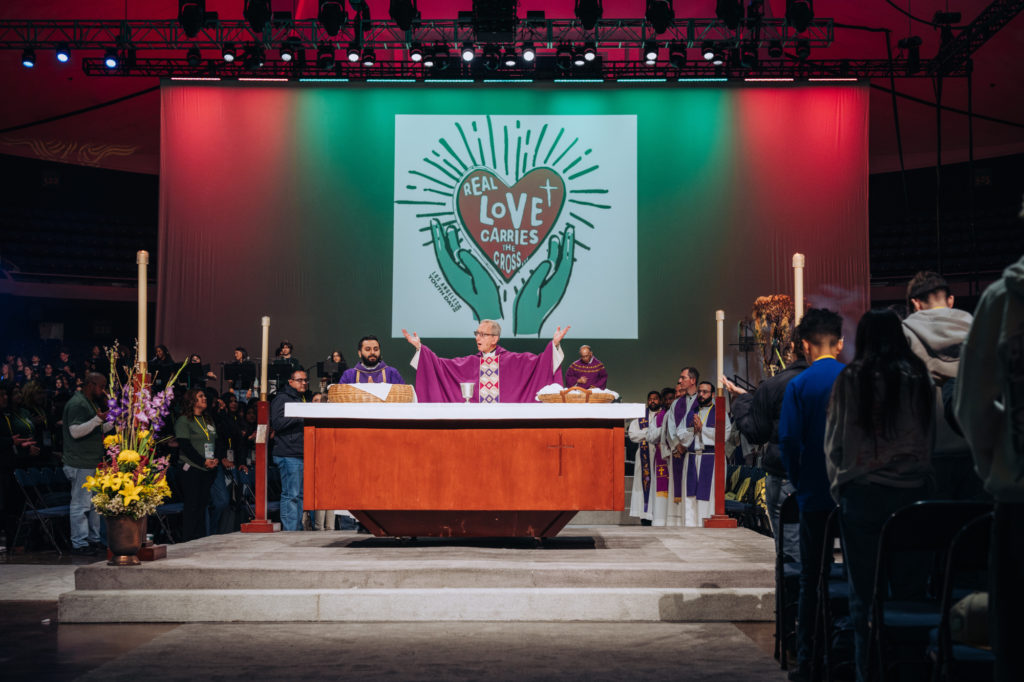
Much of the messaging geared toward the high-schoolers was rooted in the theme of the day, “Real Love Carries the Cross,” which was partly conceived by a select group of teens.
Daniela Reyes, 16, and Dominick Fierro, 16, parishioners at St. Peter Claver Church in Simi Valley, were two of the teens who helped formulate the theme and were at Youth Day as part of the spirit team.
“We wanted to open the theme up so more kids can feel like they can connect to what we’re talking about,” Reyes said. “We tried to go about that in a way that more kids will actually find themselves in.”
“No one is perfect. Everyone has their own struggles, beliefs, things that they go through in life,” Fierro said. “With true love and prayers across, it brings out people’s true love for something.”
Many teens attending Youth Day reflected on what challenges they face and how God is helping them carry their crosses.
“Basically, it’s everything,” said Alejandra Quintero, 15, a parishioner at St. Thomas Aquinas Church in Ojai. “Everything comes with challenges with new things. It’s really a test with youth to keep that relationship with God, where they can be involved and love God, and also keep faith as they’re going through the new challenges.”
April “Aj” Lopez, 17, who was among a group from Our Lady of Guadalupe Church in Oxnard, said she feels pressure about other people’s expectations and opinions, but that none of that matters when you’re in God’s plan.
“It’s better to trust in what God is doing or what he can do than to worry at all,” Lopez said. “Someone will show up for you if you pray. Something will happen if you believe God will make it so. But truly believe it.”
In the Mass to cap the day for the second group of high-schoolers, Auxiliary Bishop Brian Nunes emphasized that while gifts and feelings of love are great, the true sign of love is a choice that Jesus made first.
“Chocolate is great, but it’s not an image of love,” Nunes said. “Flowers smell great, but they’re not love. In fact, any time we get something that’s shaped like a heart, we start going down the wrong road away from love. Because a heart symbolizes a feeling. The best image for love is not a heart. What could it be? It would be a cross.
“Jesus tells us in the Gospel to pick up our cross. He gives us the best image of what love should look like.”