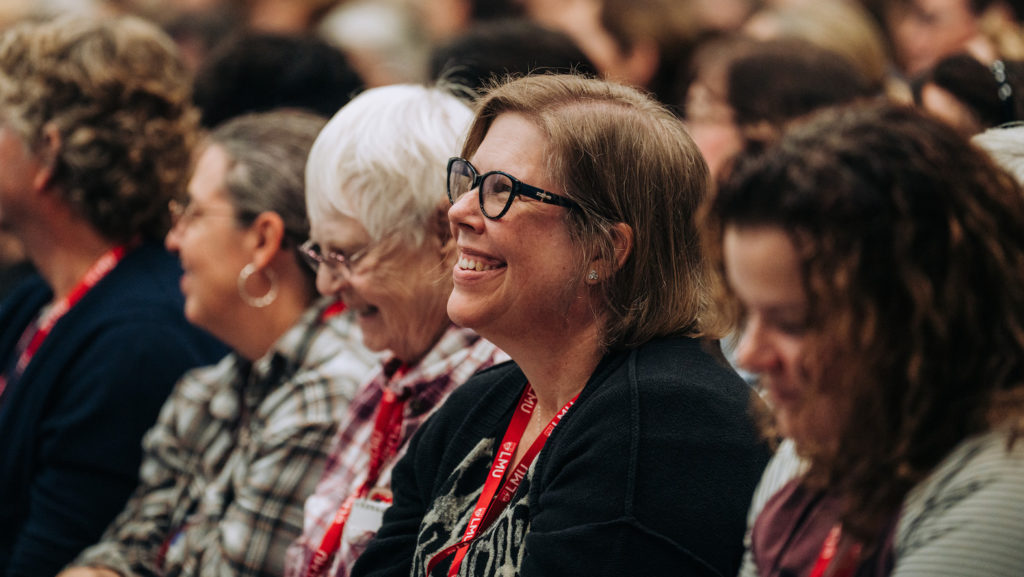
As he was speaking to the crowd of hundreds gathered inside an Anaheim Hilton hotel conference room, Father Agustino Torres, CFR, paused to make an observation.
“Guys, there are some crazy things happening today,” said Torres during his Friday afternoon workshop at the 70th Los Angeles Religious Education Congress, held Feb. 20-22 in and around the Anaheim Convention Center. “Sometimes we feel our hope is diminishing.”
The crowd murmured in agreement.
“Thank you for not giving up on the Church,” continued Torres, a Franciscan Friar of the Renewal based in the Bronx. “Thank you for not giving up on us priests. I know we have our bad days and you see us in our bad moments, and that you don’t leave. God must have renewed your hope.”
Over the course of RECongress’ three “adult days,” that message of hope and perseverance offered nearly 13,000 catechists, teachers, parish staff, and ordinary Catholics resources and inspiration to face some of the practical challenges associated with declining religious practice, a broken immigration system, and an increasingly polarized political and ecclesial climate.
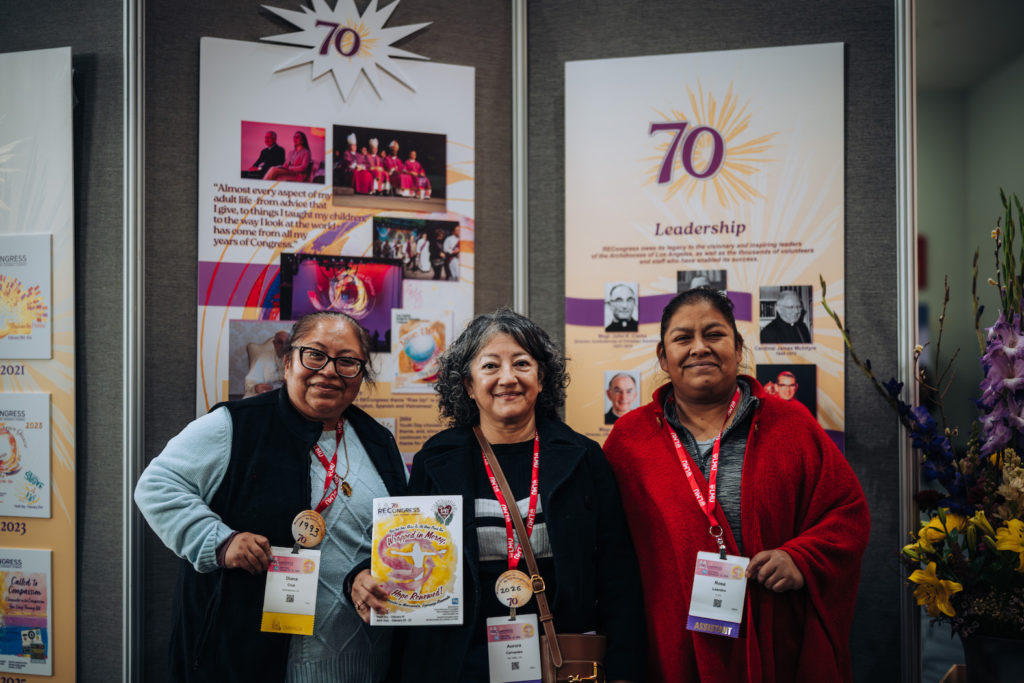
Some of the best-attended sessions at this year’s Congress addressed a perennial challenge for religious educators: how to successfully pass on the Catholic faith to younger generations raised in a secularized culture.
A Saturday panel discussion led by Rosie Chinea Shawver, executive director of Catholic Campus Ministry Association, looked at how college campuses and Catholic parishes can make young people feel welcome.
Christian Santa Maria of the University of San Diego acknowledged that despite years of experience, “we have to be honest with the fact that we don’t know how to do this.”
“I’m not saying that’s everywhere, but as a Church, we don’t know how to do this,” said Santa Maria, director of ministry at USD. “So if we’re honest about that, we’re honest about diagnosis, then we can start getting some imagination of what we can do as a solution.”
Edgar Guzmán, the director of campus ministry at the St. Paul Catholic Newman Center that serves California’s Central Valley, said that direct, in-person interactions inviting college students to “show up, instead of sign up” go a long way.
“It’s a mystery to them. Why would someone care that deeply for me?” Guzmán said. “This generation, even face-to-face conversations, is a little bit of a challenge for some people. And hearing that and seeing that, I see the mystical expression on their face, like, you’re talking to me? Do you see me?”
At Spanish-language workshops, several Latino catechists and parents came looking for guidance on how to transmit the Faith, particularly to the children of immigrants.
“They’re living in a very difficult world, and they have to choose between good and evil, between material things and spirituality, and the pull of the world is very strong,” said Linda Ayala, from St. Elizabeth of Hungary Church in Desert Hot Springs, a small town deep in the Diocese of San Bernardino.
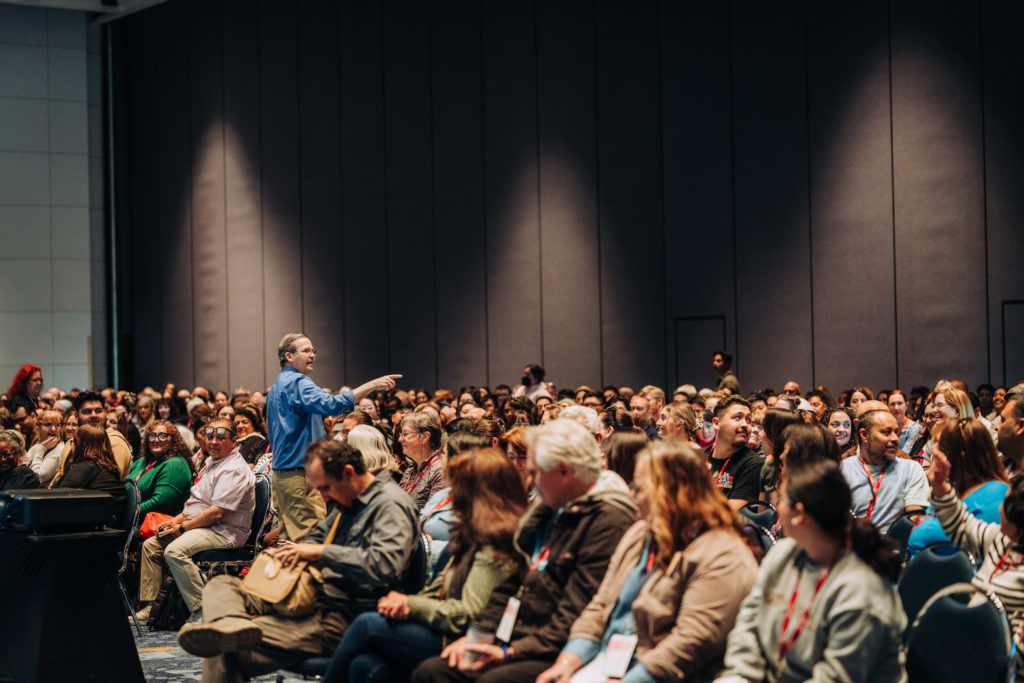
Ayala and her friend, Felix Romero, were among the hundreds who turned out for a Friday morning Spanish workshop with Auxiliary Bishop Slawomir Szkredka titled “Learning, desiring, and living the will of God,” based on the temptations of Christ in the desert.
When the Polish-born bishop opened the floor, he took several questions on how to approach children facing their own worldly temptations, like cohabitation and leaving their families for better career opportunities.
Listening and spending time with young people, while helping them see God’s action in their personal histories is key, Szkredka said.
“Even in their mistakes, their sins, the important thing is to have patience, ask the best from your children, and show them the value of having a friendship with God,” answered Szkredka in perfect Spanish to a catechist and mother. “Because if they see in us joy, peace, patience, and that we accept our crosses, they’re going to detect something: that friendship with God isn’t just about rules.”
The next day, hundreds more turned out for a Spanish session on the theme of discernment with Father Cristóbal Fones, SJ, a Chilean Jesuit who works in Rome as the director of the Pope’s Worldwide Prayer Network, which helps broadcast the Holy Father’s monthly prayer intentions via specially produced videos.
Fones interrupted his presentation several times to lead the crowd in song with his guitar. But the substance of his talk — centered on how to distinguish between wants and desires, and how to hear God speaking in the events of everyday life — made Luis and Eva Santos feel better equipped in their mission of reaching out to lapsed Catholics in their family and neighborhood.
“Many times, we haven’t known when is the best time to let our children make decisions for themselves, or what free will really is,” said Luis, a deacon at Our Lady of Perpetual Help Church in Downey.
The night before, the married couple spent time with the Blessed Sacrament and a relic of St. Carlo Acutis in the RECongress’ “Sacred Space” to pray for a young, married family member struggling with the fear of having children.
“It was beautiful, we felt the presence of Our Lord Jesus Christ,” said Eva.
The Congress kicked off with a Friday morning opening ceremony in which Archbishop José H. Gomez surprised participants with a message sent by Vatican Secretary of State Cardinal Pietro Parolin on behalf of Pope Leo XIV.
“By deepening your relationship with Jesus, who is the Truth, and continuing to be faithful and joyful disciples in your daily lives,” read the message, “your authenticity as educators and catechetical leaders will enable you to transmit the Gospel in such a way that it leads to a true encounter with the Lord and contributes to building up a lasting and life-giving culture.”
Then, Yolanda Chavez spoke to participants via a taped video message shown in the Anaheim Convention Center arena during the Congress’ opening ceremony.
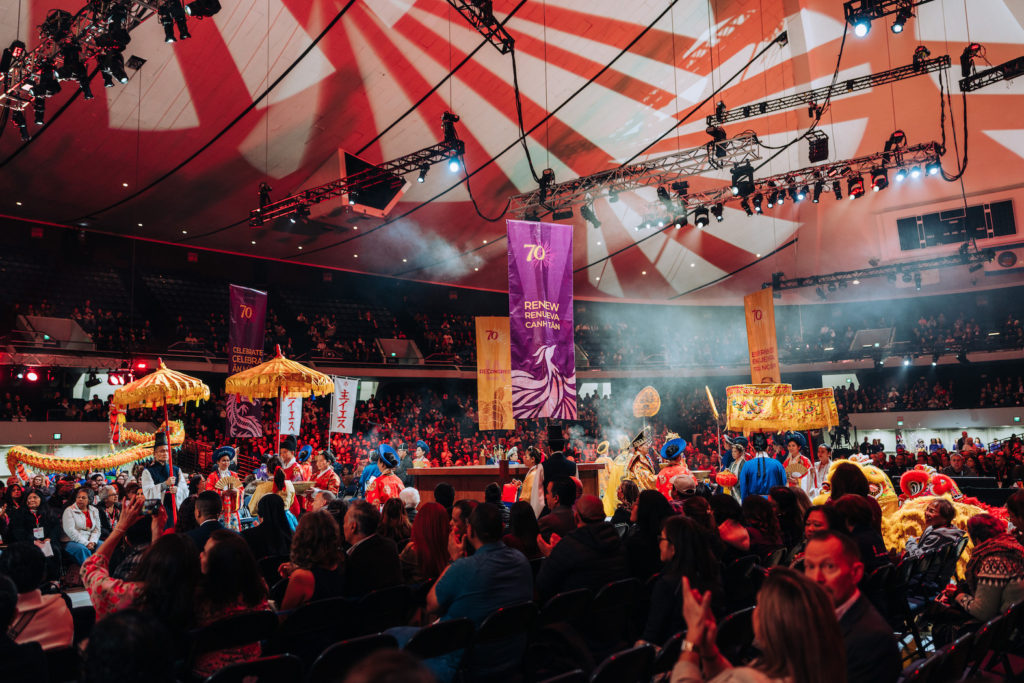
Chavez is a volunteer for the LA Archdiocese’s Office of Religious Education, which coordinates the Congress. She explained in Spanish how after living and working in Los Angeles for the last 30 years, she recently received a deportation notice. Rather than subject her family to further harm, she relocated to Mexico.
“The first night, I cried a lot,” Chavez said. “God was in my tears, weeping with me. … I love the God who crossed the border with me. Today, I know God. His name is mercy.”
Later on Friday, immigration advocate and attorney Linda Dakin-Grimm received a standing ovation from some 500 people after a Saturday presentation explaining where today’s immigration policies stand, and praising the Catholic Church’s recent response to U.S. Immigration and Customs Enforcement actions.
“The administration is and will continue to take aggressive and sometimes unlawful actions … there is deep pain ahead,” Dakin-Grimm said. “The single most important thing you can do is, as often as you can, call and write your Congress people to demand they change the law to accommodate our migrant brothers and sisters.”
Meanwhile, the leadership of the Catholic Church in the U.S., Dakin-Grimm said, “has met the moment” and “spoken authoritatively and unanimously.”
A few moments later, during a midday break between workshops on Saturday, some 80 people gathered for the annual “Prayer Walk to End the Death Penalty,” sponsored by the St. Camillus Center for Pastoral Care, the Catholic Mobilizing Network, and Clemency California.
Organizers gathered printed postcards asking California Gov. Gavin Newsom to commute all death sentences, as more than 500 still stand on death row. Several speakers paid tribute to Father Chris Ponnet, the walk’s longtime organizer and St. Camillus chaplain who died last October.
“My consolation in his passing is that he is standing before our God as we speak and presenting all that needs to be done here on our earth,” Sister Mary Sean Hodges, OP, foundress of the Partnership for Re-Entry Program, told the crowd gathered outside. “He is interceding for us. We know he is present here.”
Father Greg Boyle, SJ, founder of Homeboy Industries and a regular speaker at RECongress, said that in his advocacy for the commutation of all death sentences, Ponnet “knew how to put first things recognizably first.”
“He was the shape of God’s heart, we now honor him with our feet,” said Boyle.
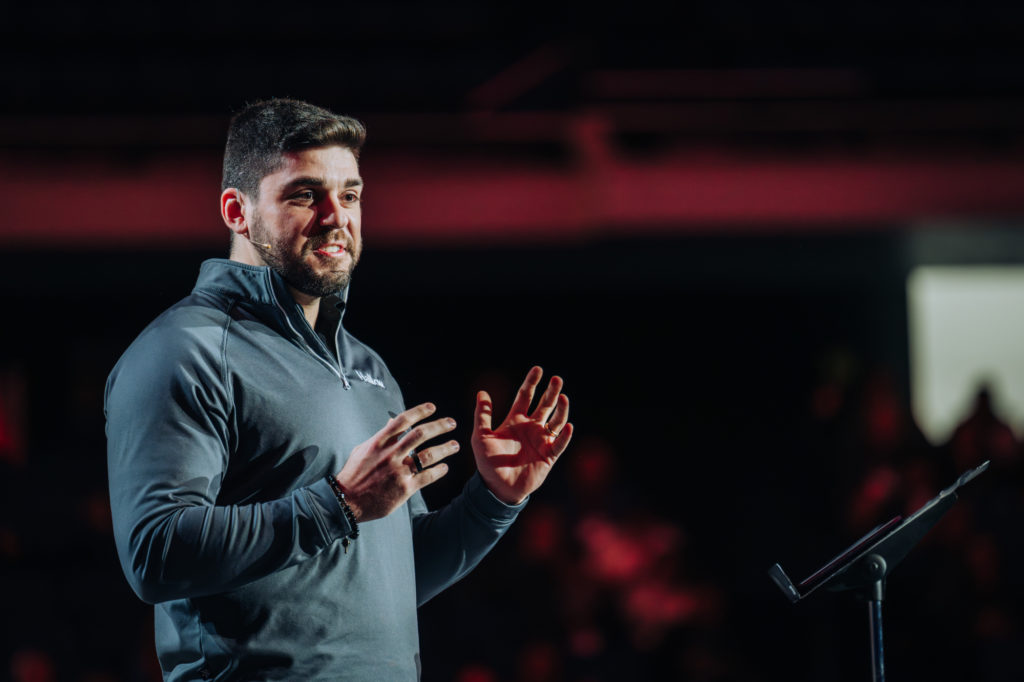
In his Saturday morning keynote talk, Alessandro DiSanto recounted his journey from narrow-focused Wall Street workaholic to accidental evangelist.
The co-founder and CFO of the Hallow prayer app said he was struck by the Gospel passage from Mark in which Jesus sends his disciples out “two by two” — a strategy of moral support and accountability. He looked up to find the definition of “mercy” as having compassion for another in misery and driven to do something about it to help.
“Without relationships, there is no mercy,” said DiSanto. “Our capacity for mercy depends on our relationships.”
After giving examples of those who have used the Hallow app to find relational bonding with God that has, in some cases, literally saved their lives, he observed:
“In this increasingly loud, hectic, divided, expensive, and, in many ways, violent world, the peace you are looking for is not a ‘what’ but a ‘who,’ ” said DiSanto.
“The peace you are looking for, the world cannot give you. The peace you are looking for is Jesus of Nazareth,” he added, echoing a famous quote from Pope Benedict XVI.
Later that day, at the “Front Row with Archbishop Gomez” event, Catholic speaker Julianne Stanz asked the archbishop and Msgr. Anthony Figueiredo about the difficulty of explaining the Catholic tradition of venerating saints’ relics to non-Catholics.
Figueiredo, a British priest who lives in Assisi and travels the world promoting devotion to St. Carlo Acutis, said it’s important to remember that “saints never point to themselves.”
“[St. Carlo] always pointed to the presence of Christ in the Eucharist, to Jesus as the ‘highway to heaven,’ ” said Figueiredo.
“It’s important to reflect on who that saint was, because [praying in front of] a relic brings you to the life of the saint that is there,” said Archbishop Gomez. “It helps me to reflect on how that saint is interceding for me to God, and that’s what gives me peace and joy.”
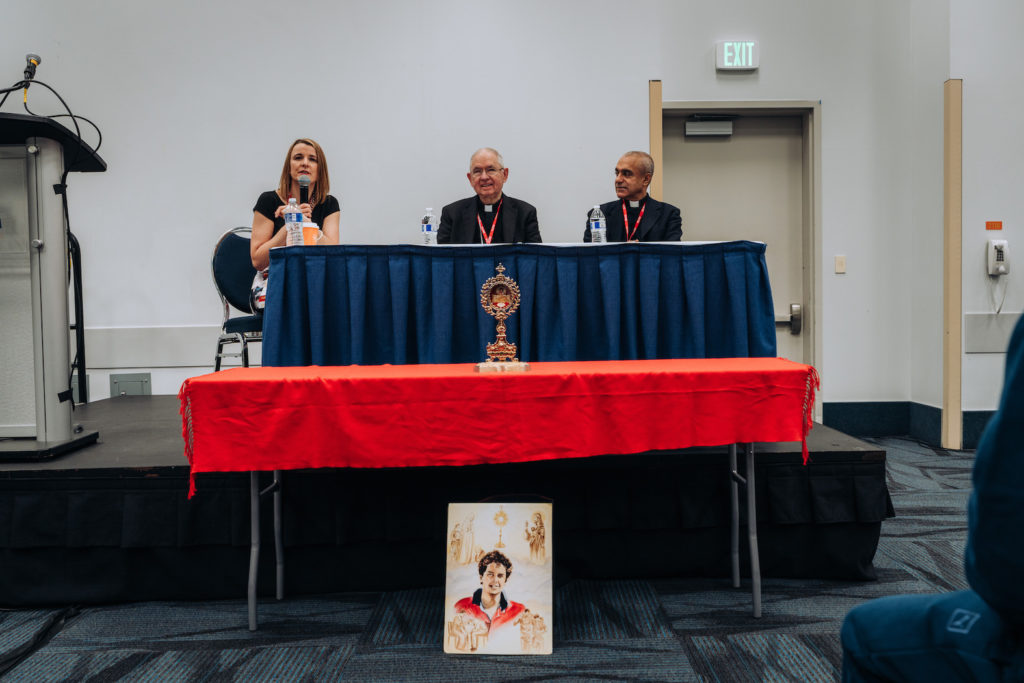
At the conclusion of Sunday’s closing Mass, Archbishop Gomez blessed attendees holding a reliquary containing a piece of Acutis’ pericardium (the membrane that protects the heart) brought from Italy by Figueiredo.
In his homily, Gomez told religious educators that “the Church needs you. Jesus needs you.”
“As we know, we live in a time of confusion. There is a great longing out there for people to know the truth about their lives. We need to bring them to that truth that we find beginning in God’s first pages of Genesis. The truth is that God loves us and has a beautiful plan for our lives.”
At the end of his Friday workshop, Torres also sought to echo the Congress’ theme of “Wrapped in Mercy, Hope Renewed!” when inviting Congress-goers to make the most of this year’s Lent, telling them that “hope renewed begins with a step to allow the Holy Spirit to reach you.”
“I don’t care if you’re going to use Hallow or Crux or Word on Fire or Word of Whatever app, if it’s something you download, just let it be something. Be with something. Allow this Lent to go deeper and be a renewal of hope through simplicity.”