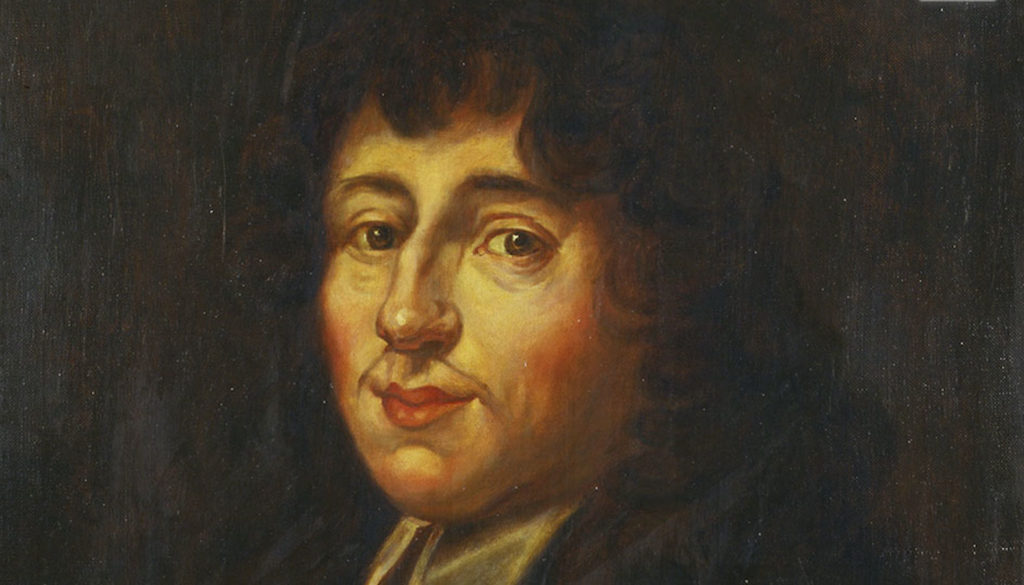
The astronomer Galileo died at the beginning of 1642, when Nicolaus Steno had just celebrated his fourth birthday.
The 40 years that followed would be momentous in the history of science, and Steno would play a large part in the drama. Isaac Newton formulated his laws of motion. Robert Boyle established chemistry as an experimental science. Gottfried Leibniz developed his calculus. Christiaan Huygens explained Saturn’s rings.
Steno stood as an equal among those major figures.
In his brief career, he
— founded the field of geology;
— established the laws of stratigraphy used for dating the earth;
— discovered and named the ovaries in human females;
— discovered a salivary duct that still bears his name;
— and wrote pioneering studies of the brain and heart.
These accomplishments, and many others, fill the pages of a new biography of Steno by Oxford historian of science Nuno Castel-Branco: “The Traveling Anatomist: Nicolaus Steno and the Intersection of Disciplines in Early Modern Science” (University of Chicago Press, $35).
What sets Steno apart from his peers is that he eventually converted to Catholicism and in 1988 was declared “Blessed” by the Catholic Church. Today, there are churches named for him.
Steno grew up in Copenhagen, a city that was solidly Lutheran. His father and, later, his stepfather, were goldsmiths. He attended the city’s Cathedral School, whose curriculum was rigorous, including courses in Hebrew and Greek. In his family’s workshop he learned the value of precise measurement and mechanics. At school he gravitated toward mathematics and geometry, which he intended to pursue, he said, “not as my primary, but as my only work.”
Necessity, however, led him to take up a more practical career in medical studies. Then, as was the custom, he took up a “medical pilgrimage,” traveling from city to city studying under great masters in the field of anatomy. He received his degree from the University of Leiden, in Holland, and there he helped establish a new approach to scientific research.
He wanted certainty.
It was customary at the time to propose speculative accounts, based on reason, of how bodily organs might work. In this way, Rene Descartes (for example) advanced influential ideas about the function of the human brain. “Steno did not reject reasoning altogether,” Castel-Branco says, “but thought it must be based on observations.”
So he placed empirical data at the center of his research. He performed dissections — of human cadavers and of animals — and meticulously recorded what he saw.
He applied mathematics to the study of the body, geometry to his examination of the muscles. He recorded only results, with minimal interpretation, because (as one of his contemporaries argued) “man, improperly fitting causes to effects ... forms a false science within his own mind.”
With empirical tools, Steno said, he wished to “give to the muscles that which astronomers give to the skies, [and] geographers to the Earth.”
He made his way from Leiden to Paris, Florence, Cologne, Rome, and other centers of learning, making occasional trips home to Denmark. Before he turned 30 he had published much and gained an international reputation. A prominent colleague, Jean Chapelain, praised young Steno, saying he “definitely surpasses all the ancients and moderns” in the field of anatomy.
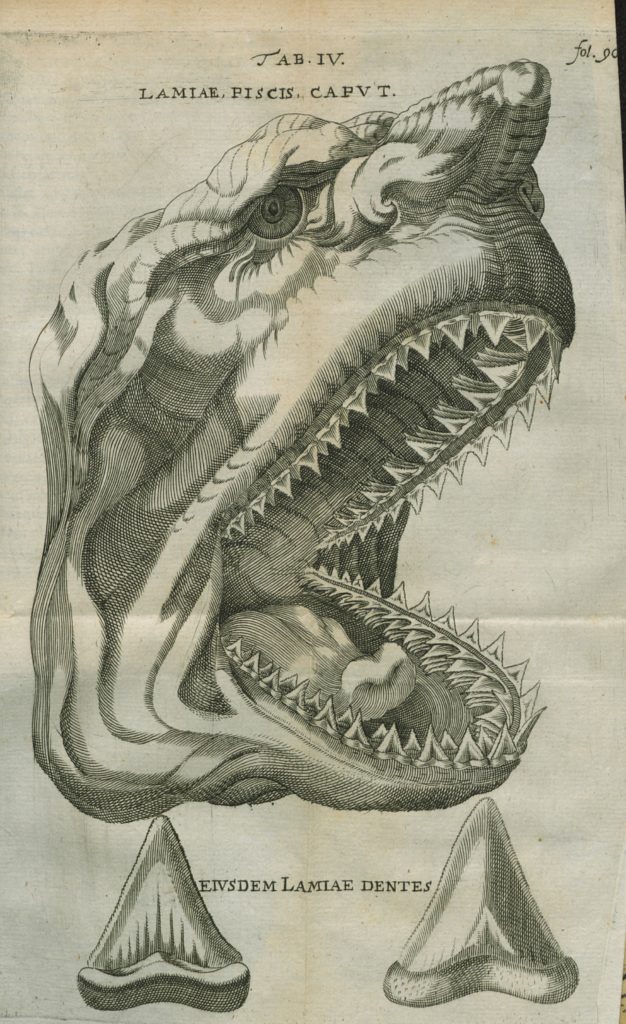
While living in Italy, Steno conducted a public dissection of the head of a shark. Castel-Branco notes: “Steno realized during the dissection that shark’s teeth were identical to a kind of fossil often found far from the sea.” From this he concluded that the oceans had once been much higher than they were in his time. “This led him to argue that the Earth has a history, which can be known through a series of rules still taught today as Steno’s principles of stratigraphy.”
Amid his many successes, Steno suffered a spiritual crisis. Raised Lutheran, he began, while a young student, to experience doubts. He noticed a general religious indifference among scientists, and he decided he would not allow himself to lose faith. He adopted a “rule of life” to help him “avoid everything that could be thought unwise in light of the Gospel.”
Years later, he witnessed a Corpus Christi procession that moved him deeply. Eucharistic devotion of this sort was uniquely Catholic and opposed in all forms of Protestantism. He decided: “Either that Host is a simple piece of bread, and silly are those who give so much honor to it, or here is the true body of Christ, and why don’t I honor it too?”
He resolved to conduct a thorough examination of the claims of Protestantism and Catholicism. He moved to Rome to be closer to the best libraries. There, he could consult the Scriptures in their original languages, which he had studied as a youth.
He ruled out one Protestant system after another — as he had earlier eliminated speculative theories about the brain — until only the Catholic Church remained. On the feast of All Souls’ in 1667, “around evening,” Steno recalled, “all at once so many arguments and circumstances came together for me.”
He entered full communion, Castel-Branco notes, “the same year he published his geometry of muscles and his first account on fossils.”
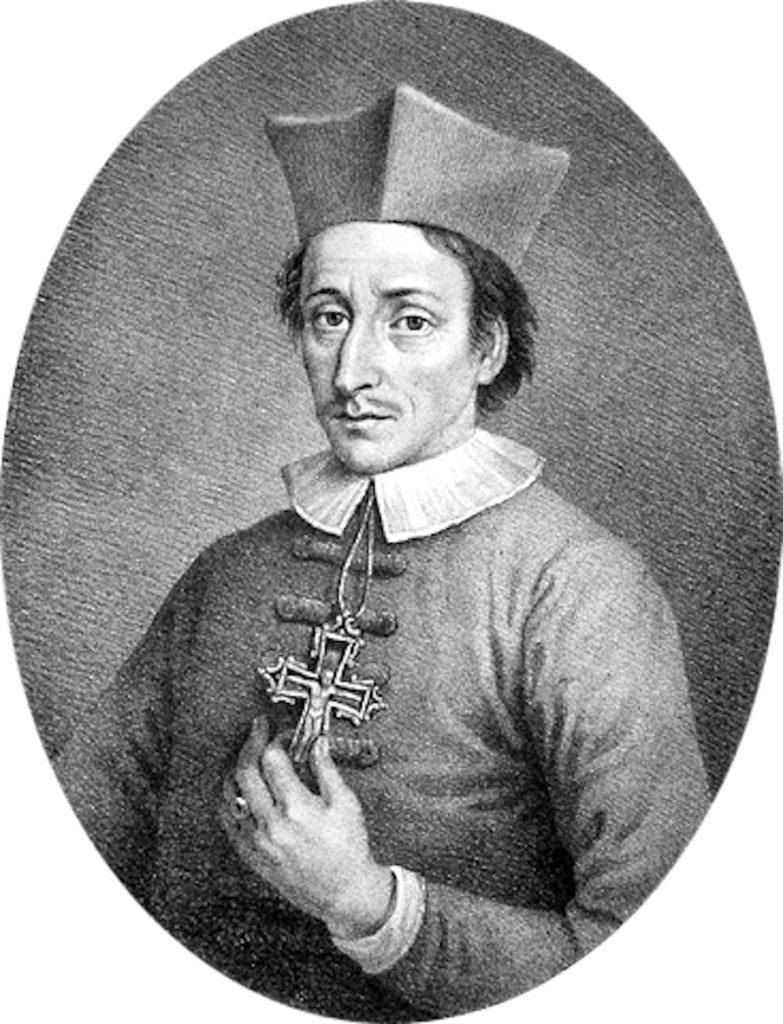
Steno continued scientific work for eight more years, until 1675, when he was ordained a priest. In 1677 he was made a bishop and assigned to northern Germany as the pope’s vicar.
His scientific work remained integral to his Christian witness. Castel-Branco recounts: “At the end of a religious debate at the court of Hannover, Steno dissected a calf’s head and heart to show the beauty of God’s wisdom.” In another episode, to convert a man tempted to atheism, the bishop “dissected an animal heart to speak again about the ‘wisdom of God.’ ”
He died at age 48 on Dec. 5, 1686. Immediately he was venerated as a saint in the region where he had served. St. Pope John Paul II beatified him in 1988. Now, Dec. 5 is his feast in the Catholic Church.
Like Steno, his modern-day biographer has pursued an itinerant and astonishing academic career. Castel-Branco, still quite young at 35, earned a graduate degree in physics before gaining his doctorate at Johns Hopkins University. He currently holds a prestigious research fellowship at Oxford’s All Souls College.
Steno’s story is told with depth and verve in “The Traveling Anatomist.” The author, Nuno Castel-Branco, was born and raised in Portugal and has, like Steno, pursued an itinerant and astonishing academic career. Castel-Branco, still quite young at 35, earned a graduate degree in physics before gaining his doctorate at Johns Hopkins University. He has held faculty positions at Harvard and the Max Planck Institute and currently holds a research fellowship at Oxford’s All Souls College — widely regarded as one of the most prestigious academic honors in the English-speaking world. He has published original research in physics and cosmology and hosts a Substack titled “Stories of Science.”