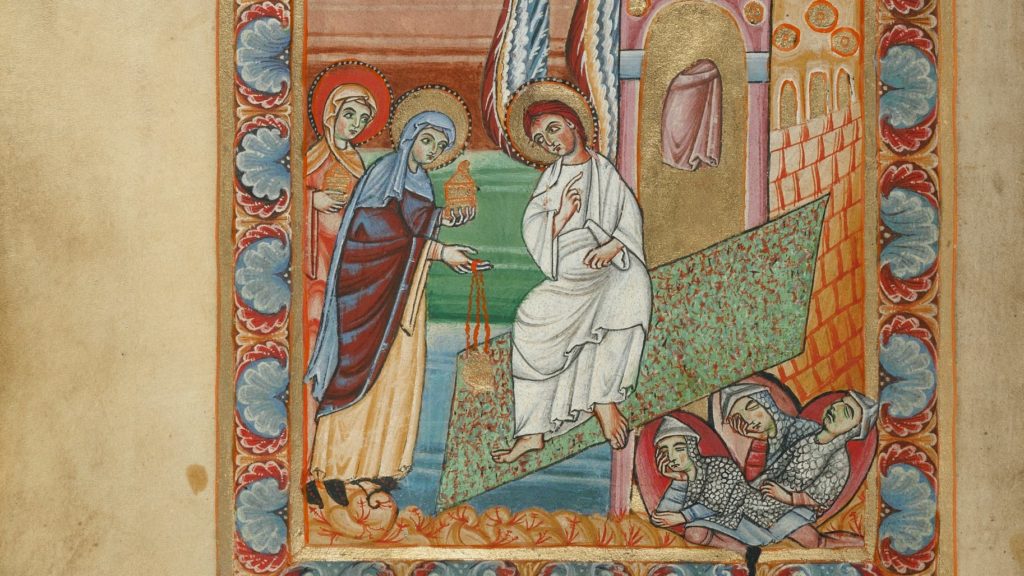
John’s Gospel account of the Resurrection (John 20:1–10) contains an interesting detail in the narrative of Easter: Peter and the Beloved Disciple running to the tomb together.
The Beloved Disciple — whom our tradition recognizes as John the Evangelist — arrives first, bends down, looks in, sees the linen wrappings but does not enter. Then Peter arrives and enters. He sees the wrappings and the “napkin” (soudarion) that covered Jesus’ head, rolled up and placed separately. When John finally enters, we are told, he “sees and believes.”
What does he see now that he did not see when he first looked from outside the tomb? Well, the face cloth (soudarion) seems to be the only detail that is new. It must have communicated something to John. But what?
Commentators point to the orderly placement of the funerary vestments, particularly the face cloth, now rolled up and placed separately. There is no sign of haste and disorder, which would typically indicate a robbery. (Also: if robbers had been involved, they would have likely carried away the body still wrapped in the shroud, rather than through the trouble of removing the linen wrappings!)
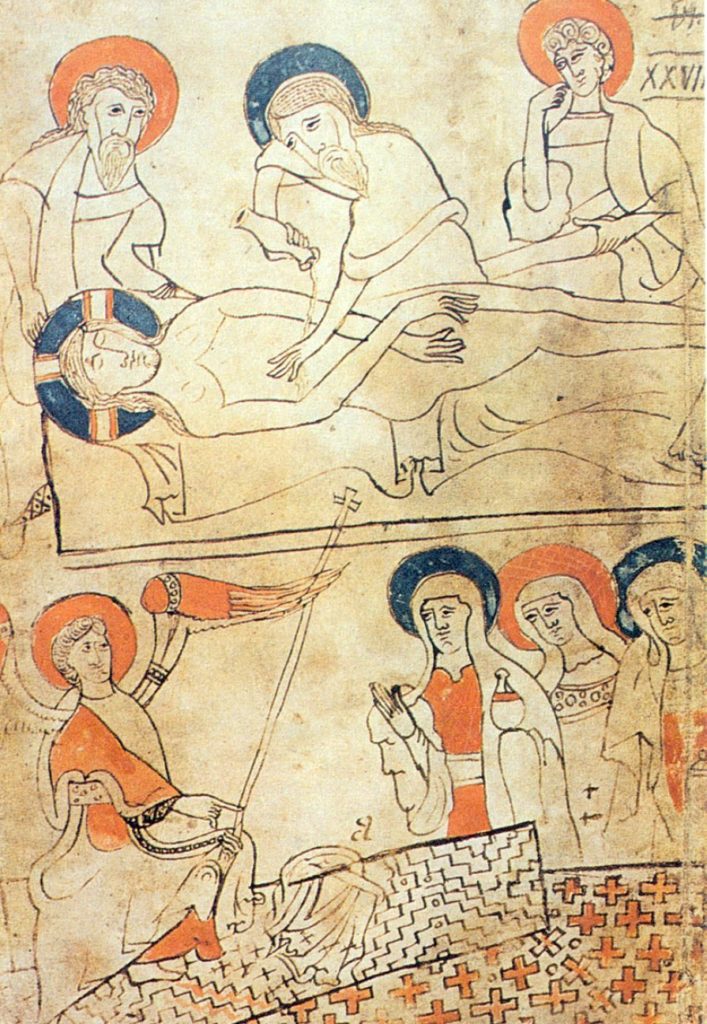
John’s faith appears when he sees and believes. He believes that Christ is risen, or at least he begins to believe (the form of the Greek verb used allows for both meanings) because he sees the orderliness of the place. Peter is not mentioned as reaching the same faith at this moment. So why would it be only John to believe that the Lord is risen? Is he simply more perceptive?
There seems to be more than meets the eye happening here.
Some biblical commentators argue that the face cloth by itself carries a deeper meaning. The word soudarion is used as a Greek — or, to be exact, Latin via Greek — “loan word” in some Aramaic translations of the Old Testament.
In fact, the famous veil worn by Moses (except when he speaks with God) in the book of Exodus is called a sudara. Scripture says that Moses’ face was shining because he had been speaking with God, and this supernatural radiance made the Israelites afraid to approach Moses. Therefore, after relating the words of God to them, Moses would put a veil over his face, and would remove it while entering the presence of God.
Gospel readers familiar with the Aramaic tradition would have made the connection between the experience of John in the tomb and the veil of Moses. Even St. Paul seemed to draw on a similar association when he compared the veiled face of Moses hiding the fading glory with the unveiled faces of Christians reflecting the glory of the Lord (2 Corinthians 3:12–18).
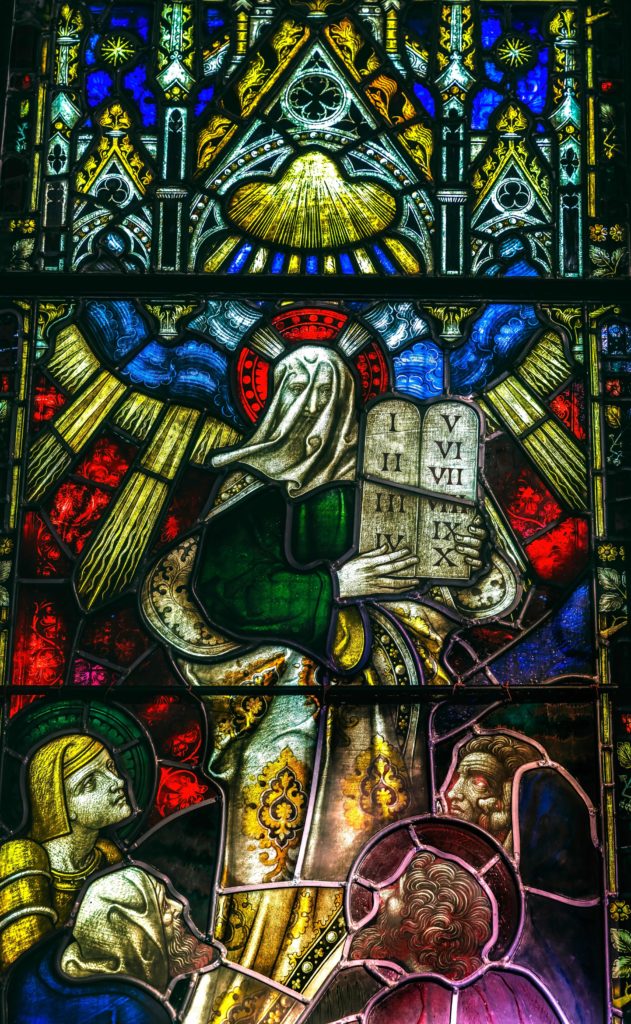
By noticing the rolled-up soudarion, the Beloved Disciple would have related the veil, Moses, and God’s glory. Perhaps, as argued by biblical scholar Sandra Schneiders, he would have recalled that Moses removed his veil when coming before the Lord (Exodus 34:34). Thus, John would comprehend that Jesus, as new Moses, in his glorious humanity, removed the veil while ascending through resurrection to his Father.
But all these intriguing linguistic connections aside, there is something deeply human about the veil covering the head of the Lord being removed. And there’s a certain saint that (literally) sheds some light on the scene.
St. Maria Faustina Kowalska was a mystic who lived from 1905 to 1938 and had a deep influence on St. Pope John Paul II and on Catholics beyond her native Poland.
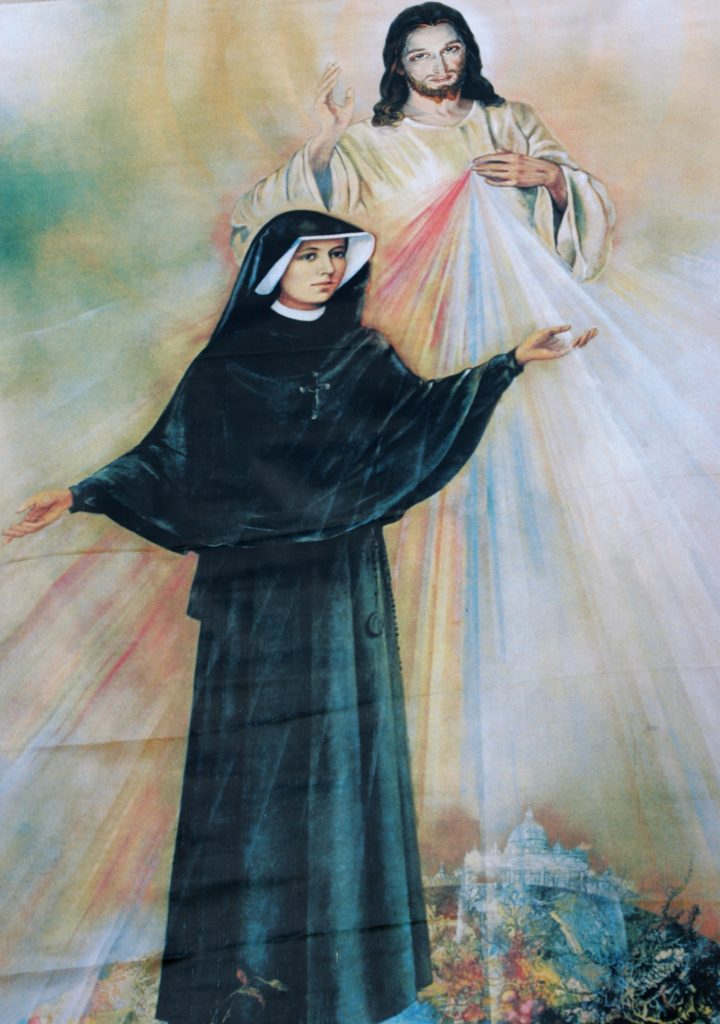
She is well known for directing the painting of Jesus of Divine Mercy, which presents the Risen Lord entering the “Upper Room” where Jesus’ disciples gathered, as if stepping into our own darkness of fears and worries. Rays of light illuminate and even seem to envelope the viewer. This risen body — healed and transposed into the realm of immortal glory — is a proof of God’s mercy. The mutilated body of Jesus, scourged, nailed to the cross, left hanging until death, then pierced, is now risen into bodily immortality. All our evil deeds, so brutally inscribed on Christ’s tortured body, are undone. Christ approaches us, in his glorious humanity, saying, “Peace be with you.”
In Faustina’s image, the Risen Lord looks downward. In her “Diary,” the Lord himself explains: “My gaze from this image is like My gaze from the cross” (#326). A spiritual possibility is intimated here. At the hour of mercy, that is, at the hour of Jesus’ death, John the Beloved Disciple saw Jesus’ gaze.
Peter and the other apostles, as we know, were not there with John at the foot of the cross. When John enters the tomb, which in Greek is called mnēmeion, a place of remembrance, he remembers that merciful gaze. But now he also sees that this gaze is no longer veiled by death. Death covered it only for a time. With the veil of death removed, mercy triumphs. John saw it and believed.
We can now recall that for Moses to speak to God with unveiled face — to be thus immersed in divine life — was itself a gift of God’s mercy, because no one can see God’s face and live (Exodus 33:20). The veil of death, which covered the face of humanity since the fall of Adam and Eve, is now being lifted as the glory of God, reflected on the face of the Risen Lord, is seen by those who believe.
When we look at the image of Divine Mercy, Jesus’ eyes gaze downward. We do not see them. We see his face, but he has not looked at us yet.
When he does, our gazes will meet. We will be enveloped in God’s mercy. We will believe in the Resurrection.