Over the next three issues of Angelus, we’ll be looking at three Old Testament prophets who anticipated the Christmas story. The following is Part One of our three-part series. Read Part Two here, and Part Three here.
Throughout December, we sing with gusto from the Gospels. In Advent hymns and then Christmas carols, all our lyrics proclaim the divine birth.
And yet we sing just as often from the Old Testament prophets — because the coming of the Messiah was foreseen long before it came to pass. Indeed, they foretold the story so vividly that they are essential to its telling.
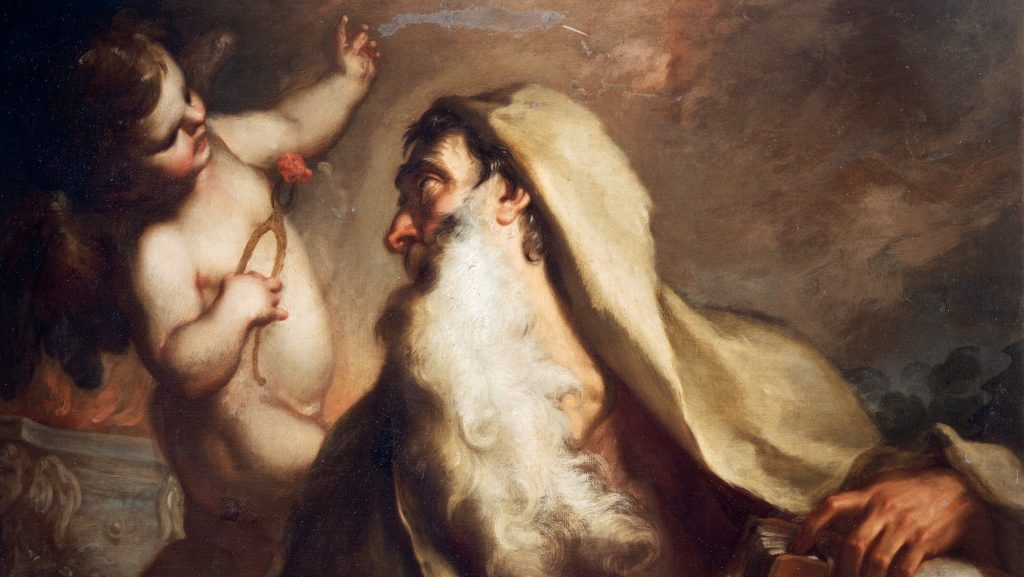
Consider, first, the prophet Isaiah. He is invoked so often in the Gospel accounts of Jesus’ life that his Old Testament book is sometimes called the “fifth Gospel.” In the fifth century, St. Jerome began his commentary on Isaiah by proposing that his subject “is not only a prophet but also an evangelist and an apostle.” A later Church Father, St. Isidore of Seville, retold the entire life of Christ using only oracles taken from Isaiah!
It does seem as if Isaiah — whose life stretched from the eighth to the seventh century before Christ — was granted a clear vision of the Messiah’s arrival. He had detailed foreknowledge of the event, and he communicated it all to the Israelite people. His predictions came to define Israel’s expectations and stoke their longing.
Thus, Isaiah’s voice dominates the season of Advent, which the Catholic Church observes as a period of waiting and preparation for the commemoration of Jesus’ birth at Christmas. Since ancient times, the “O Antiphons” have been the official song for the season. We know these mostly through their English translation, “O Come, O Come, Emmanuel.”
Each antiphon is a pastiche of prophecies gathered from several books of the Bible. But most, by far, come from Isaiah. The “O Antiphons” speak of:
- the Root of Jesse (Isaiah 11:10)
- the kings silenced before the Christ (52:15)
- the gentiles beseeching him (11:10 in the Latin Vulgate)
- the Key of David (22:22)
- his Messiah’s power to open and shut (22:22)
- his liberation of prisoners (42:7)
- his place as cornerstone and foundation (28:16)
- his virginal conception and birth (7:14)
- his role as lawgiver and king (33:22 in the Vulgate)
Isaiah looks ahead and sees a coming age of peace, brought about by a Prince of Peace. “The people who walked in darkness have seen a great light” (9:2). “The wolf shall dwell with the lamb…” (11:6). It is Isaiah who first tells his listeners, “Prepare the way of the Lord, make straight His paths” (Isaiah 40:3), a summons that will be echoed by John the Baptist in the Gospels.
Writing eight centuries before the event, Isaiah spoke with remarkable accuracy. In the fullness of time, many Greeks and Romans converted to Christianity on the strength of his predictive power. The apologists of the early Church employed this as the “proof from prophecy.” It brought about the conversion of St. Justin Martyr in the early second century, and he used it to convert many others.
Some of the prophecies in Isaiah speak of people and events that were present in Israel in the eighth century B.C. But others make no sense apart from their fulfillment in Jesus Christ. They are like stories left without an ending.
Isaiah challenges the proud King Ahaz, for example, to ask God for a sign — any sign. But Ahaz refuses. So Isaiah tells him that God will send a sign anyway: “Behold, a virgin shall conceive and bear a son and shall call his name Immanuel” (Isaiah 7:14). The oracle corresponds to no historical circumstance in the time of Isaiah or the seven centuries that followed. But the earliest Christians recognized it immediately as a prediction of the birth of Jesus, and so it is invoked in the first chapter of the first book of the New Testament (Matthew 1:22–23).
When Advent hymns give way to Christmas carols, Isaiah remains a dominant narrator. “Isaiah, he foretold it,” we hear in the popular German song “Lo, How a Rose E’er Blooming.” The lyric is based on the biblical prophecy from Isaiah 11:1 about a shoot coming from the stump of Jesse. The carol uses the symbol of a rose to represent Jesus, who is foreseen by Isaiah to come from the lineage (root) of Jesse, and is identified with Mary, his virgin mother. The rose blooming in the cold of winter signifies that Jesus’ birth brings hope and a new life in the midst of darkness.
So the “fifth Gospel” remains in our December celebrations today. The Church proclaims the Book of Isaiah on all the Sundays of Advent and then again at Midnight Mass on Christmas Eve.
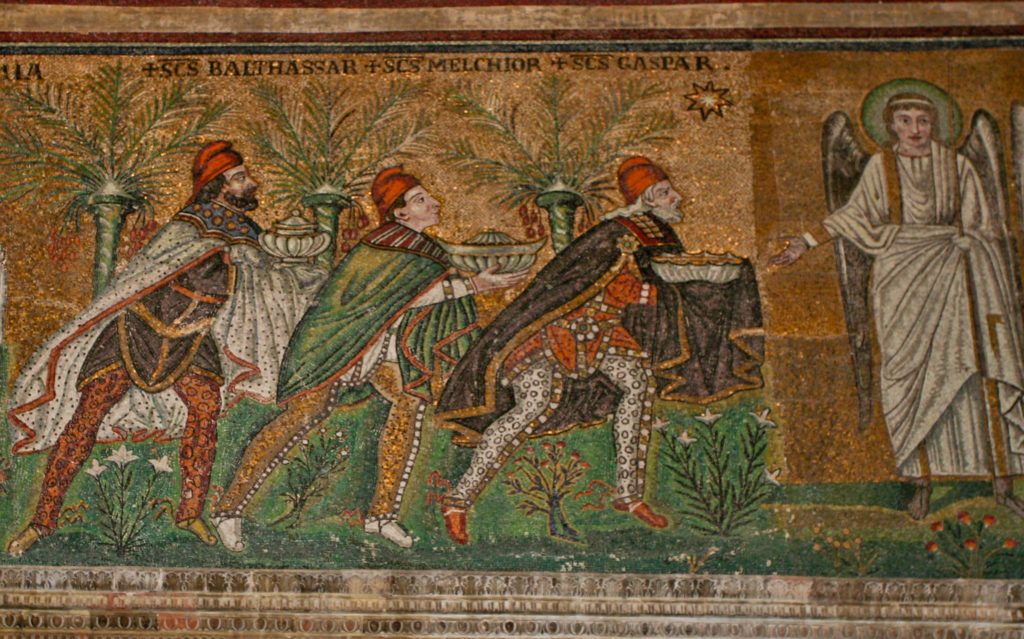
In his Gospel before the Gospels, Isaiah predicted a virgin would conceive and bear a son named Immanuel (“God with us”). He prophesied that the child would be called Wonderful Counselor, Mighty God, Everlasting Father, and Prince of Peace. He spoke of kings coming to honor the Messiah, bringing gifts of gold and frankincense (Isaiah 60:1–6).
The Church cannot tell the story of this season — cannot sing the songs of Christmas — without the Gospel that was written before the Christ was born.