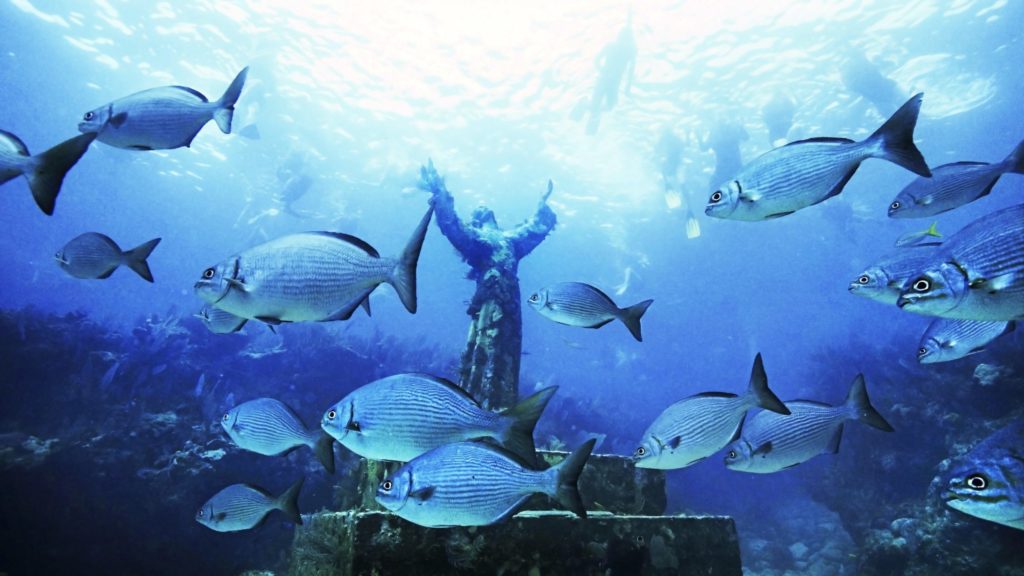
I was at a noisy wedding reception last year, and the woman sitting next to me asked about the design on the ring on my right hand. Both her arms were completely tatted, psychedelically colored, with more individual images than it would be proper for anyone but her husband to count.
I shouted that the face of my ring showed an anchor, a symbol of the Trinity — and the most common image used in inscriptions and graffiti in the Roman Catacombs.
She pursed her lips in excitement. “Ooh,” she said. “I have a tattoo of the fish from the catacombs.”
But, she quickly added, she couldn’t show it to me. I pursued the matter no further.
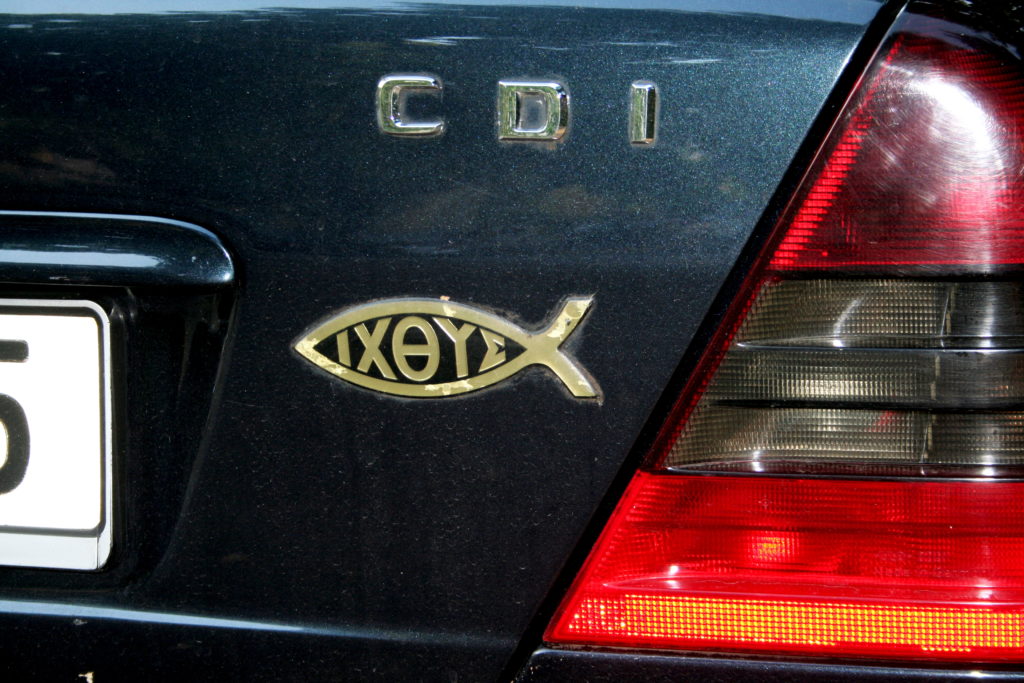
But I believe her, and I’m sure that the ancient Christian fish is a very popular tattoo, as it’s a very popular bumper sticker.
The fish is in fact the symbol most commonly associated with the ancient Church. It is everywhere in the archaeological record — scratched onto walls as graffiti, traced onto oil lamps, and detailed in beautiful mosaics and frescos.
The Fathers of the Church left an impressive paper trail explicating the fish and its many layers of meaning. And, as it turns out, the symbol was as complex as it was common.
The only symbol comparably popular, for us today, is the cross, which was itself rarely depicted in Christianity’s earliest centuries. Today the cross appears on steeples and hymnals, necklaces and bumper stickers. Well, the fish had a similar ubiquity in antiquity.
What did the fish represent? Above all, it was Jesus Christ. The dominant language of the early Church was Greek, and in Greek the phrase “Jesus Christ, Son of God, Savior” produced the acronym ICHTHYS, the Greek word for fish. So the fish is a simple creed: it professes belief in Jesus’ divinity and his identity as the Christ, the anointed Savior (see Matthew 16:16).
Scholars, however, believe that the visual symbol preceded the acronym.
Fish are plentiful in the Scriptures that were proclaimed in the Church’s liturgy, so the symbol evoked many scenes familiar from sacred history.
Think of the Prophet Ezekiel: “And wherever the river goes ... there will be very many fish. ... Fishermen will stand beside the sea ... its fish will be of very many kinds, like the fish of the Great Sea.” This prophecy was often interpreted as a vision of the future Church, whose baptismal “river” would be home to many “fish” — that is, many Christians who are identified with Jesus Christ. Of course, the fishermen who “stand beside the sea” foreshadow the apostles and their successors, the bishops, whom Jesus appointed as “fishers of men” (Matthew 4:19).
The fish is Jesus, and the fish is also the individual believer. There is no contradiction here. Writing in North Africa in the late 100s, Tertullian explained: “We little fishes, after the example of our [big] fish, Jesus Christ, are born in water. Nor have we safety in any other way than by permanently abiding in water.”
Though he writes in Latin, Tertullian shifts to the Greek word ichthys when he describes Jesus. Surely he means his hearers to remember the acrostic “Jesus Christ, Son of God, Savior,” which was by then firmly established in Christian culture.
And in Jewish culture as well. Some scholars say that reverence for the symbol predates Christianity and may originate in the common patrimony of Christians and Jews. The prophet Habakkuk had said, “You have made man like the fish of the sea” (Habakkuk 1:14); and, according to the Babylonian Talmud, Rabbi Samuel offered an interpretation strikingly similar to that of Tertullian, his Christian contemporary. He said: “Men are compared with fishes, because just as fishes of the sea die at once when they come up on dry land, so does man also die as soon as he abandons the Torah and the precepts.”
A Christian separated from the Church, like a Jew apart from the Torah, was a person out of his element — a fish out of water — condemned to spiritual death.
But we have not yet touched on the original and the deepest meaning of the fish.
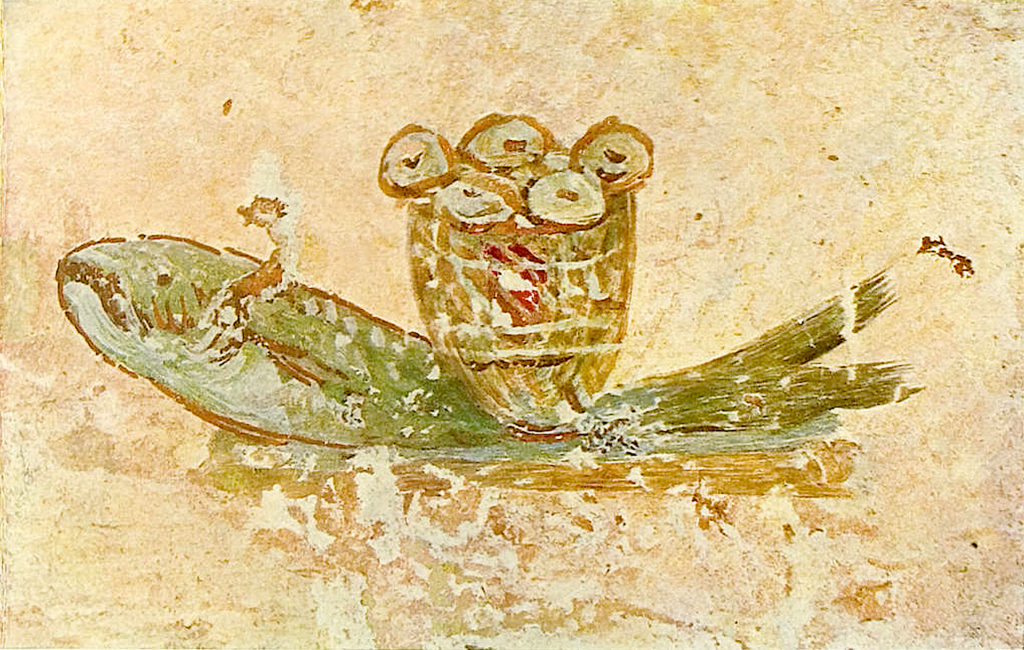
The fish is the primal symbol of the Holy Eucharist. One need not be Catholic to recognize this fact. Erwin Goodenough, an agnostic scholar at Yale University, wrote that the Gospel According to John — which he called “the primitive Gospel” — gives us “the earliest explicit acceptance of the fish as a eucharistic symbol and as a symbol of the Savior who was eaten in the Eucharist.” John does this, in his sixth chapter, by moving immediately from Jesus’ multiplication of the loaves and fishes to the Bread of Life discourse, his extended sermon on the Eucharist.
At the end of John’s Gospel, we see the figures of fish and bread return as Jesus prepares a lakeside meal for the disciples (John 21:9). For the early Christians, all of these events prefigured the life-giving blessing that Jesus bestowed upon the Church. The Protestant scholar of archaeology Graydon Snyder concluded: “the fish was, with the bread, the primary symbol for the Eucharist, the meal that developed, maintained, and celebrated the new community of faith.”
No text could make the association as clearly as one particular depiction in Rome’s Catacomb of St. Callistus. There we see two fish on a gravestone, one fish bearing bread, the other bearing a cluster of grapes.
The fish is a creed. It’s baptismal. It’s eucharistic. It’s Christ. It’s the Christian. By faith, by baptism, by the Eucharist, believers know communion with God. They are identified with him, partakers of the divine nature (2 Peter 1:4) — little fish in the likeness of the big fish, who is Jesus Christ.
St. Ambrose of Milan bids us to linger in meditation upon nature’s fish, and learn from them: “Imitate the fish, which ... should fill you with wonder. It is in the sea, and above the waves. It is in the sea, and swims over the billows. In the sea the storm rages, the winds howl; but the fish swims, it does not sink, because it is wont to swim. To you, this world, too, is a sea. It has many billows, heavy waves, fierce storms. Be a fish, so that the waves of the world do not sink you.”