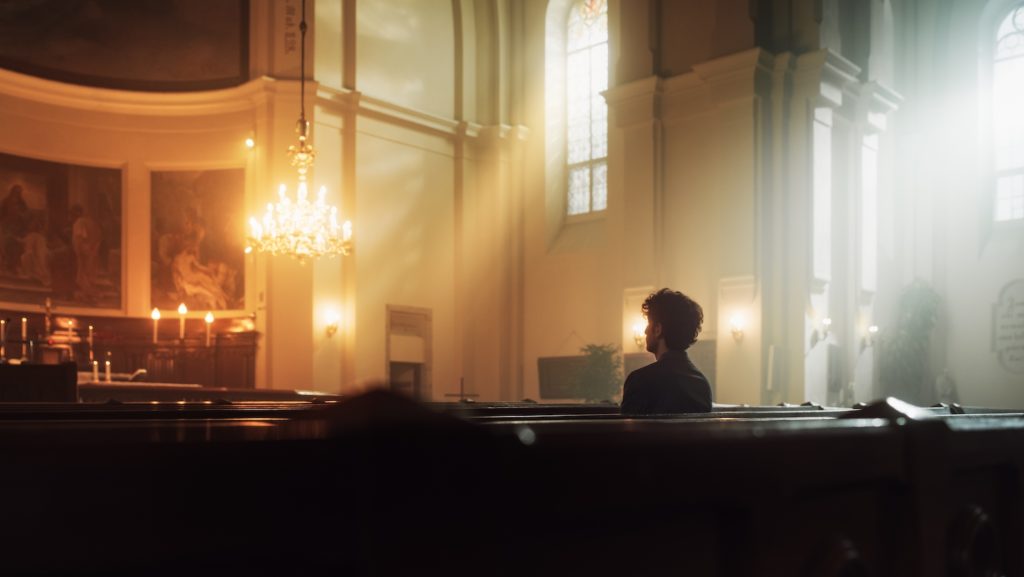
What does one do when God talks to you while you are in the depths of sorrow and distraction — can you even hear him? Do you even want to listen? After all, there is grieving to be done.
But Paul Tupper did not tune out the Creator when he (God) spoke to him after the death of his wife, Jean, at age 56 of cancer in 2021. A man of numbers — Paul was a CPA — but more so of abiding Catholic faith, he listened to God amidst his despair.
It took time, but what Paul heard, and, eventually, discerned with clarity, was a divine mandate for a dramatic life change — one that would move him from the comfort zone of spreadsheets and budgets to the calling of a writer.
To write ... what? The listening continued (“Jesus patiently communicated with me”), attentive and daily, and the writing commenced. It proved a challenge: After all, there was a skill to be honed, a flabby muscle to be exercised.

And it was. A result — not the result, because the listening continues, as does the writing — is a lovely book, “Perfect Moments With God” (Perfects Moments Press, $15.99), a gathering of bite-sized, easily digestible, heartfelt, often tender and inspiring reflections penned by the accountant-turned-keyboard evangelist.
Paul’s spiritual obedience and acquiescence to this new calling blossom in some 100 uncomplicated, often-intimate, purposeful, and ego-free observations — each a freestanding vignette of a life slice that has been contemplated with profound humility and motivated by the determined search for the Thy Will which is to be done.
In the whole, “Perfect Moments with God” is a personal recommendation to readers to consider Paul’s own practice and habit, which as spiritual lifts go, is light: to take time daily to listen to the Creator, to “shut everything else out and be in God’s presence.”
Despite the sorrow that motivated the author, “Perfect Moments with God” is not a reminiscing work or a widower’s memoir. It seeks no pity. Its plainspoken takes — this one prompted by a work memory, that one was provoked by dwelling on a Gospel reading from morning Mass, another was sparked by something as random as a stranger entering an elevator — each share an oh yeah head-nodding lesson-learned outcome.
One reflection toward the book’s end, titled “Anxiety,” was prompted by a 2022 Wall Street Journal article — “Can Anxiety Be Good for You?” Reflecting on the premise that the answer is yes, Paul — an admitted anxious soul — turns on the spiritual contemplation that is thought out, not off-the-cuff, and produces a head-nod assessment:
“If we really stopped to reflect on the fact that Jesus is right here with us, right now — that he actually dwells within us — why would we ever worry about anything? St. Paul sums it up in an amazing way. If we turn our fears over to God — if we dismiss them — then ‘God’s own peace, which is beyond all understanding, will stand guard over our hearts and minds, in Christ Jesus.’ (Philippians 4:7). These passages, by the way, are among my favorites in all the Bible.”
In one of the book’s earlier entries, “Doing What We Can with What We Have,” Paul assesses the quality of his own praying. Once a commuter into New York City, the suburban denizen would say a daily rosary — a couple of decades in the morning Subway ride downtown, the balance said in the evening’s uptown return ride — but years later found the need to confess.
“At the time, I never gave much thought to the fact that I was doing other things while praying to God. It seemed better than not praying at all, right? But looking back on it, was this practice really OK? Was I being disrespectful to God? After all, I wasn’t giving God the attention he deserved because I was often doing something else while praying.”
Surely most readers will find themselves in Paul’s reservations and mea culpas — the relatability repeats frequently through many of the book’s chapters and vignettes.
The subway rosary-ing chapter shares another admission overlayed with a lesson:
“Now that I’m no longer working there is more time to pray, so I don’t have to squeeze it in while doing some mundane task. It’s possible to have true quiet time with Jesus. That quiet time is important.”
There being nothing new under the sun, there is nothing new in “Perfect Moments with God,” but then there is no aspiring to such: This is a collection of one man’s discovery of spiritual truths, the kind often found hiding in plain sight, and his assertion that one need only take the time to look, or listen — attentively, even briefly — to enjoy the same results.
About admissions, I have one to make: Paul is a friend. Along with Jean’s sister, and her husband, as well as my wife, we formed a nucleus of Holy Cross alumni who by chance lived in Milford, Connecticut, where our collective children attended the same parish school. And like Paul, I too commuted into New York City.
I did not find out until some months afterward that Jean had passed away. Some time later, Paul reached out to discuss this book idea. We met a few times, and I gave what limited advice I could.
Such situations were not new to me, and I had the usual reservations. Frankly, anyone can get a book published, and millions do. But would this one be good?
Paul has stuck the landing. Yes, it is good, and then some. Swapping out flash and smart phrase turns and snark for humble and honest and clear prose, and making transparent his own faith life and fears and even self-doubts, he has crafted a work of gentle intimacy that touches the reader’s soul.
Consider settling down with a few chapters now, and a few later. You may find these to be, like the book’s title, perfect moments with God.