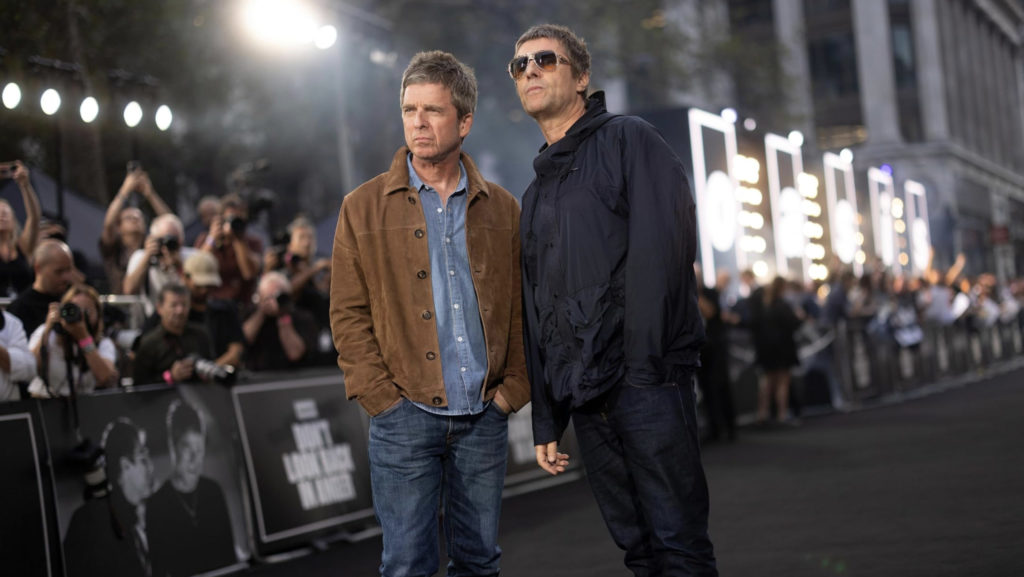
“Oasis: Don't Look Back in Anger” (released by Disney in select theaters since Sept. 11) is the rare Rock documentary that begins with the band breaking up.
It’s 2009 and we see camcorder footage as a Paris concert promoter announces that the Gallagher brothers, Noel and Liam, have had a fight backstage. The show is canceled, the tour is canceled, and indeed, the band is canceled. The crowd, while dismayed, is notably not surprised: most Oasis fans were surprised they even lasted this long.
The doc then snaps 15 years back to the future where the impossible is announced: the brothers have reunited and are attempting a world tour. This is met with a fair amount of skepticism; when it happened, I remember betting a friend not whether it would succeed or not, but rather which brother would strangle the other first.
Oasis never quite broke through in America. The extent of our familiarity usually amounts to some frat bro playing “Wonderwall” on the guitar in the corner of the party, which garnered him inexplicable success with female guests. But to the rest of the world, Oasis was the second coming of The Beatles, a comparison the band themselves encouraged with their refreshing lack of humility. In fairness, it’s not too far off: they were Northern English lads with an inherited Irish wit, as if the Fab Four never put on suits or crossed the Ganges.
Lead guitarist and songwriter Noel had a preternatural instinct for pop hooks, and singer Liam provided the bad boy swagger, nakedly hedonistic in an era where rock stars at least pretended to care about the issues. After decades of highfalutin rock music, there was something blessedly primordial about Oasis, their sound echoing back 10,000 years from out of the cave. They even looked the part, with simian brows and hairy hooligan knuckles. Appearances can be deceiving because they were also the cleverest quote in rock media, turning that Irish wit on anyone they considered their rival (usually the whole world). Luckily for the world, they were often too busy insulting each other.
Part of that primordial appeal was their rather biblical dynamic. Simply put, Noel created all the songs and Liam created all the problems. You see echoes of it in Isaac and Ishmael, Jacob and Esau, the prodigal son and his dutiful brother, and even Martha and Mary. The older sibling does everything by the book while the younger sibling skates by on their charms, the life of the party that the other sibling hung on the streamers for. When Jesus tells us we need to love our brother, he’s not speaking metaphorically; he’s recognizing a pattern of behavior. The Gallagher brothers didn’t heed that call, which led to the fateful spat in a Parisian green room.
We Oasis fans have long given up hope of a reconciliation, which is why the news felt like a miracle and most of us didn’t believe it. You should always be suspicious when a dream comes true — think of the skeptical cleric in every Marian apparition. The brothers hardly believed it themselves, spending most of the documentary waiting for a disaster that never materializes.
The tour proves a resounding success, even in America. In the interviews of fans from the likes of Korea, Brazil, and Spain, there’s no translation issue because Oasis lyrics are hardly more decipherable in English. What does “slowly walking down the hall / faster than a cannonball” even mean? Noel wrote it and even he doesn’t know, though he notes the fans understand it better than he does.
To the Catholic film critic, sometimes you feel like a hammer to whom the world is all nails to pound into Christ’s palms. So it’s with great relief that the film itself recognizes the Catholicity of it all, albeit punctuated by four-letter words other than Mary.
There are dozens of spontaneous sign-of-the-crosses scattered throughout, a mutual genuflection when Liam walks onstage and sees the fans he assumed had forgotten them, and the fans who never thought they’d see him next to his brother again. Then there are moments where Liam wears a tambourine on his head, a ridiculous gesture suddenly sanctified when the light behind it radiates out like a halo in some medieval icon.
The final word of the documentary is given to a Catholic priest from their hometown of Manchester, delivering a homily on the day of their return concert. He points out that the real reason the shows keep selling out isn’t just the music. After all, Noel and Liam have been playing these songs separately for years. It’s the reconciliation that’s the main attraction, the possibility that even the most fractured relationship might someday be healed.
What’s funny is that the reunion was born more out of financial necessity than brotherly love, with Noel suddenly finding it in his heart to forgive only after losing half his estate in a costly divorce. Their relationship at the beginning of the documentary is civil, if strictly professional, as if any affection is just another performance for the fans.
But as the shows pile up, they’re as surprised as anyone to find that a fiction practiced daily becomes your reality. After years of silence, they now text every day, and their sons, long strangers from their fathers’ feud, have become the best of mates. It becomes the rare instance of a divorce somehow bringing a family closer together.
The Gospel reading on the day of the Manchester concert happened to be from Matthew 18, in which Jesus explains the need to forgive our brother “seventy times seven times.” As the priest underlines, this means forgiveness in perpetuity, no matter the cost, and with forgiveness there’s always a cost.
Who knows if this current Gallagher brother reconciliation will last. But then every ending is just an opportunity for a new beginning, a fresh chance at epiphanies that never stick.
As the chorus of one of their best songs goes, “because we need each other / we believe in one another / and I know we're going to uncover / what’s sleeping in our soul.” It’s yet another lyric Noel hardly understands himself, but that’s precisely the point: the answer lies in the thousand failed attempts to the truth.