On the first day at one of my old jobs, my new co-worker warned me to never trust the human resources department. That man was later fired after an assignation with an in-house bookkeeper, but I believe his point still stands in principle: They aren’t a resource to us humans — we humans are the resource.
Like any raw natural resource, humanity must be trimmed and shaped into a product. This process is called the job search.
First, we must pretend the position is our passion, that it was our childhood dream to peddle B2B software for medical data resellers. We then confess a weakness, but not a real weakness, for that is just gauche. We repeat this interview at least seven times per position, and if successful, you won’t even recognize yourself by the end. If you need proof, just scroll through LinkedIn: it’s like Facebook after the “Invasion of the Body Snatchers.”
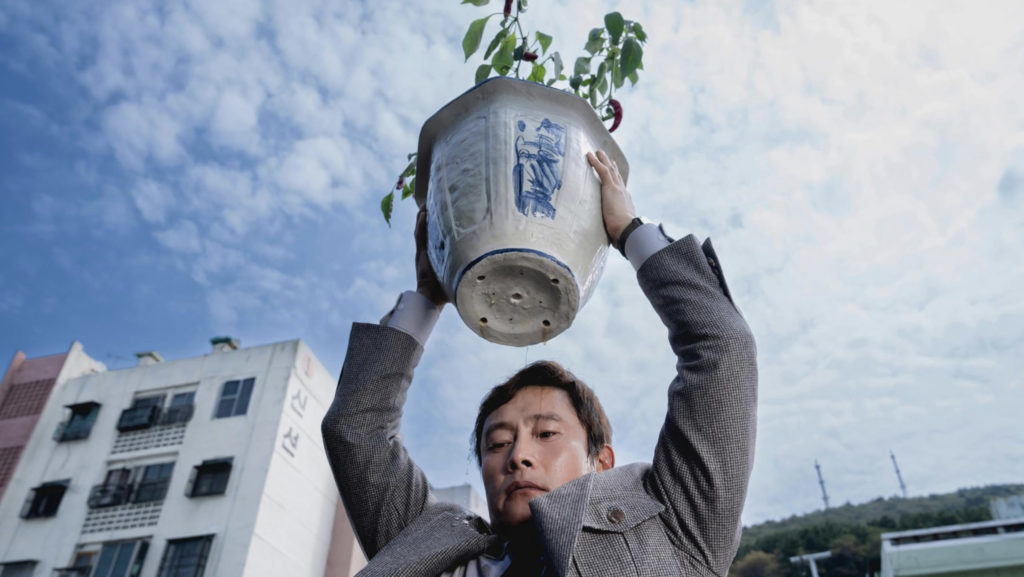
Korean filmmaker Park Chan-wook’s latest film, “No Other Choice,” is a depraved and often funny look into this process of dehumanization, the story of a man who becomes so desperate for gainful employment that he ceases to care about what he loses in the process.
Man-su (Lee Byung-hun) is a paper manufacturer, and a darn good one at that. He’s even won the coveted Pulp Man of the Year award, spoken about in his industry with the hushed reverence of a papal medal or a finals MVP. During a barbecue outside his beautiful home with his lovely wife Mi-ri (Catholic actress Son Ye-jin), his two beautiful kids, and two beautiful dogs, Man-su makes the terrible choice of tempting fate and declaring himself perfectly happy. He might as well announce he’s retiring and go on one final drug bust.
The paper industry immediately consolidates and Man-su is back on the job market, where he quickly learns that Pulp Man of the Year means little when your competition is also previous Pulp Men. After 13 months without success, Man-su is close to losing his house and, worse yet, his bourgeois respectability. They have already sacrificed his wife’s tennis lessons and the Netflix subscription — Man-su may grovel on his knees in front of the hiring manager, but he will not demean himself to rent.
When his wife jokes how she wishes other applicants would be struck by lightning, a thought strikes Man-su. If he is to emerge as the top Pulp Man, he must make his rivals pulp, permanently.
What follows is “Kind Hearts and Coronets” for the upper middle class, more like “Kind Hearts and Corporations.” Lee is brilliant as a man who approaches cold-blooded homicide with complete and utter befuddlement, flunking all attempts to get his murder in the first degree. It doesn’t help that the more he stalks his quarry, the more he realizes they’re as pathetic and human as himself. He first has to kill that part of himself that cares, to chop and skin and shuck and flatten his tree until he becomes a paperman in all senses of the term.
“No Other Choice” could have settled for being a simple anti-capitalism parable and made out with Oscars galore like the 2019 Korean hit “Parasite,” but it takes a far more interesting track.
Of course, the system is soul-corroding and American hegemony has turned South Korea into a distorted fun house mirror reflection of our own neuroses (a child could tell you that, or at least a North Korean one). The title signals its true interests, that soft determinism or lack of imagination that keeps us stuck on our path and whether there’s even a distinction.
“No Other Choice” is a mantra repeated throughout the film, first told to Man-Su by the superiors who fired him, repeated by him thereafter, and eventually infecting his family. It’s a comforting delusion, forging the path ahead by eliminating any other offramp save the one you want. As Man-su observes his potential victims, he grows furious at how these men won’t listen to their wives and simply move onto another industry. Can’t they see they have so many options? Unlike him, whom circumstance has forced into an intricate campaign of serial assassination.
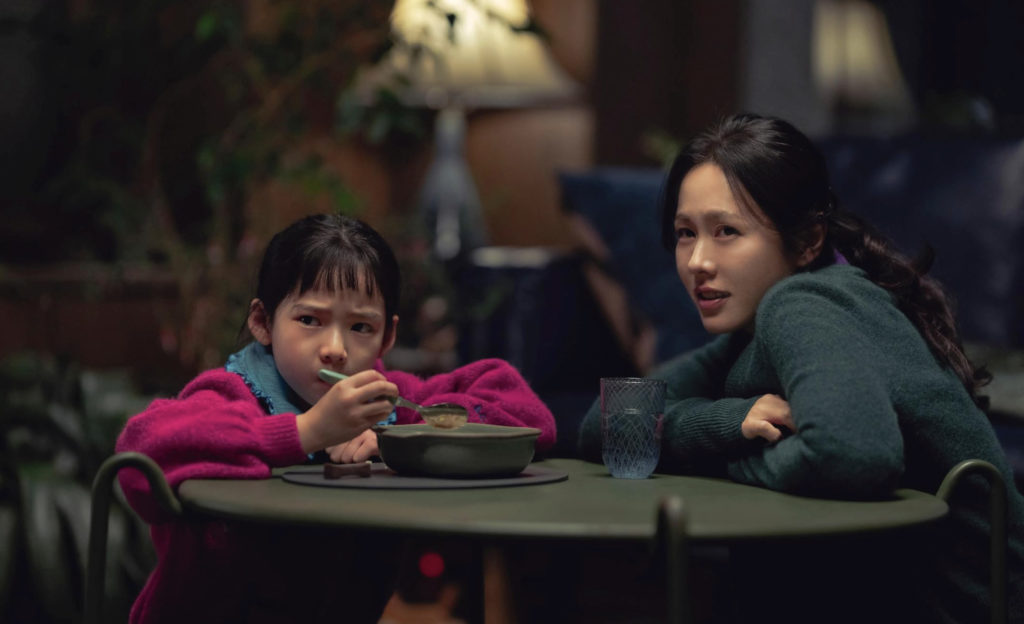
His own wife has been telling him as much, and his patience and excuses are wearing thin. Mi-ri is one of my favorite characters and performances this year, the housewife who handles downward social mobility with surprising aplomb. Lesser films would and have made her character the motivator or motivation for her husband’s misdeeds, but her grace under pressure denies him a proper excuse.
Man-su pretends to be humiliated while she’s the one pulling shifts as a dental hygienist, her fingers in the whispering mouths of all her former friends. Man-su is in some ways too simple to be a true moral actor, his decline is more inevitable than intriguing. Mi-ri alone knows she has a choice, which gives her soul some real market value should she choose to sell.
Man-su is already sort of a blank sheet of paper, imprinted with the phrases and ideas from those around him. His murder plot isn’t even his own, remember? It was dashed out by Mi-ri in a fit of black humor. He doesn’t even properly transcribe what he hears, and whenever he tries to pass it off as his own thoughts, he manages to garble it into gibberish.
Meanwhile, his autistic savant daughter is also limited to repeating what others say, but she reapplies those phrases to different contexts which eerily translate. In this family, it’s the women who make lemonade, and the men who sit staring at the lemons. In a sick final joke, the coveted position turns out to be managing an AI-automated paper factory, the lone human in the entire facility. Man-su in a sense dresses for the job he wants by hearing everything yet understanding nothing, and killing his humanity to fit in with the new office culture.
So we learn there indeed is something worse than humans becoming just another resource: finding out we’re no longer being mined.