When I recently started reading investigative journalist Peter Schweizer’s “The Invisible Coup,” I had not realized it had reached the No. 1 spot on The New York Times’ famous bestseller list — or that it was a mash-up of conspiracy theories based on private research written to read like a political thriller.
In it, Schweizer points to several historical phenomena, current trends, and nativist nightmares to argue that the United States has fallen prey to an “invisible coup” that threatens the country’s very foundations.
One of them is the episode of the famous 1980 Mariel boatlift, in which Fidel Castro allowed (or sent, depending on who you ask) approximately 175,000 Cuban refugees to enter the U.S. While much has been written about this mass emigration before, this is the first time I’ve heard it interpreted as the first step in an international conspiracy.
Castro, the book argues, used the open-door policy to Cuban refugees as an opportunity to send people who were socially undesirable to our shores. It was immigration as infiltration, the exporting of enemies of his regime as an attempt both to mock U.S. criticism of his dictatorship and subversion of another government by taxing the social resources of local and state authorities.
Schweizer proceeds to accuse other nations of participating in similarly intentioned subversion-by-immigration campaigns. In Mexico, he writes, government officials have long nourished fantasies of recapturing the portions of the U.S. that were lost to Mexico with the Hidalgo Guadalupe Treaty after the U.S.-Mexican war.
I have worked with Mexican immigrants for a long time as a pastor, and I don’t see their motivation to be subversion by immigration, nor evidence of Mexicans being sent by their government.
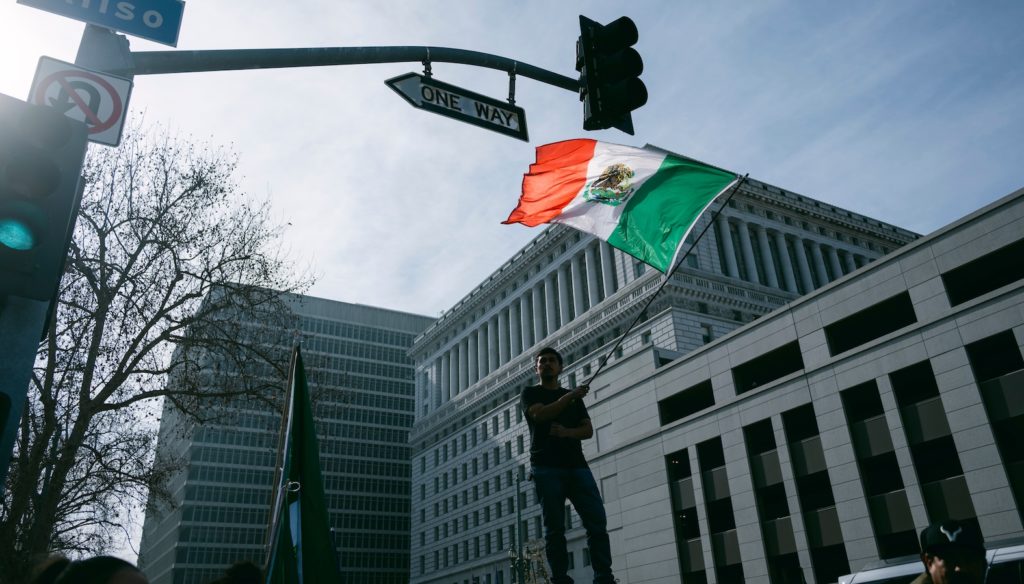
Most of the Mexican immigrants I’ve known come for a better life: often economic opportunities, yes, but also often because their relatives are here. They are loyal to Mexican identity and culture, but not on any mission for Anschluss. They like it here. Their children like it here even better, and would not be the foot soldiers of the kind of Reconquista that Mexican intellectuals might dream of. Displaying the Mexican flag does not indicate they want to import the Mexican government any more than Irish-Americans who put out Irish flags on St. Patrick’s Day want to import Ireland’s.

Schweizer also points to the many Mexican consulates in cities across the U.S. as evidence of this campaign. But don’t these consulates have the obvious function of serving the many immigrants here? The millions of dollars immigrants sent back to Mexico and other countries are a life-sustaining pillar of its economy.
Schweizer makes valid points regarding the manipulation of immigrants in electoral campaigns, and even the difficulty of a rush to make citizenship less demanding. Indeed, dumbing down the questions asked or skipping requirements because of partisan interests, especially in election years, is worrying. But I also sometimes think that even native born 18-year-olds should be given a test before allowing them to vote.
“Invisible Coup” has some chapters that are frightening, like the one stating that Chinese parents are relying on surrogate mothers for their IVF-conceived children to guarantee citizenship. Schweizer claims that most of the thousands of children born in this way in the U.S. are immediately taken to China to be raised (what he calls the “Manchurian generation”) to eventually return and presumably infiltrate our country.
The same applies to his remarks about the alliance of U.S. “liberals” with so-called “progressive” movements around the globe. Certainly, there are members of Congress that have some suspicious allies in unfriendly countries, and that growing anti-capitalist fervor seems to forget Marxism’s failed legacy in so many parts of the world.
Schweizer sees this as a Catholic phenomenon also, joining critics who heard in Pope Francis’ criticisms of “individualism” echoes of socialist ideology but never stopping to consider that the Christian message of love cannot be reduced to anti-capitalism, as if everything is a binary choice between socialism and Ayn Rand-style selfish radicalism.
He equates Catholic Charities with radical institutions and foundations that might advocate open borders. Some workers at Catholic Charities might have radical and ideological beliefs, but the organization itself is not promoting open borders, nor is it involved in human trafficking, as some Catholic blogs have angrily (and falsely) charged.
Indeed, until a year ago, Catholic Charities accepted government contracts related to legal immigration and refugee work. I find most government connections problematic and wish there would be clarity in some of them, but to accuse the bishops of participating in the “Invisible Coup” because they gave service to people here legally is simply calumny and indefensible.
The book concludes with a chapter advocating some “reforms,” but Schweizer never bothers to address the sticky problem of moving millions of people out of the U.S. His concerns about government corruption and the global “revolutionary” enterprise are valid “up to a point,” but his breathless, Chicken Little-ish style is self-defeating sometimes. And what does he propose to do with the millions of undocumented or partially documented or potentially documented persons here?
Obviously, something must be done besides sweeping millions who were through our borders back to their native countries. There has been little comment in Catholic circles about the bipartisan “Dignity Act,” which proposes a pathway to legal status and assimilation in limited cases, with some tough provisions.
I imagine extremists at both ends of the political spectrum would find much to disagree with in the bill. But as Archbishop José H. Gomez recently wrote, a discussion of its proposals might at least help us find a concrete solution for a great chunk of our population who are inextricably involved in our economy, and in insecure status.
Meanwhile, U.S. Immigration and Customs Enforcement is buying properties across the U.S. to create a Gulag Archipelago of deportation centers across the country to the tune of $38 billion. This promises a logistical nightmare for all involved, including millions of parents of U.S. citizens, sons and daughters of U.S. citizens and permanent residents, brothers and sisters of U.S. citizens (residency applications take age into account), and co-parents and significant others of U.S. citizens. The disruption of homes and families would ensure an increase of the Siamese twins of broken families, with all their consequences, and the culture of poverty. There is another way.
Under the current administration, closing the border is a done deal. Now let’s work on the problem at hand. A best-selling book on that would be useful.