
Julia Roberts once told a story about working with Dolly Parton on the set of “Steel Magnolias.” Roberts couldn’t believe that Dolly wouldn’t commiserate with her about the Louisiana heat.
“When I was a little girl, I wanted to be famous and I wanted to be rich,” Parton told her. “And now I’m both those things. I’m not going to complain about it.”
It was classic Dolly. Ready, pithy, and down-to-earth. It nudged the conscience while deftly steering wide clear of sanctimony. And it was what Dolly did with her fame and wealth — free books for early readers, scholarships, supporting victims of natural disasters — that made her that rarest of things: a universally beloved American public figure.
She was such a national institution that it doesn’t feel like she’s really gone. And in a way, she isn’t. Her music, her charities, and her nonjudgmental humility will continue to touch lives, forming a legacy bigger than the flesh-and-blood human being that was Dolly Parton.
Perhaps this is why I was reminded of Dolly while reading a book from a seemingly different universe shortly after the news of her passing.
Daphne DuMaurier’s “Rebecca” is a Gothic thriller published in 1938, a melodrama of the English landowning aristocracy that is worlds apart from Parton’s hometown of Pigeon Forge, Tennessee. The novel is told from the perspective of a nameless woman who feels overshadowed by her husband’s late wife, the titular Rebecca.
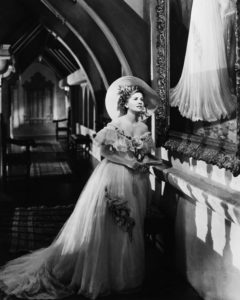
The heroine becomes obsessively jealous of Rebecca, and her evident posthumous hold on her groom, the aristocrat Maxim DeWinter. Notably, Rebecca never appears in the book or speaks for herself; when the novel begins, she is already dead. When DeWinter brings his new bride — young, naive, and from a lower social class — to his family’s sprawling seaside estate of Manderley, she is unsure of herself, lonely, and adrift, with no meaningful work to do and her every need and desire met.
Into the void comes the figurative ghost of Rebecca, who, like the late Dolly Parton, we are made to understand was larger-than-life, beautiful, multitalented, evidently beloved by all.
Aside from the fact that one woman is fictional and the other is not, there is a key difference between Rebecca and Dolly: Dolly lived a life of purpose, where she put her fame and wealth to work for others. A member of the idle rich, Rebecca’s interests do not appear to have extended beyond Manderley and its social orbit.
Because of DuMaurier’s masterful, evocative prose and Alfred Hitchcock’s suitably creepy film adaptation, “Rebecca” is (rightfully) remembered as a work of claustrophobic horror. But it is also a dark meditation on the tragedy of having everything but standing for nothing.
It was hard to miss just how much of the action in “Rebecca” happens either during meals, while waiting for meals, or planning meals. And what meals! DuMaurier devotes her prodigious stylistic talent to the considerable spreads at various teas, lunches, and breakfasts with a frequency and length that rivals J.R.R. Tolkien. Because she has nothing else of substance going on, consumption punctuates her day and marks the passage of time.
With all the gothic freakiness, it is easy to forget that the characters in “Rebecca” occupy the same English countryside milieu as famous British fictional characters like Mr. Toad and Bertie Wooster. Instead, DuMaurier’s characters have more money than sense. When the narrator tells DeWinter’s sister, the horsey Beatrice, that she doesn’t hunt or really ride horses, her sister-in-law cannot fathom what the new bride is going to do all day in the country.
Beatrice and her family often seem like they wandered in from “Right Ho, Jeeves” — we are told their unseen only child Roger is interested primarily in horses and is going up to Oxford simply because they don’t know what else to do with him. But where Kenneth Grahame and PG Wodehouse wrote gentle, humorous sendups of the idle country aristocracy, DuMaurier portrays a teleological vacuum.
The DeWinters’ decadent, hermetically sealed social scene is a hothouse that breeds murder, jealousy, and obsession (okay, it does sound a little bit like a classic country western ballad). It seduces the reader until we get a splash of cold water anytime we are shown that Manderley and its inhabitants are only matters of passing interest to the DeWinters’ middle- and working-class neighbors.
When the main characters briefly export their sordid drama to the house of a nice retired doctor in a quiet part of London, there is a stark, almost comic contrast between his happy home life after decades of service, and the rotten fruits of their indolent self-absorption. In the end, to resolve their dilemma, DuMaurier’s heroine and her husband contract their world further, choosing an isolated life of stifling ennui.

What does all this have to do with Dolly? Twenty-first-century American readers might find the fantastic generational wealth in “Rebecca” unrelatable, but our lives are frictionless and convenient in a way the characters could never have imagined. And yet our society is prey to the aimless consumption DuMaurier portrays: we have online delivery but one-third of our young people struggle to find meaning or purpose in life.
“Find out who you are,” Dolly is supposed to have said, “And do it on purpose.” In a time when many are struggling to do just that, her example of putting her gifts to use for others offers a blueprint. It defined Dolly’s life. It could have changed Rebecca’s story. It could do the same for ours.