Art and Advent go hand in hand. The wealth of Christian imagery that has adorned churches and homes for centuries is a constant celebration of the Incarnation — the Word made Flesh.
Over a millennium ago, St. John Damascene (whose feast day falls during Advent) made a stirring and lasting case for Christian art when he wrote, “When He who is a pure spirit, without form or limit … takes upon Himself the form of a servant in substance and in stature, and a body of flesh, then you may draw his likeness, and show it to anyone willing to contemplate it.”
This applies to all elements of the story of salvation. But it is in Advent, and its sense of anticipation, where art shines. If the images we admire hint at the greatness they represent, they create a longing for a true encounter with Christ, the same longing as we await his birth.
In that spirit, here is an Advent wreath of four images to illuminate our prayers and preparations for Christmas.
‘Madonna del Parto,’ Piero della Francesca
Piero della Francesca painted this work around 1460 for the village church of his mother’s hometown. In part a homage to the woman who bore him, the fresco also put forth an innovative iconic vision of the Blessed Virgin. The result? Pregnant women prayed before it for centuries, hoping for a safe birth (or parto in Italian).
A pair of angels draw back the curtains of the baldachin (reminiscent of Mary’s mantle) to reveal the Mother of God. She is slightly turned to emphasize her pregnancy, nearly coming to term. She lowers her eyes modestly as expected in female portraits of that era, yet her confident bearing highlights her awareness of her role as the God-bearer.
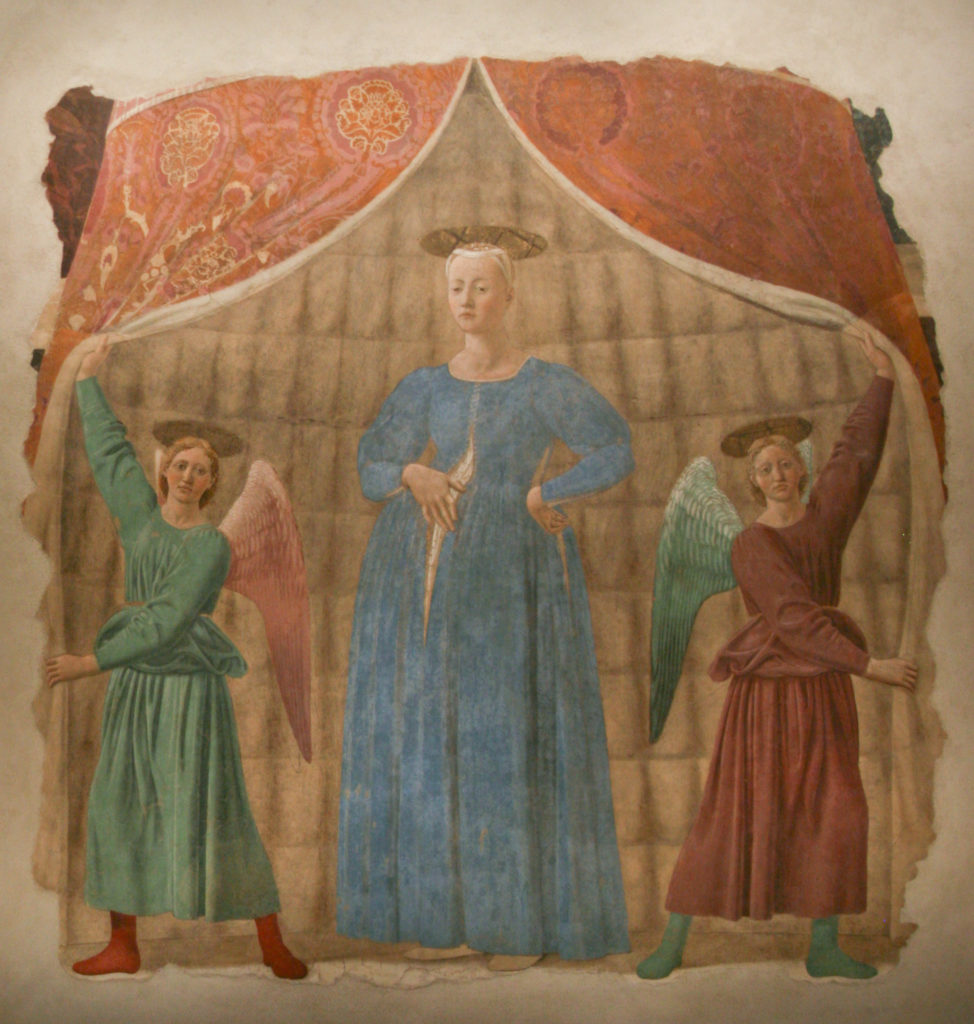
Despite her pearlescent skin and elegant head and neck, the Blessed Virgin of Piero della Francesca transmits a very human sense of presence, with the voluminous folds of her gown and her hand resting on her hip. Her solemn expression speaks to all mothers who, while revelling in the joy of a newborn, contemplate the responsibilities and suffering that motherhood brings. Her blue gown parts at the front revealing a flash of brilliant white protruding from within. From her immaculate womb, the Light will soon enter the world.
The silent serenity of Piero’s Mary illustrates one way we can prepare for this festive season: prayerful calm awaiting the Prince of Peace.
‘Census at Bethlehem,’ Pieter Brueghel the Elder
Where Piero painted quiet contemplation, Pieter Brueghel the Elder captures worldly chaos in this 1566 oil on canvas.
In a snow-covered landscape, people work, play, fight, and bargain on what appears to be a normal, busy day. Brueghel’s ability to orchestrate dozens of figures engaged in myriad activities adds to the charm of this painting: skaters race on the ice, young people throw snowballs, pigs are brought for slaughter — a veritable feast for the eyes.
This painting, made for a domestic setting, was meant to dazzle and delight, allowing the viewer to continually notice something new. But through the waves of activity in the center foreground, a quiet figure in blue forms a visual anchor amid the commotion. It is Mary, heavily pregnant, seated on a donkey led by Joseph; both are going to the census booth.
That’s because, of course, “a decree went out from Caesar Augustus that the whole world should be enrolled” (Luke 2:1). Joseph, a dutiful citizen, was “to be enrolled with Mary, his betrothed, who was with child” (Luke 2:5). In a few hours, in a stable outside the town, the God-Man will be born and laid in a manger.
The striking contemporary setting carried meaning in both Brueghel’s time and ours, a reminder to stay focused. It is easy to get caught up in holiday activities — shopping, cooking, partying — and miss the true event happening in our midst.
‘Nativity,’ Conrad von Soest
At first glance, Conrad von Soest’s depiction of the birth of Christ might seem silly, or even disrespectful, but the 15th-century German painter was using merriment to stimulate devotion.
His composition crams a lot into the compact space, yet he keeps our focus on the mother and child placed in what seems like a stylized chapel on the left. The A-beam roof frames the circle of Mary’s halo, while the rest of the space is filled with seraphim, red-hot angels who burn with love for the Lord.
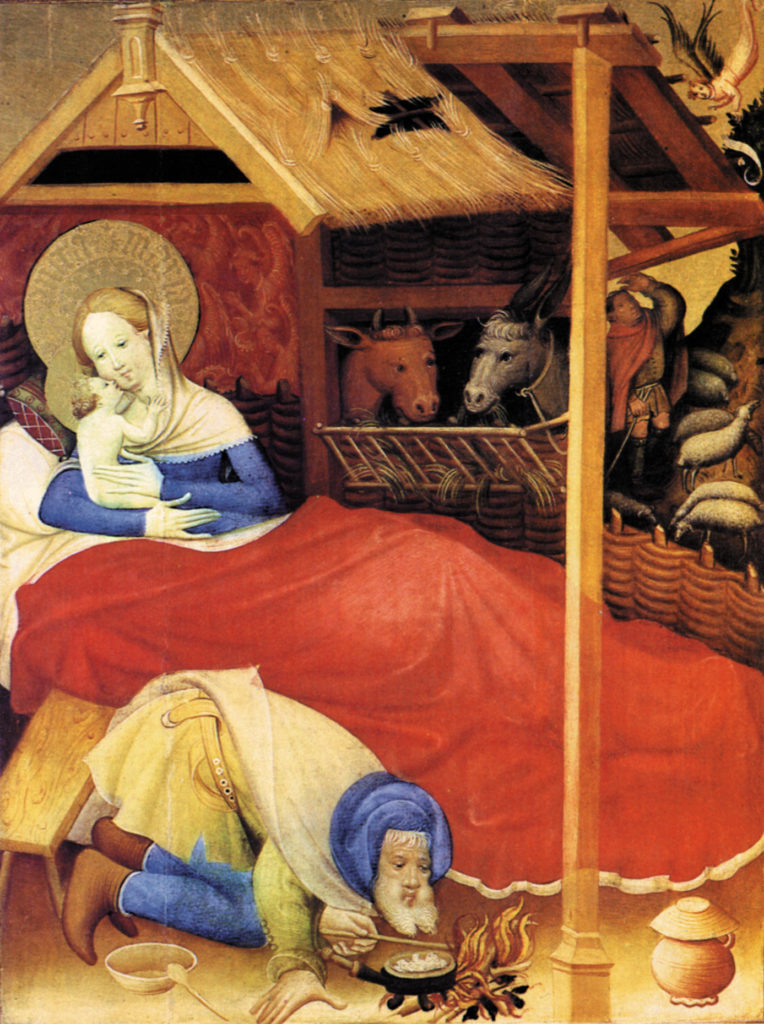
The dilapidated stable with the hole in the roof supported by a few rickety beams speaks of the humility of Jesus’ birth. On the right, a shepherd gazes toward the heavens, his coloring blending in with that of the ox and ass to form the backdrop of the scene. For their part, the animals are charmingly expressive, like animated characters in a child’s cartoon, silently conferring while chewing on hay.
The most surprising figure, however, is St. Joseph squatting in the foreground. If Mary’s pose is drawn from monumental statues, Joseph’s seems inspired by farce. Hunched over a fire, his cheeks puffed, he is trying to multitask by cooking breakfast and heating the room. The wooden bench, bowl, and spoon are reminders of his work: sturdy but unglamorous. Joseph’s efforts are not held up for mockery, however, but serve as a bridge between us, the viewers, and the sacred scene.
Joseph wears yellow and blue, the same colors as Mary, drawing the couple together even at opposing ends of the scene, Mary’s lace-trimmed veil complements the jaunty belt and buttons of Joseph’s tunic: they are a visual pair.
While Mary worships her son, born naked on a winter’s night, Joseph tends to heating their little shelter and preparing their meager meal. His bright blue trousers recall a local legend that Joseph gave his own clothes, his hosen, to make swaddling clothes for the Infant Christ.
Joseph helps us contemplate Christ’s humanity as he does what he can to participate in this great mystery. During Advent, Joseph is a model for us, to humbly offer what we can to prepare the way for the Lord.
‘Seeing Shepherds,’ Daniel Bonnell
The Nativity is a joyous mystery, but how to depict the intensity of that emotion through the still medium of painting?
While Medieval painters used abundant gold leaf and the Renaissance produced arrays of musical angels, contemporary artist Daniel Bonnell employed the texture and luminosity of oil paint to produce his “Seeing Shepherds.”
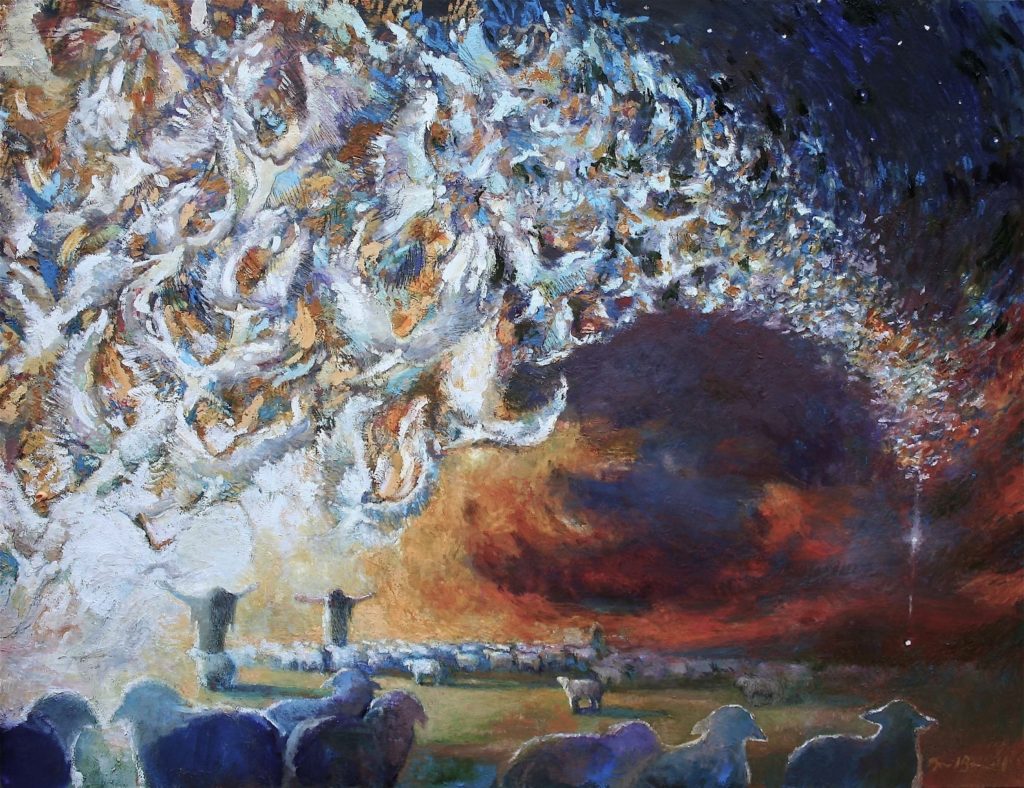
The low vantage point suggests that we are standing behind a flock of sheep, one of shepherds “living in the fields and keeping the night watch over their flock” (Luke 2:8). In the darkness of one of the longest nights of the year, a light appears in the distance. The star hovers in the center of a tsunami of color: lapis, azure, crimson, coral, and gold, and an angel announces the good news of the birth of the Savior. The distant star seems to erupt into “a multitude of the heavenly host with the angel, praising God and saying, ‘Glory to God in the highest and on earth peace to those on whom his favor rests’ ” (Luke 2:13–14).
Bonnell’s virtuoso handling of paint fills the sky with color and movement. The energetic brushstrokes add a kinetic energy to the broad wings carrying the lithe forms and the canvas is overwhelmed with the spirit of rejoicing. How can we, alongside the humble shepherds who are privy to this display, not join our fellow believers and bask in the rapturous beauty of Christmas?