As I read U.S. Supreme Court Justice Amy Coney Barrett’s new book “Listening to the Law: Reflections on the Court and Constitution” (Sentinel, $32), I could not help but remember the unfortunate events of her two confirmation hearings: first as judge of the 7th Court of Appeals in 2017, and later for the Supreme Court in 2020.
“Listening to the Law” is in many ways a clever book, and Barrett is quite circumspect about the details of those hearings, in which her judicial impartiality was challenged on the basis of her religious faith. While she does not describe the specifics of the grueling (and very partisan) questions she had to answer during that first Judiciary Committee hearing in 2017, she admits it “was much more aggressive than I anticipated.”
“I walked out of the hearing room a little shell-shocked,” Barrett writes.
Her friend and mentor, Judge Laurence Silberman, had come to give her support and was eager to talk about what happened: “He wanted to go over the hearing blow by blow in the middle of the crowded hallway. (I had to duck into a side room to take a few deep breaths first.)”
She doesn’t say whether the deep breaths were accompanied by sobs or primal screaming. But the hearings were a watershed of progressive bigotry against Catholicism.
Sen. Dianne Feinstein (D-California) famously summed up her concerns when she told Barrett: “The dogma lives loudly in you.”
Fellow Democratic Sen. Dick Durbin of Illinois, a Catholic himself, weighed in with a statement about Pope Francis and was gratified when the nominee said she agreed with him that the pontiff was “a pretty good Catholic.”
I think both hearings were historically significant because they expressed a notable lack of confidence in Catholics from the country’s elites. But unfortunately, this book is not about such reckonings.
“Listening to the Law” paints a cozy, if not rosy, picture of the atmosphere of respect and the good relations between the justices and the other workers in the highest court of the land. It sounds a bit like whistling past the graveyard, but I suppose the book’s goals include making nice with everyone and ignoring some problems.
For instance, there’s no mention of the unprecedented (and clearly politically motivated) leaking of the Dobbs v. Jackson Women's Health Organization decision in 2022 before it was formally announced. (Agatha Christie, where are you when we need you?)
The book has two paragraphs about the way justices today are subject to negative reactions after difficult decisions.
“I’ve had my share [of consequences] including death threats, lewd packages, protests at my home and a few ugly public encounters.” She acknowledges that Justice Brett Kavanaugh has had it worse (given that an armed would-be assassin went to his house), but writes: “I can take it: these last years of being in the public eye have toughened me up.”
Barrett goes into more detail writing about anecdotes from the history of the Supreme Court than she does describing present-day problems.
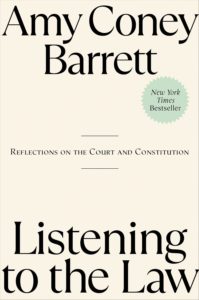
The book is described as “reflections” and mixes genres a bit. It is partly a very good introduction to constitutional law and history, and also part celebrity memoir. It begins with a nostalgic recollection of family history and then moves to discussion of law that is at times entertaining, and at others very serious.
As a memoir, it tells of her great-grandmother’s home and family life, describes the courtship of her grandparents, and recounts her father’s advice about not controlling one’s emotions or being controlled by them. She also touches on family recipes, the hectic quality of life with seven children in the home (including two adopted from Haiti), and offers glimpses of her relationship with her husband.
What we don’t hear about is the Justice’s Catholic faith. She mentions that she took her oath of office on the Bible she has used since Second Grade. (Really? You never got a Children’s Bible? You were using the Adult Study Edition since you were 8 years old?) There is no other reference to the Bible, however, even though Harry Potter is alluded to once, as are the TV shows “Portlandia” and “Friday Night Lights.” The only and lonely specific mention of Catholicism is a joke she makes when talking about the meanings of words and contexts. She says “bachelor” means an unmarried man, but thinks few people would apply the word to Catholic priests.
There is nothing about the faith life of her family. Nothing about turning to God for strength when tested by circumstances like the prejudice her nominations met. Nothing about prayerful discernment in making big decisions for the family. No worry about the integrity of her faith serving in government.
As a pastor, I think that if a member of my parish stepped out to such prominence and wrote a memoir, I would expect something more about belief. Couldn’t she squeeze Jesus in there somewhere? Is this the secularist revisionism that Richard John Neuhaus wrote about in “The Naked Public Square”?
My conclusion is that the Justice is targeting a secular audience. Her book is both brilliant and coy. One annoying detail is that she refuses to use the generic masculine: For someone who speaks a lot of tradition and convention in language, her persistent use of the feminine as inclusive strikes me as odd (e.g. “A person in revolutionary America would likely see herself as a citizen of a state first and of the union second, if at all”.)
I doubt that Feinstein would agree with Barrett’s brilliant exposition and defense of textualism as a judicial strategy. I don’t pretend to be an expert, but trying to read between the lines, I am led to believe that Barrett considers some of the court’s decisions that have produced tremendous controversy and drastic breaks with tradition (like abortion and homosexual marriage) to be (or have been) more appropriately amendments to the Constitution and not judicial “findings” of new implied rights.
One thing Feinstein might like about “Listening to the Law,” however, is that it is sanitized of dogma. This very tightly constructed memoir slash “Apologia pro Interpretatione Legis Sua” is more like a brief for acceptance across a broad range of society, and is free of what Feinstein might have meant by “dogma.”