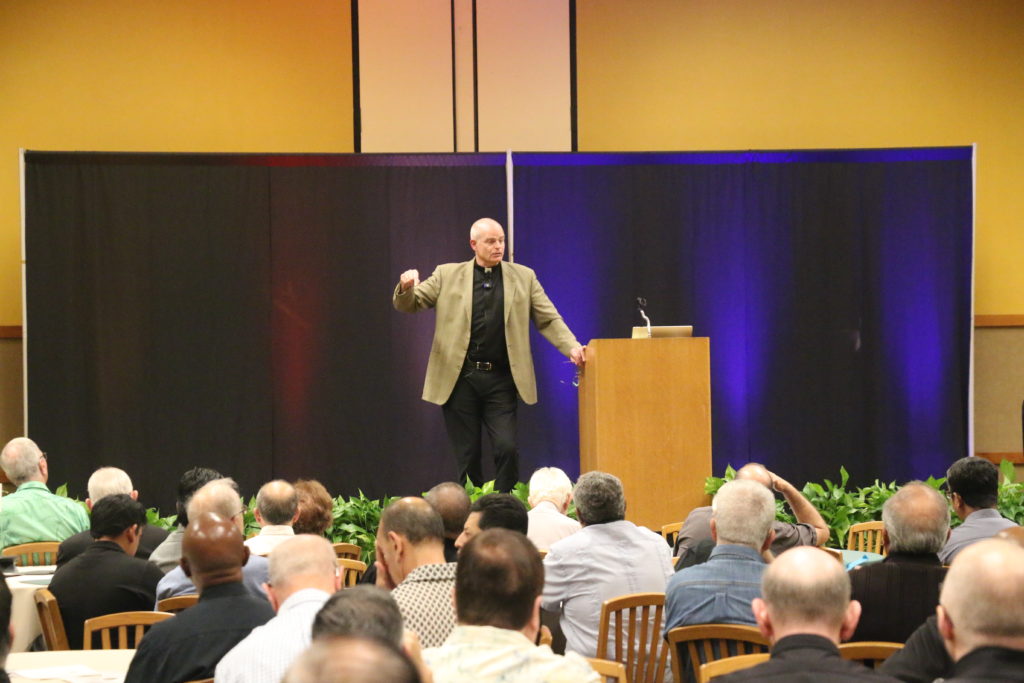
As the questions around artificial intelligence (AI) continue to swirl in our everyday lives, Father Brendan McGuire — a former Silicon Valley engineer and tech executive-turned-priest — challenged priests in the Archdiocese of Los Angeles to “not sit on the sidelines” and to prepare for the societal transformation through AI that is already underway.
“All of humanity is on the line,” McGuire told priests during the archdiocese’s annual Presbyteral Day gathering Sept. 28. “This is not a moment where we can fall. You, as the leaders in the Catholic world of LA, you need to be really struggling with this and work with this stuff. You cannot stand on the sidelines. This is not the time to rest.”
McGuire’s wide-ranging presentation inside the Cathedral of Our Lady of the Angels’ conference center touched on how AI models work, how and when they can be used effectively for ministry, and what to make of growing fears that AI may wipe out humanity.
“We can’t ignore what they’re saying,” McGuire said of recent statements from Silicon Valley tech workers expressing alarm over AI safety. “Because what they’re seeing, the emerging behaviors, is frightening them.”
“I don’t think it’s probable. I don’t think it’s impossible. What I don’t want to do is wait to find out what the percentage is. We need guardrails.”
McGuire, a native of Ireland, worked as a tech executive in Silicon Valley before pursuing the priesthood for the Diocese of San Jose, where he now ministers as pastor of St. Simon Church in Los Altos.
McGuire has helped bring the Catholic Church’s voice to the attention of tech companies, including helping shape Anthropic’s Claude AI system’s governing document. He’s also one of the founders of the Institute for Technology, Ethics, and Culture at Santa Clara University, which partners with the Vatican’s Dicastery for Culture and Education.
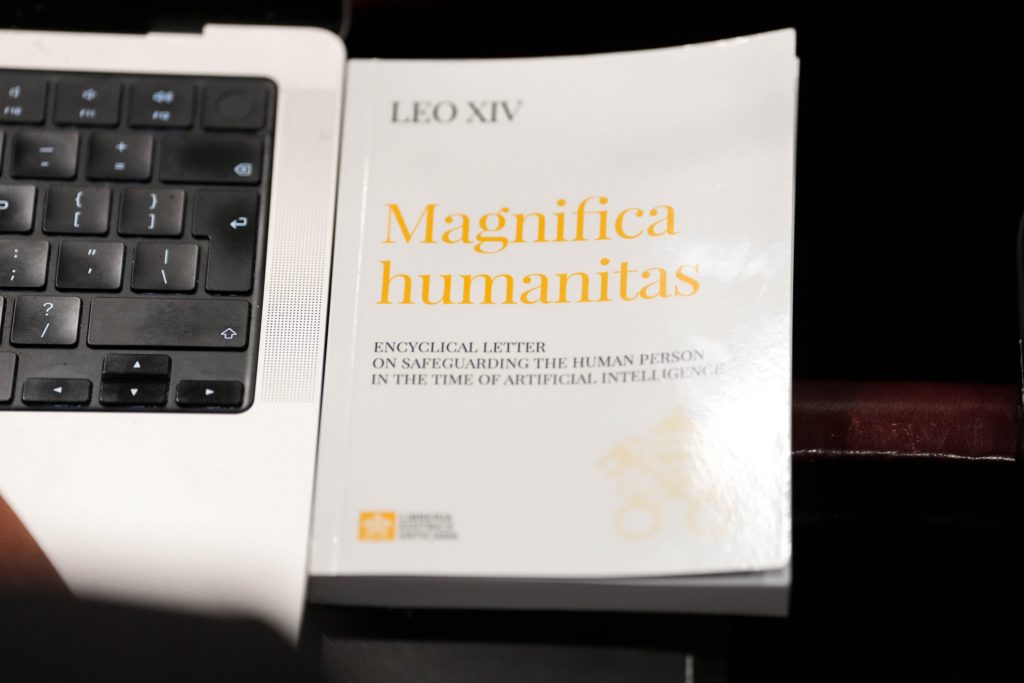
McGuire pointed to Pope Leo XIV’s encyclical, “Magnifica Humanitas” (“Magnificent Humanity”) — which he helped introduce to the global press last May — as a guiding document to bring the dignity of humans into the AI discussion.
“We have been serving technology, and [Leo] wants technology to serve us again,” said McGuire.
In the encyclical, Leo invokes two contrasting biblical construction projects, the Tower of Babel of Genesis and the rebuilding of the walls of Jerusalem described by the prophet Nehemiah, as the choice facing humanity today: “Between constructing Babel or rebuilding Jerusalem; between a power that claims to dominate the heavens and a people who work together in the presence of God to rebuild the walls of fraternal coexistence.”
In finding that harmony between humanity and AI, McGuire believes there’s still time for religious leaders to make a difference.
“If this is the wall that we’re still building, the mortar is still wet,” he said. “We can build this wall. But what I’ve seen developed in the last year alone, I can tell you that the mortar is drying out fast. That’s not to frighten you, but to give you a sense of urgency for this moment.”
McGuire was clear that AI development needed a “slowdown” and accountability, despite seeming evidence that the small handful of companies and investors don’t seem interested in that.
“There is a handful of elites that are making decisions for all humanity,” McGuire said. “That is not acceptable to us. We cannot allow that power. We need to engage, we need to get our people to engage and to demand guardrails, to demand transparency, to demand participation.”
But the AI discussion wasn’t all doom and gloom. “Now that I’ve scared you a little bit, I want to give you some hope,” McGuire said.
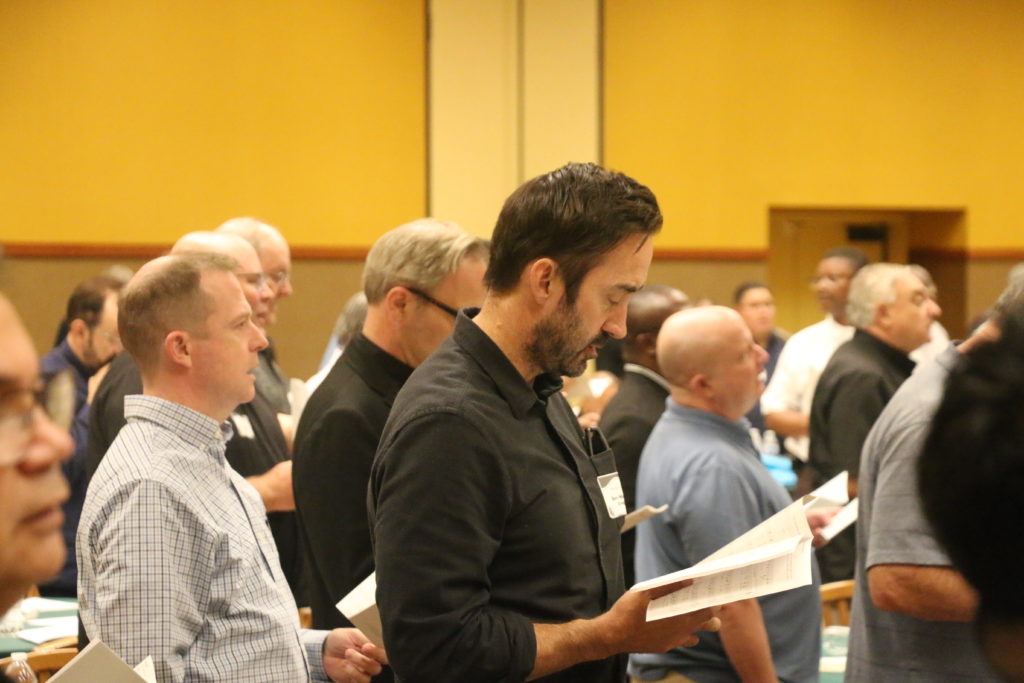
Several times, McGuire asked the priests to reflect on questions about AI, including how they used it, where they’ve already seen AI in their parishes, and what reassurances or concerns they had.
The answers ranged from thoughtful to humorous to heartbreaking.
One priest shared that he asked ChatGPT to give him the liturgical calendar in a clear format, and it gave him the wrong date for Easter.
Another priest shared that he was surprised that he could argue with his chatbot and how easily it would concede.
Another priest said that while ministering on a major university campus, he met students who were already using AI as their therapist, asking it for emotional support, life decisions, and financial assistance.
The slippery slope of using AI to write homilies also came up. McGuire cautioned against simply prompting: “Write me a homily for tomorrow.”
“The preaching of the word of God is the single most important part of our responsibility [in the liturgy],” McGuire said. “It’s not just showing up.
“But make sure it’s yours. Make sure it’s not the machine. It has to be your stories. It has to be your people, in your pew, because if not, they’re going to see it and they’re going to feel it. And the pope is pleading with you to not do it.”
Beyond the doomsday scenarios, McGuire told priests that an AI transformation was already taking place, and that they would have to be ready for the imminent ramifications.
“I’m asking you to discern,” he said. “I’m asking you to make this part of your new vocabulary and discernment. I understand that’s new work, it’s hard work, and it doesn’t feel pastoral. But it will be pastoral, trust me, because you will be dealing with people’s problems in every aspect of society in the next decade.
“That’s not a doomsday. That’s reality.”