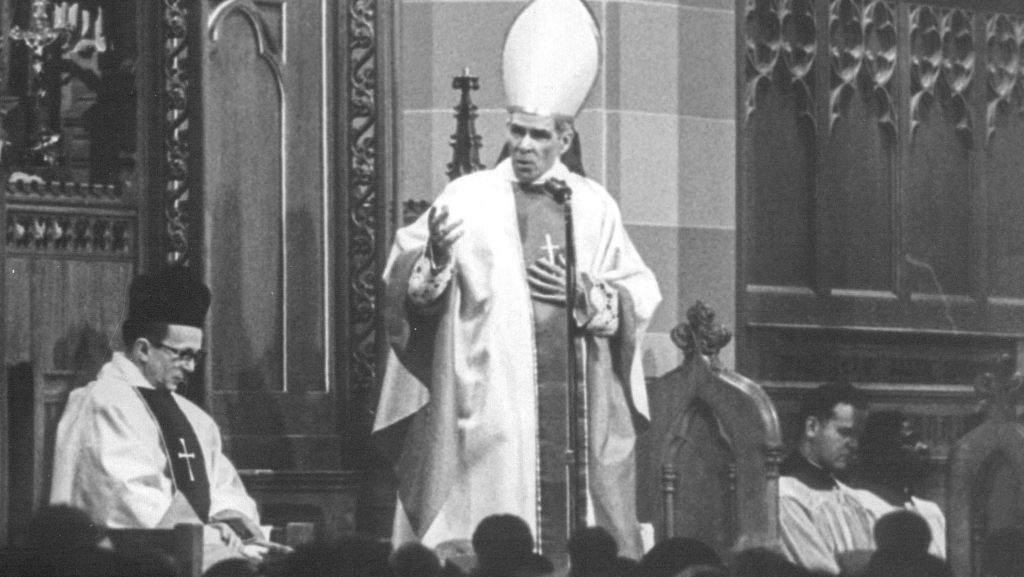
I’ve been reading many things about Blessed Fulton Sheen in the days before and after his beatification Sept. 24 in St. Louis – stories about his television years, the chalkboard, the Emmy, beating Milton Berle on Tuesday nights.
But his years as Bishop of Rochester have stood out to me as a complicated part of his story. When he arrived in Dec. 1966, a lot of people speculated he’d been sent upstate and exiled by New York’s Cardinal Francis Spellman. The three years that followed there didn’t really work, by some standards. But I think those years offer more lessons for pastors and dioceses than anything he did in front of a camera.
In November 1964, Blessed Sheen famously told the bishops at the Second Vatican Council that “it is souls, not territories, which make the missions.” Around the same time, he predicted in an interview with NBC that priests “will no longer be like gasoline station attendants caring only for the regular clients who come in weekly for refueling. They will also be explorers digging for the Holy Spirit in the souls of their fellowmen.”
Sheen understood before many of his peers that the West was passing from Christendom to mission territory.
Just two years later he had his own diocese, complete with a chancery building, an annual budget, and a lot of priests who had never asked to be explorers, but rather were perfectly fine inside their churches, waiting for people to come.
It seems he did a great deal in a short time, including moves that were very much ahead of the rest of the Church in the U.S. at the time.
In his first month he created the position of “Episcopal Vicar for Urban Ministry” and named a young priest named P. David Finks to the job. (Finks liked to call himself “an evangelist in reverse: instead of getting people to join the Church, I try to get the Church to join the people.”) Sheen had the priests elect their own vicar general and set up an elected council of 12 priests to advise him — something unheard of in 1967. He wrote that “the earthquake of secularism has shaken us out of hiddenness and complacency” in his first pastoral letter to the diocese, which drew coverage from Time Magazine. Sheen wrote about the changing times with hope, comparing them to the veil of the Temple tearing open.
A few months after, according to his biographer Thomas Reeves, he’d put a tax of between one and a quarter and three percent on new church constructions to be able to invest money in the inner city and send money to the foreign missions. He started a Hispanic apostolate and supported a community group called FIGHT that was pushing Kodak (remember them?) to hire from Rochester’s poorest neighborhoods. He was constantly talking with business leaders to open up jobs for his people. In 1968 he set up a housing foundation that now functions as the Bishop Sheen Ecumenical Housing Foundation fixing and building homes for low-income families in 13 counties of upstate New York.
That was also the year of St. Bridget’s, which is what a lot of the older people in Rochester remember. On Ash Wednesday he announced that he was giving the parish, an inner-city congregation of around two thousand people, a lot of them Puerto Rican, to the federal Department of Housing and Urban Development as a site for low-income housing.
The move was a surprise, as it became clear he hadn’t talked to the pastor or anyone in the parish about it. More than a hundred priests signed a protest, and parishioners threw pebbles at the bishop’s car. Yes, to the future Blessed, Catholic TV star.
He dropped the whole thing shortly after. After that his talks in the city’s biggest auditorium were half-empty and he told one of his priests, “The whole world comes to hear Fulton Sheen, except his own diocese.” He resigned in October 1969, a year earlier than the standard retirement age for bishops, but said he was “not retiring, only retreading.”
When Sheen left, he apologized to his priests for having sometimes been “monologuing” when he should have been dialoguing. That mea culpa is one of the most underreported examples of Sheen’s holiness.
For his golden jubilee in 1969 he wrote a poem for his priests that says:
“if Secular Man turns us off,
It is because we give him only paperback sociology,
And not the Theology of the Crucified.”
And that’s what he was trying to do.
When he saw Rochester, a very typical American city, he saw mission territory and assigned someone full time to lead that mission. Sixty years later, the Catholic Church is still trying to catch up. Most dioceses seem to have an office for just about everything, but do they have anyone whose job focuses on making sure Jesus Christ is announced in its neighborhoods, or on the digital platforms used by parishioners, places of loneliness and hunger for meaning?
What do I take from his time in Rochester? Make the city someone’s job, for a start, with a real title and the bishop behind it. Focus not only on serving practicing Catholics (which dioceses and parishes all have to do, and do better), but also seeking out the wounded and the lonely — especially in city settings — and get the Church to them, as Fulton Sheen asked Finks to do.
One of the clearest lessons of St. Bridget’s is the need for the Church to listen. Sheen was right that a church building should serve the poor. But he decided without listening first, and announced it like a press release. He was surely excited and motivated by a sincere concern for the poor, but he never sat with the families who were going to lose their parish. I’ve discovered that people will tell you what hurts, what their needs are, and what they are searching for when they feel cared for by the Church. Today, I see this happening more, but we still have a way to go.
I think the Rochester chapter also offers some wisdom for today’s generation of “Catholic creators.” “The whole world comes to hear Fulton Sheen, except his own diocese” might make us wince a little, but should provoke an examination of conscience: If people in other states know my name but my own pastor and the other parishioners don’t even recognize me, it might mean I’ve got it backwards. Digital missionaries are sent out from their local Church, but their big followings can make it easy for them to forget.
So many of the things Sheen did were enormously fruitful, but he also seemed to realize they can’t stand in for the Cross. His jubilee poem ends:
“The doubting world, like Thomas, will believe
Only when we too show the red scars of love.”
It sounds crazy that Fulton Sheen had millions of people watching him on television but couldn't fill an auditorium in his own city. At the end he stood in front of his priests and admitted he had been monologuing. I wish more of us had that courage and humility, starting with me, because a lot of what we do in the Church, both in person and online, sure looks like a one-way street monologue.
Pastoral and ministry leaders, as well as for Catholic influencers and digital missionaries: it’s time to ask who is going to take responsibility for the “city” — those who, whether on the streets or on their screens, are far from the Faith and hungry for God's mercy and love.