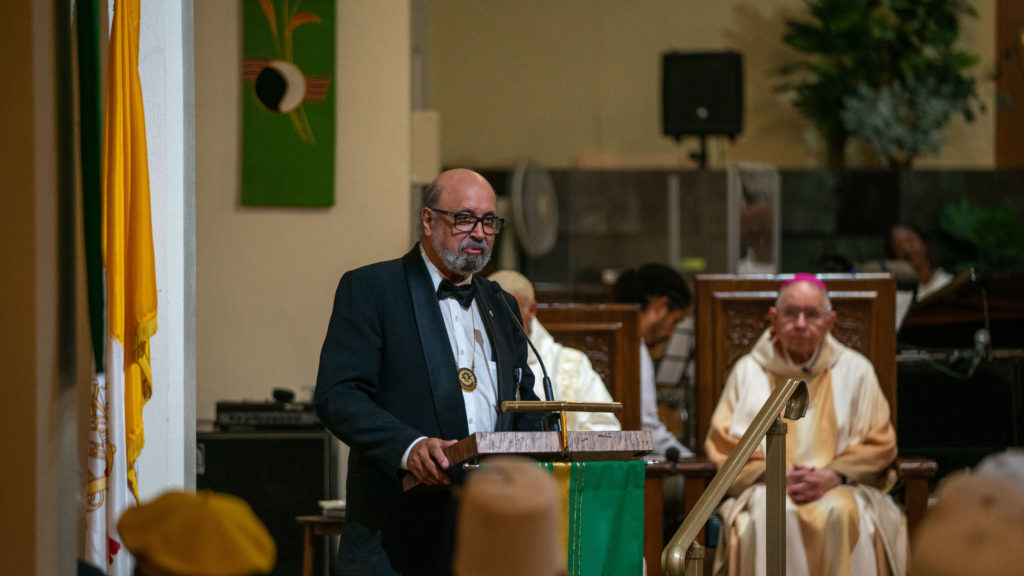
When Greg Warner Sr. was elected to the post of “Supreme Navigator” for the Knights of Peter Claver’s national leadership earlier this summer, it marked the first time in the order’s history that a knight from the Western U.S. had been chosen for the position.
For his fellow Knights and Ladies Auxiliary in Los Angeles, the election was a cause of pride – and surprise.
“We were very, very shocked that anyone from LA could win anything national,” said Keith LaSassier, one of Warner’s fellow fourth-degree knights from Los Angeles.
The Knights of Peter Claver are the largest historically African-American Catholic lay organization in the country. Members are dedicated to supporting parishes and apostolates through outreach to the poor, community service, and evangelization efforts.
While Louisiana and Texas have long been the historical strongholds of “Claverism,” the election of a knight from Southern California to the supreme navigator position is a reminder of Black Catholicism’s “vibrant” history in Los Angeles, said F. DeKarlos Blackmon, a former supreme knight of the order.
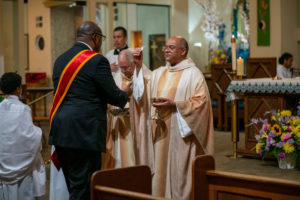
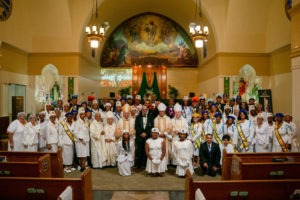
Blackmon was among those who turned out for a special Sept. 6 Mass of Thanksgiving for Warner’s election at Transfiguration Church in Leimert Park, where Warner’s local council is based.
“[Warner] is someone who can defend the faith not simply by carrying around a sword, but by his very tongue, by speaking the truth of Jesus Christ and the tenets of the faith of the Church,” said Blackmon, who traveled with the order’s National Supreme Chaplain Archbishop Shelton Fabre of Louisville, whom he serves as vice chancellor for pastoral services for the Archdiocese of Louisville.
Warner’s personal story tracks with that of many Black Catholics of his generation in Los Angeles: His parents moved from Louisiana to California when he was 9 years old and enrolled him in local Catholic schools. He went on to start a family and launch his own business, a printing company in Gardena.
In the 1990s, his pastor at the time, Father Jarlath Dolan, and fellow Transfiguration parishioners encouraged him to join the Knights of Peter Claver. Since then, Warner has served in many leadership positions for them on the West Coast.
“Greg Warner loves the Knights of Peter Claver,” said LaSassier, who has known Warner for more than 20 years. “He goes above and beyond, even to the point when it’s annoying. He’s very forward. He doesn’t mince his words, doesn’t bite his tongue. There’s no phoniness about him.”
Warner’s election comes as the order faces the same challenges confronting Church leaders across the country: decreased Mass attendance, a decline in vocations to the priesthood, and polarization across political and ideological lines.
As navigator, Warner will be responsible for helping “exemplify,” or formally induct, the order’s highest ranking fourth-degree members across the U.S. — among them bishops — and reducing the financial burden of costs like ceremonial regalia. But his more pressing duty will be to find ways to strengthen the order’s ranks through member retention and recruitment.
“We’re trying to get younger people to come, because that’s where the life is,” Warner told Angelus. “It’s about getting them more active in the Church.”
In Los Angeles, the knights’ emphasis on inclusivity has brought in young members like 26-year-old Steven Camerena.
Raised by immigrant parents from Mexico, Camarena started taking the Catholic faith seriously by attending St. Lawrence of Brindisi Church in Watts as a teenager. His search for community and mentorship led him to enter the parish’s local Knights of Peter Claver council seven years ago.
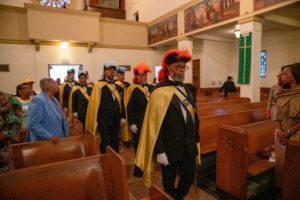
“I hope the order grows more among Black Catholics, but also to other colored communities within the Church,” said Camarena, who attended the Mass for Warner in his regalia.
“The knights don’t segregate anybody, it’s open arms and everybody comes. As a Mexican American, I feel welcome with my brothers. I feel fraternity.”
Camarena said that the mostly older knights on his council teach him “how to be a man in today’s world.”
“They’ve taught me to work through obstacles, what fatherhood looks like,” said Camarena. “And it’s been a way to keep myself grounded.”
At the Sept. 6 Mass, Fabre expressed confidence in Warner and, citing Jesus’ instructions in the Sunday Gospel on how to handle disagreements among believers, acknowledged the obstacles he will face.
“In this role you will be called upon to bring healing, reconciliation, and peace to the conflicts that might arise among members,” said Fabre.
Blackmon, who led the knights from 2010 to 2016, said Warner’s election was also a credit to Archbishop José H. Gomez, whose longstanding support for Black Catholics has helped people understand that “all of us can sit around the table of the Lord without regard to distinction.”
“[Warner’s election shows] that for the Black apostolate in the Church of Los Angeles, all is not lost, that our best is still yet to come,” said Blackmon.