In Book X of his well-known work, “The Confessions,” St. Augustine describes memory as a vast interior palace or storehouse where the self is constituted. It’s through memory that man searches for God and for himself.
“O my God, profound, infinite complexity, what a great faculty memory is, how awesome a mystery! It is the mind, and this is nothing other than my very self,” he wrote.
For Augustine, one’s identity is bound up with the narrative the soul remembers about itself.
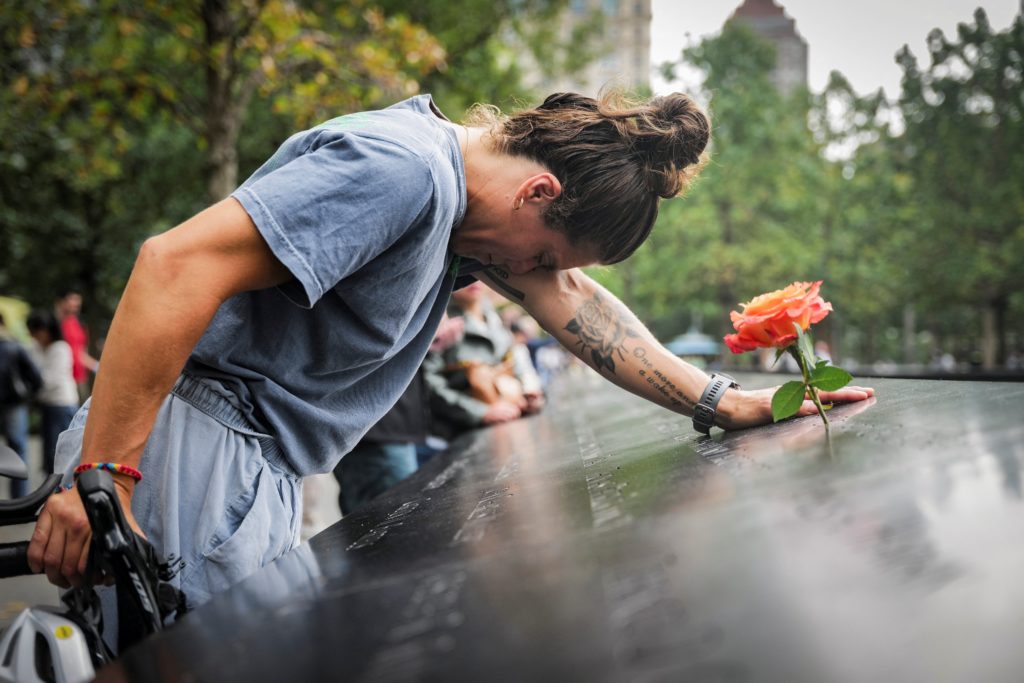
I have been thinking about this concept of memory in light of this month’s 25th anniversary of the Sept. 11, 2001 attacks.
As a millennial on the brink of adulthood, that day and its aftermath shattered my understanding of the world and our country’s place in it. In a sense, it was the day my peers and I lost our innocence: the early hours of Sept. 11 were the “before” of life; the 8 o’clock hour became the “after.”
Most people over the age of 30 can answer the question, “Where were you on Sept. 11?” I still see the entire day, as if my mind has saved all of the photographic negatives.
Each year on the anniversary, I find myself playing the film reel, perhaps as a subconscious response to the admonition we received in the months and years after: “Never Forget.”
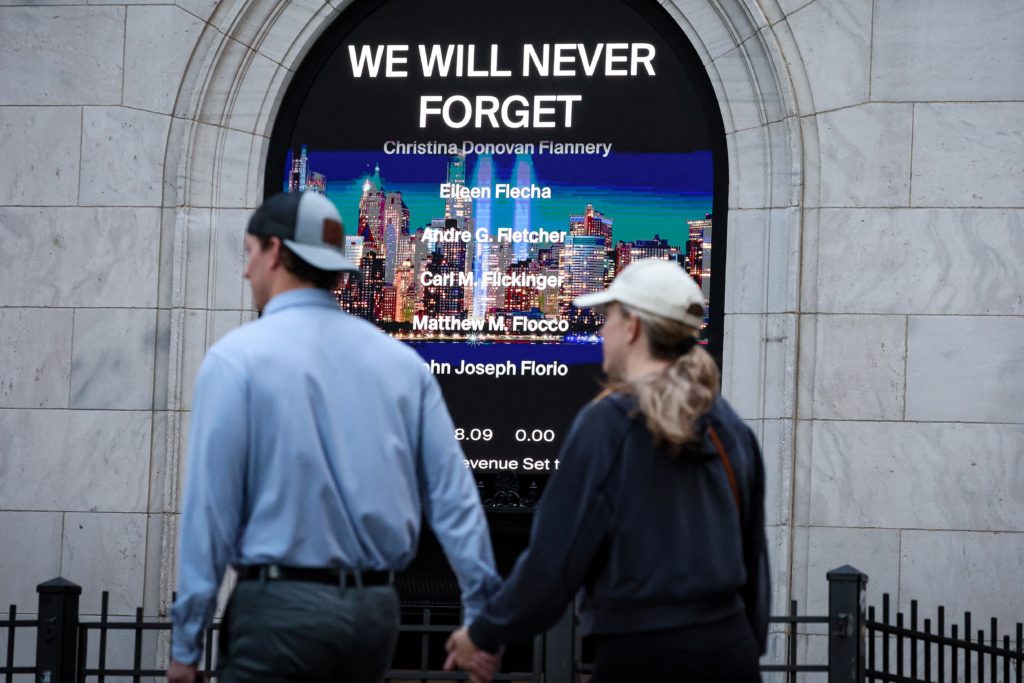
I think it’s also because that day hardwired my generation for an adulthood marked by constant vigilance.
I was sitting in first period health class, one week into my senior year of high school in New Jersey, 80 miles south of New York City. My teacher was waved out of the classroom and returned a few minutes later, rolling in a television on a large, black cart. It was tuned to the local news station, where we saw the North Tower of the World Trade Center on fire.
Things got hazy. I couldn’t remember if my father had to go to the New York City office that day, which he did a few times a week, or if he was in his company’s office closer to home. I wasn’t yet panicked, as the plane crash seemed like an accident.
As we shuffled through the hallways to each subsequent class, we saw new horrific scenes: the second tower hit; the Pentagon struck; the towers collapse; a plane crash in neighboring Pennsylvania. I remember my Calculus teacher, a quiet, long-haired, peaceful hippie-type, wiping tears from his eyes, unable to answer any of our questions.
The physics of it all was incomprehensible. This was no action movie, no video game. People were dying in ways that just would not compute. Maybe our brains were trying to protect us.
After lunch, alarms sounded in the hallways, signaling a school-wide emergency. In hindsight, Medford, New Jersey, was not a likely site for a terrorist attack, but no one knew where or when something would come out of the sky.
In the end, it was a bomb threat that had been called into the main office. In those years, Columbine copycats regularly threatened schools. My four years of high school were often interrupted by these kinds of emergency evacuations.
I remember that my tennis match was canceled, as students were uniformly dismissed at the end of the school day. I ran into my house and hugged my mom, who I hadn’t talked to yet. No one used their rudimentary cellphones like we do now.
She had spent the day calling friends and family members with loved ones in Manhattan. We learned that one escaped Building 7 before its collapse and that friends were walking across bridges to get out of the city. We also made contact with my brother, a college sophomore in Virginia.
And then my father came through the door. He did not have to travel to New York City that day. I was one of the lucky ones.
My parents and I spent the afternoon and evening glued to the television. I could only remember my father crying once, at his father’s funeral. That day was the second.
On 9/11, I learned that adults are just older children, completely vulnerable to the elements like the rest of us. My teachers and parents had never experienced an attack on American soil. There was no playbook, no historical memory, no wisdom to draw from.
All we could do was sit side by side and watch the news, wait for our president to tell us more, and hope that as darkness fell, it was finally over.
Millennials were not the first generation to come of age during war. In his early 20s, my grandfather was driving an Army ambulance in France during World War II; my uncle earned a Purple Heart in Vietnam before he was 25.
Yet this war was not started by another nation but by people who had clandestinely lived and moved among us, who hated our way of life, did not share our view of God, and used ordinary things like passenger jets and the U.S. Postal Service to terrorize and kill us. Train stations, concert venues, and marathon routes would all become the battlefield in Western nations.
From then on, when we woke each day, some part of us prepared for carnage, for crisis.
Our adulthood has been littered with it: clerical sexual abuse, mass shootings, financial collapse, a 20-year war. Just as we began bringing our own children into the world, we were sent into lockdown as a pandemic wiped out millions.
Memory tells us who we are and who we’ve become: for millennials, that’s a generation on edge, still waiting to exhale. We’ve gotten used to this low-level vigilance. I’m not sure we even notice it anymore. It’s like a shadow, or a persistent headache — impossible to shake, just something you have to live with.
In the quarter-century since, I have found that deliberately remembering who God is is the only real counterweight to these other memories.
In moments of fear — when I’m not sure if I’m paranoid or appropriately prepared for the worst — touching the cross on my neck steadies me. I think of the beams found at Ground Zero in the same formation, reminding us of his closeness and of his victory.
“You are the Lord and God of the mind,” Augustine wrote. “You see the fear in my heart, hemmed in as I am by all of these dangers and struggles, and many another like them. It is not that I have ceased to inflict these wounds on myself; rather I am conscious that ever and anew you are healing them.”
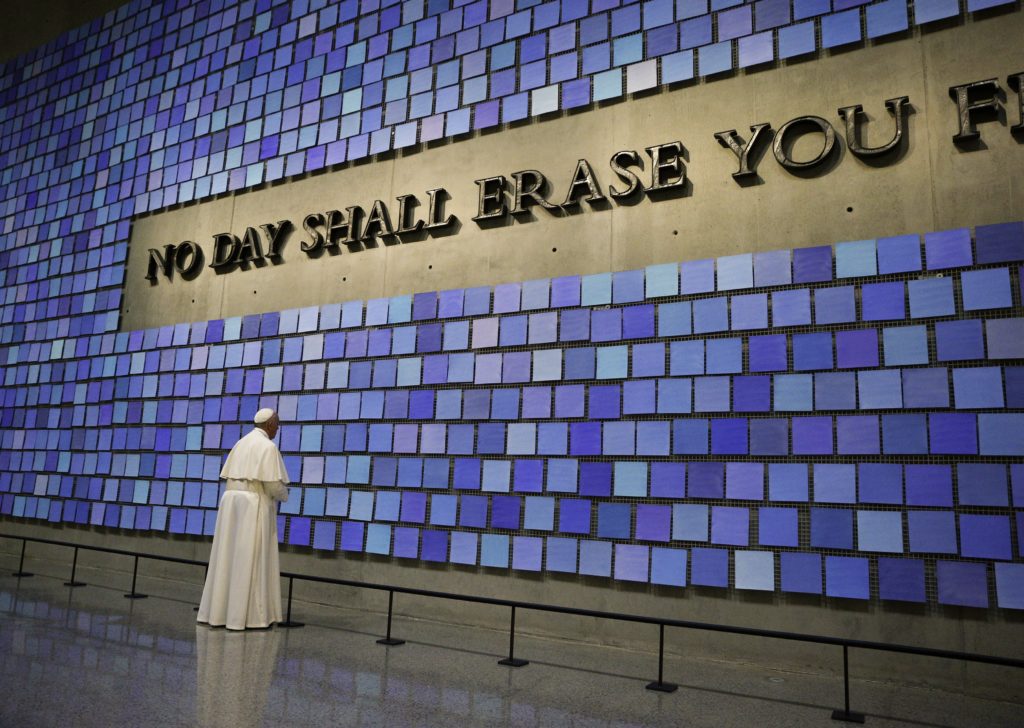
On this anniversary, may the Lord heal our memories of that terrible day, when the world as we knew it was suddenly over.