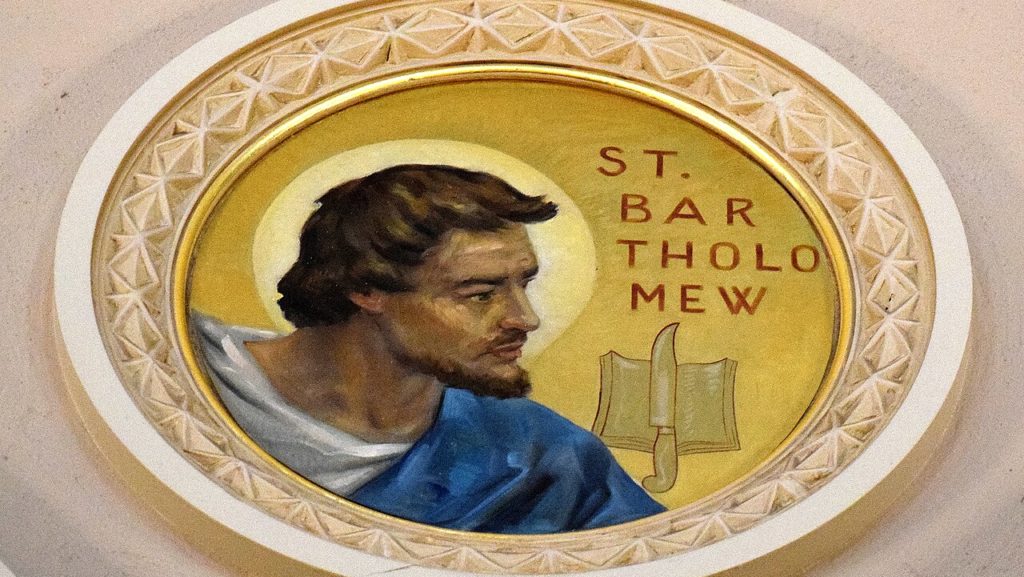
The Church honors the memory of St. Bartholomew on Aug. 24. The Gospel tells us so little about him, and — unlike Peter, John, James, and Jude — he left us no epistles to ponder.
But he was one of the Twelve, specially chosen by Jesus, and like almost all the others he died as a martyr. So he merits our careful attention.
The name Bartholomew is actually a designation of his parentage. It means “Son of Tolmai.” Tradition identifies the name with the apostle identified as Nathanael in St. John’s Gospel (1:45–51; 21:2). So he was “Nathanael, Son of Tolmai,” as Simon Peter was “Simon, Son of John” and James and John were known as the “Sons of Zebedee.”
Only once in all four Gospels does Nathanael bar Tolmai manage to steal the spotlight. People remember the moment especially for its snark.
Nathanael’s friend Philip comes to him and says that he has found the Messiah, and his name is Jesus of Nazareth.
Nathanael immediately retorts: “Can anything good come from Nazareth?”
And thus he established a putdown that has been perennial since that moment. Whenever we want to call someone’s legitimacy into question because of their place of origin, we say, “Can anything good come from ________?” You can fill in the blank with any place on the planet.
But Nathanael’s wisecrack itself probably resounded as testimony, even as he uttered it. Philip mentioned the Messiah, and Nathanael zeroed in on the association with Jesus’ hometown.
Nazareth was indeed a small village of no particular importance. It had been founded not long before, by returning exiles who were King David’s descendants. They knew that the Messiah would come from their line, and so they gave their village a name drawn from prophecy. Centuries earlier, Isaiah had foretold that from Jesse’s roots a branch would bear fruit (Isaiah 11:1), and the Hebrew word for branch is netzer. Nazareth was named for that branch from Jesse’s stem.
Jesus did not reproach Nathanael bar Tolmai for his frankness. In fact, he praised him: “Behold, an Israelite indeed, in whom is no guile!”
In speaking frankly, Nathanael had inadvertently called attention to Jesus’ credentials.
Afterward, in a brief exchange, Jesus noted that he had seen Nathanael reading under the fig tree — and perhaps the Lord also alluded to the text he was reading. For something Jesus said moved Nathanael to acknowledge Jesus not only as Messiah, but also as divine: the Son of God and the King of Israel.
Jesus rewarded him with a promise that he would see a vision like that of his patriarchal ancestor, Jacob. Nathanael would see angels ascending and descending — not on a ladder, but on Jesus himself!
And so ends the only speaking part the Gospels give to Nathanael, also known as Bartholomew. It is not the largest role, but it is far from the smallest.
It is, moreover, rich in significance for those of us who want to gain what Nathanael won by his guileless honesty.