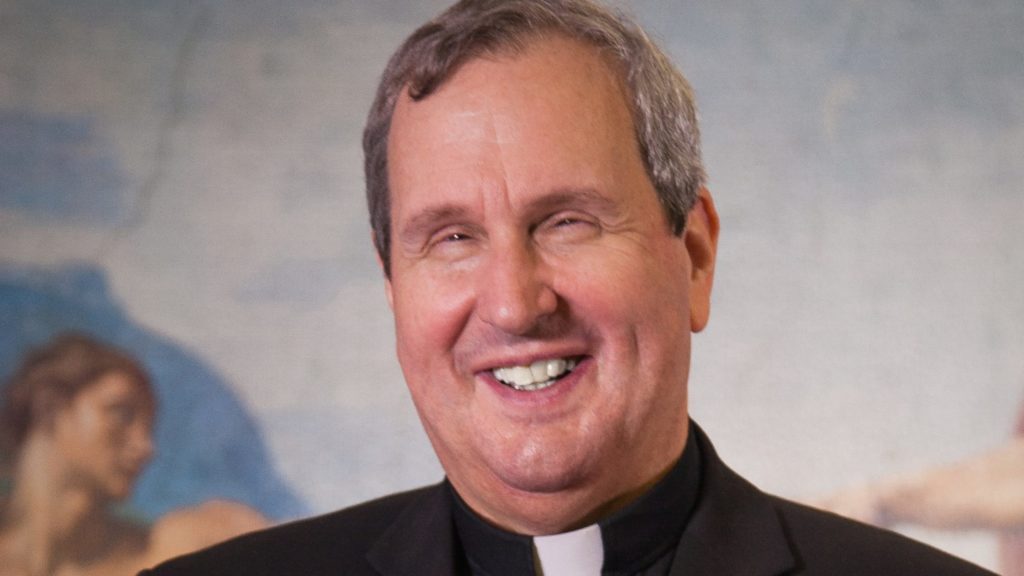
I thought I was going to be interviewing Father Robert Spitzer, SJ, before a recent lecture on the Shroud of Turin at Christ Cathedral in the Diocese of Orange.
I thought wrong.
I spent almost 40 minutes with Spitzer, a Jesuit academic of the highest order, whom I knew only through his myriad YouTube videos. Instead of a standard Q&A session, I got a Q in now and then, but then sat back as this priest’s passion for his topic and acuity of mind enveloped me.
Spitzer is a man on fire — in all the best ways. He blazes with a love of the Lord, and he marvels at the complexity of creation and celebrates the wonders of science and how it can augment anyone’s faith. If I presented an itemized list of Spitzer’s accolades and curriculum vitae, it would take up the rest of the column space. As a Jesuit, his baseline is heavily weighted in academia. As a man of science and intense curiosity, Spitzer also has the initials “Ph.D.” to go along with the SJ. This makes Spitzer a three-dimensional representation of what “Fides et ratio” is all about.
For those who may not know, he has been the foremost Catholic proponent of the scientific research on the Shroud of Turin, and was instrumental in the Shroud museum and interactive experience that opened its doors a year ago at the Christ Cathedral campus.
I have taken the “experience” in and toured the museum twice now, and it still does not disappoint. I would say the experience the second time around was even better, as I have gained more knowledge and there are new elements to the presentation that further the case for the Shroud being the actual burial accoutrement of Our Lord.
Interest in the Shroud blossomed during Spitzer’s Jesuit novitiate from 1974 to 1976. That is when he encountered the book, “A Doctor at Calvary” (Kenedy, $16.67), by Dr. Pierre Barbet. Published in 1953, this seminal book was the beginning of serious scientific inquiry into the Shroud, its origins, and the possibility, through elemental scientific study, that there was more to the Shroud than just a strange positive photographic image and the historical lore that attached to it.
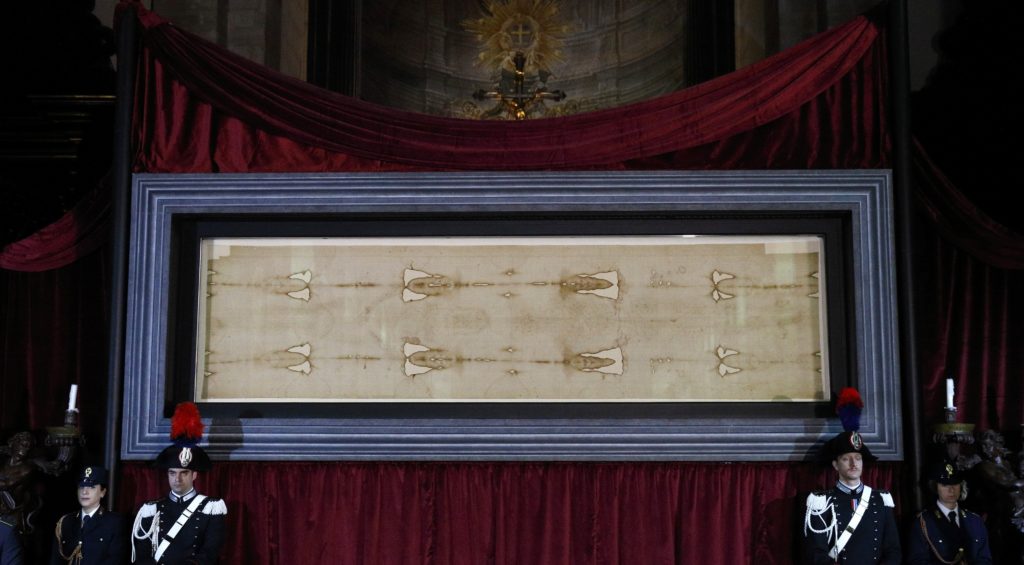
As Spitzer spoke during our interview, I tried hard not to show the panic I felt inside because there was so much he knew about the Shroud that came via his profound scientific mind, something I do not possess. I relaxed when it dawned on me that I did not need to regurgitate all the amazing details of the discoveries about the Shroud. Those who know the scientific and faith journey the Shroud has been on since the Middle Ages already know that the more science develops, the more rational arrows point to Christ.
For those who don’t know, I implore them to encounter the information at Spitzer’s Magis Center website. You may have to listen more than once, not so much because his scientific knowledge of his subject is so technically difficult to grasp — it is for some of us — but because the more you know, the more you focus on how complete and total the sacrifice Jesus made on that Good Friday.
The history of the Shroud, as I learned from Spitzer, reads like an “Indiana Jones” movie, except without all the destruction of priceless antiquities that Indy seems so prone to demolish.
Spitzer is an intellectual and spiritual adventurer. His application of science, especially his Ph.D.-powered knowledge of radiation physics and chemistry, does not prove the Shroud of Turin is the burial cloth of Christ. He admitted that to me in private and stipulated to the audience who came to see him at Christ Cathedral later that evening.
Yet his decades of study have given solid scientific answers to all six of the unique image characteristics and all 45 enigmas of the Shroud. And although each of his findings may not prove this is Jesus’ burial cloth, it proves overwhelmingly that the garment dates to the middle of the first century, plus or minus a few decades, contains pollen samples of plants found only in the Middle East, and has blood evidence and wound locations from top to bottom that mirror the Gospel account and preferred Roman Empire torture methods. These are not faith-based opinions, but observable facts of blood analysis and archeological flora experimentation, as well as Spitzer’s in-depth radiological hypothesis. He prays he will be around to test that theory when the Shroud will be available for viewing in 2030. When you watch his lecture, you will pray he is around for that as well.
In the preface of Dr. Barbet’s groundbreaking book “A Doctor at Calvary,” he is adamant that his work is not definitive, but included: “I shall never forget that the shroud, as Pope Pius XI used to say, is still surrounded by many mysteries. The future no doubt has many surprises in store for us.”
Thanks to Spitzer’s deep faith and his dedication as a man of science, Pope Pius XI may be proven to be quite the prophet, and the cross we venerate that gave us only a dead body may be bookended with a Shroud that gives us a resurrected Savior.