The history of the Catholic Church in America includes contributions from many immigrant bishops. However, the political and ecclesial context of the episcopal installation I recently attended makes it a kind of ecclesiastic Horatio Alger story.
Alger specialized in fiction featuring characters who achieved the American dream. His popular stories told how poor boys, through hard work, went from “rags to riches.” He wrote of an American ideal that was practically a myth, or a myth that was the ideal. The message was: success is always possible in America, if you’re willing to work hard enough.
The parable I am talking about is not about rising from poverty to the middle class. It’s about coming from a strange land (if this expression makes you think of Robert Heinlein instead of Scripture, it’s time to dust off the old family Bible) and becoming a shepherd of Christ’s flock in a diocese overwhelmingly populated by people whose families have been in this country for generations.
The story goes like this:
A young man comes to America from another country in search of work, without papers. He has family here, and in his 20s is washing Amazon trucks and painting houses with his brother-in-law.
He gets involved in a parish, but that is not enough for him.
With the help of the diocese’s vocation director, he discerns a priestly vocation and goes to the seminary. After four years, his bishop sends him to Rome, a prophetic sort of action. As an immigrant, our young seminarian studies the pastoral care of immigrants in the Scalabrinian Institute, where he gets a degree. He is ordained.
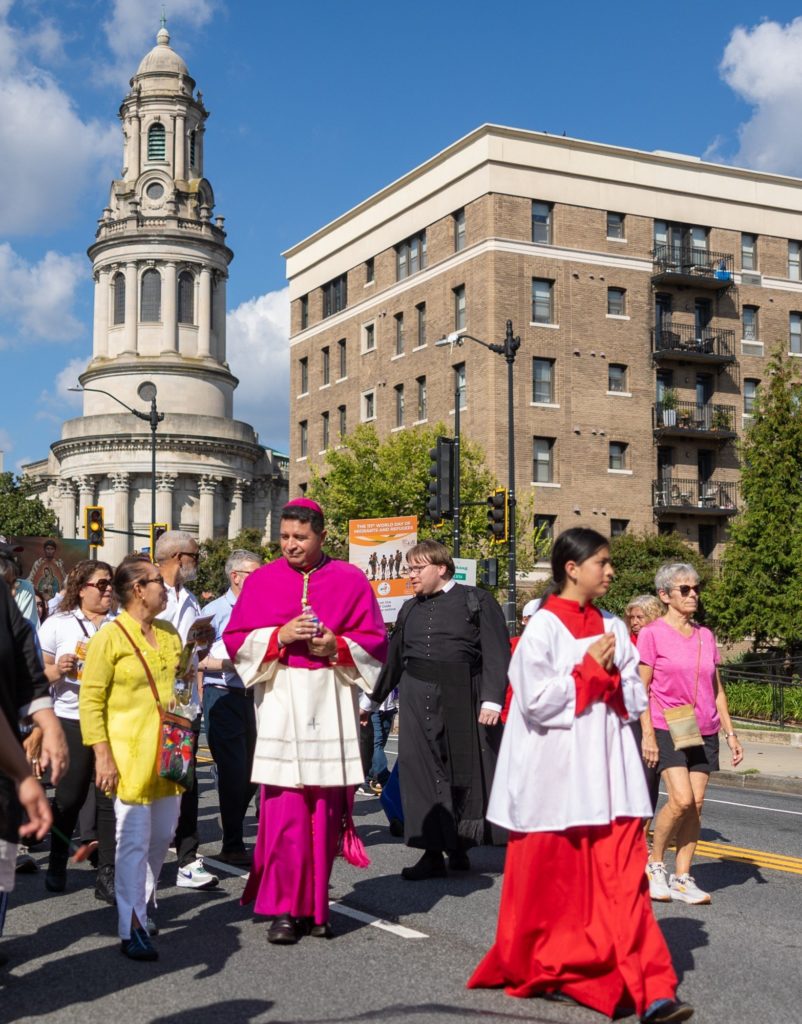
Twenty-two years later, the vocation director who helped him become a priest is now a bishop and about to retire. The former undocumented immigrant had been ordained a bishop himself three years earlier, and the new pope decides that this young man should succeed the bishop who was his former vocation director.
This is a true story. As I said to a cardinal who had come from the country the bishop had left as a young man, “You could not make the story up without people thinking that you were exaggerating.”
His installation Mass was impressive. The music included handbells, cymbals, drums, and Catholic standard hymns like “O Sacrament Most Holy,” along with African American spirituals, “Christus Vincit” in Latin and the first verse of “America the Beautiful.” (The immigrant bishop had insisted on the patriotic anthem because he believes in what it expresses.)
An army of clerics concelebrated. The former vocation director, now an emeritus bishop, joked that the three cardinals present in the cathedral were not enough for a conclave, but their presence was still special. The apostolic nuncio was there, as was the metropolitan bishop of the region, along with 23 other bishops and four more soon-to-be bishops. Hundreds of priests were there, many of them from other countries but working in dioceses throughout the United States.
Ecumenical and interfaith leaders of various denominations were there, and I wondered what they thought about the packed cathedral, the overflow halls, and the EWTN television broadcast. The sheer spectacle of it all would take your breath away, even if you are not one of us.
The Catholic (capital letter) liturgy was so “catholic” (small “c,” meaning universal) with clergy, religious, and faithful from many countries, and with symbolism that reached across many demarcations and boundaries in social life with grace. The result was pure beauty.
An African sister gave the first reading, an immigrant gave the second in Spanish. The new bishop spoke in two languages, smoothly transitioning from English to Spanish, making a discourse like Christ’s seamless garment that the soldiers rolled dice for beneath the cross.
I wondered what the bishop’s critics might have thought if they had tuned in to EWTN. A Protestant news service that drops articles in my email said, “Pope names illegal immigrant bishop.” The undocumented stuff lay far back in the bishop’s past, but the irony of the appointment amid the current social and political controversies over immigration admittedly caught the eye.
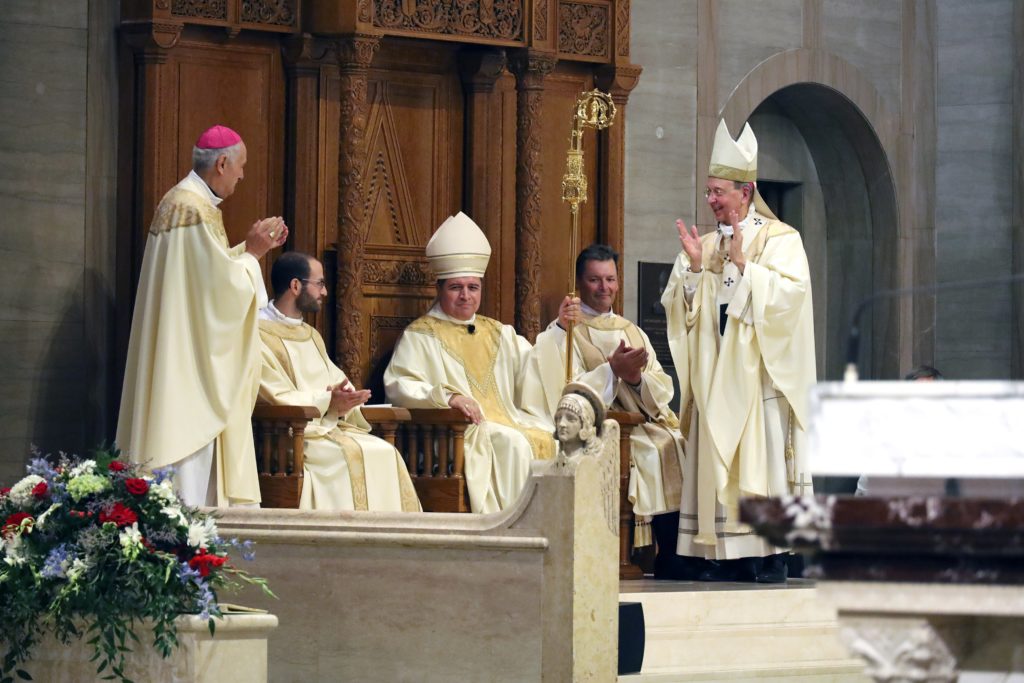
The bishop with calm gravitas alluded subtly to the controversies but focused on the providential nature of his vocation. He had not expected God’s call to priesthood even in the new land. Jesus had accompanied him the whole way, he said, even when the divine presence was veiled. The grace of God had brought him to this cathedral in Wheeling, West Virginia, and no one could mistake the seriousness with which he saw his vocation as part of the broader mission and mystique of the Church. All of us have a desire for home — for belonging, for connection — and the Church fulfills that instinct because it brings us all into communion, with God and one another.
Good fiction depends on a willed suspension of disbelief, I learned in English Lit. But we also know that truth has more surprises than writers of stories dare to scribble. In case you missed it on EWTN, I have been talking about Bishop Evelio Menjívar-Ayala’s installation as the 10th bishop of Wheeling-Charleston, West Virginia. A Salvadoran immigrant is now the shepherd to Appalachia! It has an Alger-like, only-in-America ring to it.
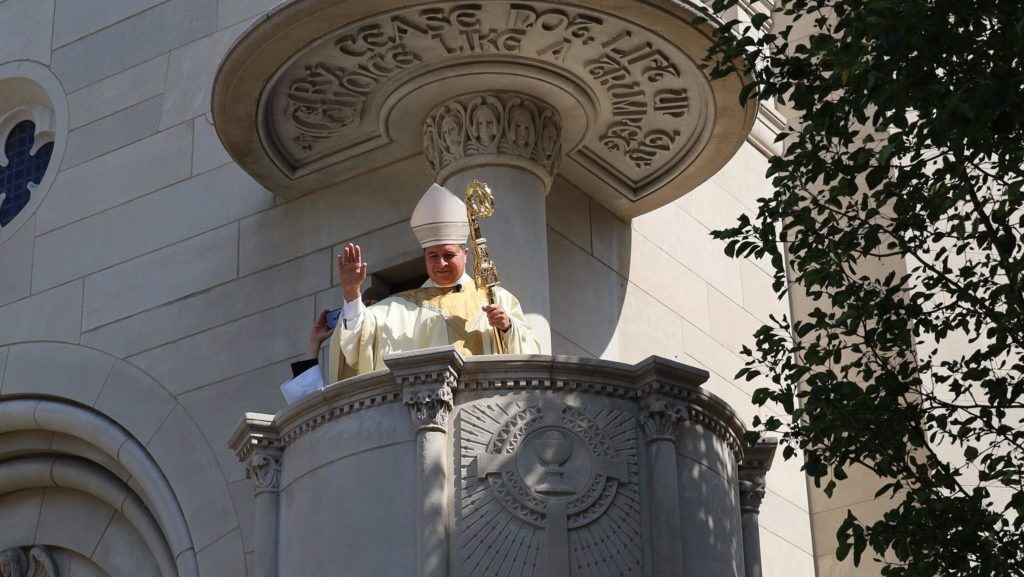
It would have been impossible for the new bishop not to mention the most famous song written about West Virginia. Very gracefully, he said the liturgy and his call to ministry reminded him of John Denver’s words because he felt he was in “almost heaven.”
Referring to the 100-degree heat that had us clerics sweltering in the sun awaiting the new bishop’s prescribed ceremonial knocking at the cathedral door, Bishop Menjivar joked, “almost purgatory,” was another notion that crossed his mind.
Country roads, indeed. Or rather, the complicated and seemingly twisted path that only reveals God’s plan in retrospect. Who would have imagined Menjívar’s trajectory? A young man leaves his native El Salvador because God was going to call him to be a bishop in a state where there are so few Catholics that it works out to about one Catholic per square mile.
Every day the Catholic Church in the United States becomes more international, not just because of the fervor and youth of immigrants but because our clergy is more and more a community from many nations. There are dioceses with more foreign clergy than native-born Americans. I fear this is due partly to the decline of faith, and also an indication that in the States we have the means to import vocations.
But a man like the new bishop of West Virginia makes me think there is a message for all Catholics in the mystery of his vocation. Its inevitability against the odds is what I am talking about. Other immigrant bishops came with their vocations to serve. This one came to discover his vocation.
May the priests and bishops who come to serve us and who revere American ideals, as Menjivar does, inspire us all.