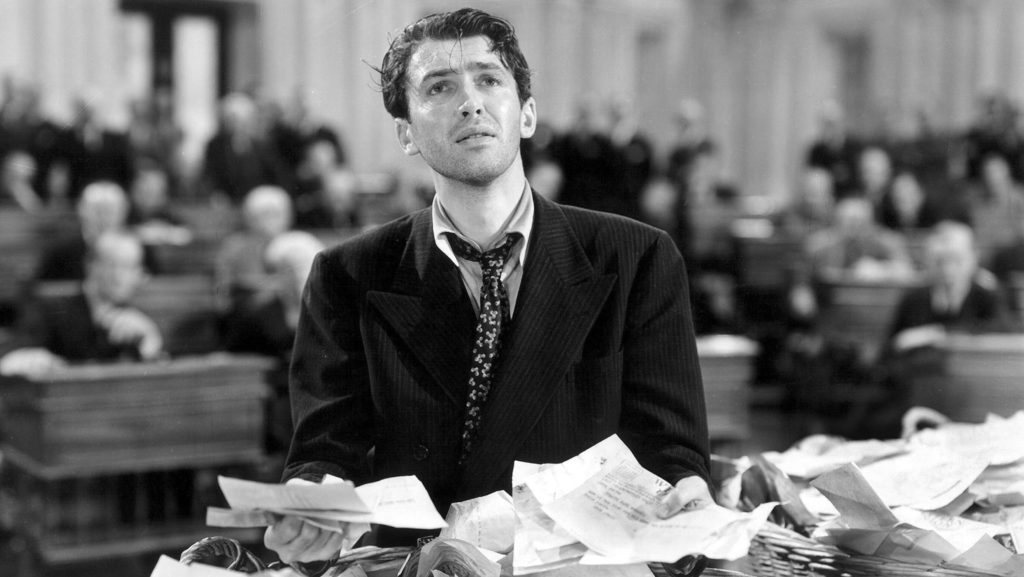
Having reached the age when you finally realize nothing good really happens after midnight, a night on the town with my wife looks a lot different than it used to be. Last Saturday consisted of us attending the Vigil Mass, going to a local eatery to pick up some sandwiches, and then returning to the parish hall to sit next to our pastor and watch an 87-year-old black-and-white movie projected onto a portable movie screen just a bit larger than one of those humungous TVs you find at a big box store.
I know what you are thinking: another power couple on the fast track!
It was a splendid way to spend an evening — and get home before 9 o’clock! It was our parish’s inaugural “movie night.” No red carpet or paparazzi, but good company, with our pastor and a smattering of fellow parishioners. Our pastor had hoped for a bigger turnout, but hopefully with word of mouth, more parishioners will come to the next movie night. If they had come to this one, I am confident they would return for more.
The movie our pastor chose was Frank Capra’s “Mr. Smith Goes to Washington.” He recalled seeing this film multiple times and thought it would be the perfect choice as America approached its 250th anniversary, with the film’s wholesome patriotic patina.
Our pastor also had a unique perspective on this film. Being an immigrant from a country with close ties to the United States, he grew up looking toward America as the epitome of the democratic process. But as patriotic and lighthearted as the film is, like a lot of Frank Capra movies, there is a darker underbelly. The film shows that American democracy can also be messy. When this film was released in 1939, most native-born Americans had a similarly naïve view of the American political process, and politicians were able to present themselves as paradigms of virtue.
But according to Capra’s autobiography “The Name Above the Title” (Grand Central Publishing, $21.57), when he premiered the film in Washington, D.C., he was almost run out of town. The senators and congressmen were outraged that this film might show their august body in any way less than heroic and pure. Some politicians were angry, thinking Capra’s movie was going to give people the wrong idea, while other politicians were equally upset Capra would be giving audiences the right idea.
“Mr. Smith” is one of Capra’s greatest achievements, although he is mostly remembered for his Christmas staple, “It’s A Wonderful Life.” Both films rely on the ineffable talent of the great Jimmy Stewart.
In “Mr. Smith Goes to Washington,” Stewart’s character, Jefferson Smith, is a naïve governor-appointed senator, whose appointment — for the express reason of his naivete — will serve the purposes of his corrupt mentor and the political machine that is calling the shots.
Besides the plotline, which sounds like something taken off the latest social media virus, the movie holds up on so many levels. Capra was Catholic and his films, though none outwardly religious, had a Catholic sensibility that comes through. “Mr. Smith Goes to Washington” is no exception, as the main character is publicly humiliated, politically crucified, and hopelessly shackled to a lost cause.
Although the film is encapsulated in the style and melodramatic aura of its time, it remains timeless in all the most important ways, none more important than a character going through a crucible of pain, maintaining his faith, and coming out the other end with a victory. The common theme in so many of Capra’s films, of one man standing for what is right regardless of the cost, has an appeal with no expiration date.
None of the big stars of that era could have pulled this off. Audiences would have demanded Clark Gable or John Wayne handle the problem with their fists, but Jimmy Stewart portrayed a different kind of masculinity. It was just as tough, but based on Stewart’s real-life war record, I would argue it was even more masculine. The fact that this inner toughness co-existed with Stewart’s “everyman” personality makes his Jefferson Smith character so relatable.
The cinematic universe Capra created has been belittled by some film critics as being too simplistic and corny. The director himself accepted the moniker of “Capra-corn” in his autobiography. But that is unfair. Yes, there is a lot of sentimentality in his oeuvre, but there is also a counterbalance of darkness and even evil. It makes for good art, and it makes for a great start for a parish movie night — and you still get home by 9 p.m.!