With bishops leading the way, every Christian should help build unity in the Church and the world by putting Christ at the center and drawing others near while being attentive to their needs, Pope Leo XIV said.
"Communion within the Church is not built by clinging rigidly to one’s own position, but by seeking, in all hearts, points of encounter in the truth, in whose light alone each person becomes a means of growth for another," he said during his homily at Mass on the feast of Sts. Peter and Paul June 29.
"It is important for us today to look to these two saints -- Peter and Paul -- to understand how we, in turn, can be apostles and builders of unity, and generous servants of the truth in charity," he said.
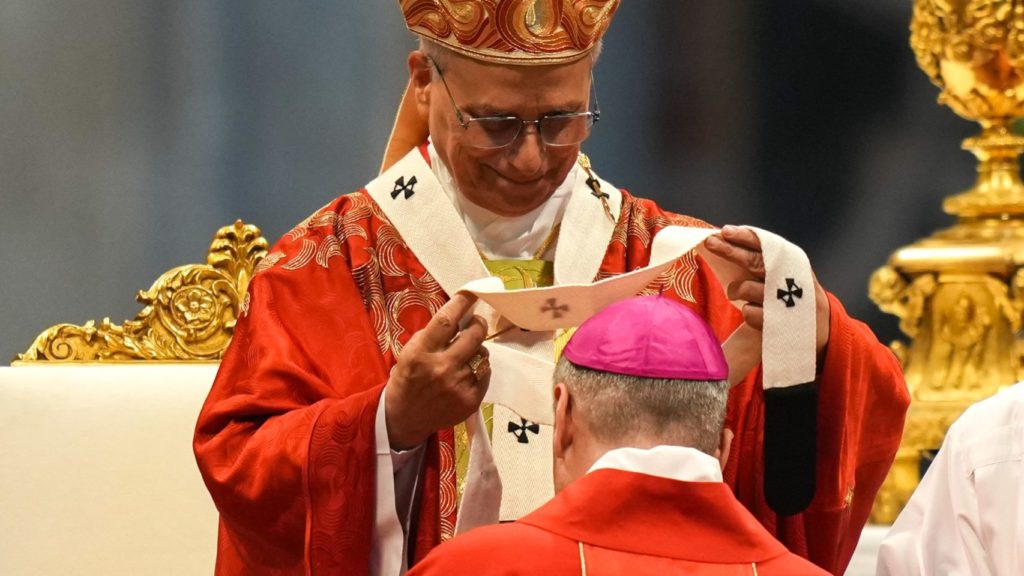
The feast day celebration in St. Peter's Basilica included the traditional blessing of the pallium, the woolen band adorned with crosses that the heads of archdioceses wear around their shoulders over their Mass vestments and symbolizes an archbishop's unity with the pope and his authority and responsibility to care for the flock the pope entrusted to him.
The pallium, Pope Leo said, expresses "the commitment of every shepherd -- and also of every Christian -- to take upon their shoulders the brothers and sisters entrusted to them, like so many lambs of the Lord's flock, and to sacrifice their energy, time, effort and even their lives for them. They do so in order that the Gospel may reach everyone, and the whole world may find in it harmony and concord."
According to the Vatican, 35 archbishops from 19 countries who were named over the past 12 months received the palliums. Four of them were from the United States: Archbishop Mark S. Rivituso of Mobile, Alabama; Archbishop Ronald A. Hicks of New York; Archbishop James R. Golka of Denver; and Archbishop James F. Checchio of New Orleans.
The pope blessed the palliums after his homily and after they were brought up from the crypt above the tomb of St. Peter. Each archbishop, wearing red vestments, then approached Pope Leo by the altar and knelt as the pope placed the pallium over their shoulders. Each shared an embrace with the pope and a few words.
In his homily, the pope reflected on Sts. Peter and Paul -- two very different saints who were martyred on different days and yet share the same feast day.
Pope Leo called them "two pillars of the Church," who provide important examples for today's bishops and all Christians.
St. Peter knew how to "acknowledge his mistakes and repent, without becoming discouraged and without failing in his mission to proclaim the Gospel and gather Christ's flock, even unto martyrdom," the pope said.
When a controversial issue threatened to divide the community, he said, St. Peter listened to his brothers and made a decision, guided by the Holy Spirit, that preserved communion and ushered in a new era for the entire People of God.
St. Peter holding the keys represents his "faithful and patient concern for unity," he said, because a key doesn't break down a door, rather it "opens and closes them by finding the proper levers within and guiding their movements, so that locks may release, bolts withdraw, and doors turn freely on their hinges, thereby joining rooms together and transforming many isolated spaces into one welcoming home."
"In this light, we can interpret the mission entrusted by the Lord to Peter and his successors for the benefit of the entire holy People of God. It is a mission to listen, with his help, to the voice of each person; to discern inspirations; to guide the way; to correct errors; to instruct, encourage, exhort and accompany our brothers and sisters so that, docile to the action of the same Spirit, they may cooperate in the salvation of one another and of all humanity," he said.
St. Peter's example, therefore, "is an invitation to every Christian to become a builder of unity, placing God at the center of one’s life and drawing close to one’s brothers and sisters, attentive to their circumstances and needs," he said, so that God's message "might be fully proclaimed."
St. Paul, whose symbols are the book and the sword, is the "tireless herald of the Good News," he said.
The symbols represent the word of God being capable of penetrating and transforming even the hardest of hearts, as was seen with St. Paul's conversion, who was led away from violence and onto "the path of love," he said.
St. Augustine said, "God took the persecutor of the Church and made him a messenger of peace. He forgave him all his sins and placed him in a ministry where he could forgive the sins of others," Pope Leo added.
"Let us pray to Sts. Peter and Paul that they may sustain us on our journey of communion in the footsteps of the Savior," he said.
Keeping with a long tradition, a delegation from the Ecumenical Patriarchate of Constantinople, led by Orthodox Metropolitan Emmanuel Adamakis of Chalcedon, was present at the Mass.
The pope and the Orthodox metropolitan embraced behind the altar during the exchange of the sign of peace, and they descended the stairs below the main altar to pray at St. Peter's tomb after Mass ended.
Before processing out of the basilica, the pope also stood a few moments in prayer before the dark bronze statue of St. Peter, which is clothed on his feast day with ornate vestments and a jeweled tiara.
Sts. Peter and Paul understood and proclaimed the Gospel with their own distinctive voice, Pope Leo said before praying the Angelus with those gathered in St. Peter's Square.
Their stark differences do not make them adversaries, he said, on the contrary, "they became the symbol of the many other diversities that the one Spirit unites into a single whole."
"The patron saints of the Church of Rome experienced the challenges of communion; they knew it, served it, and proclaimed it as a sacrament of divine life," the pope said. "Their witness has contributed decisively to ensuring that the Christian presence in history is directed not toward dominion, but toward service, unity and reconciliation."