Anyone who has ever watched a postmortem on a crime show like “The Closer” or “Scarpetta” knows they are pretty grisly affairs.
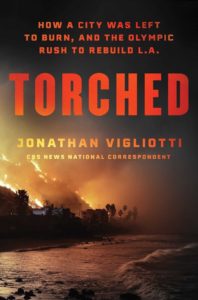
Jonathan Vigliotti’s new book, called “Torched” (Simon & Schuster, $30), is pretty grisly too. It is a postmortem of the January 2025 Palisades Fire, a dissection of all that went wrong in the disaster that saw nearly 7,000 structures destroyed.
A CBS News correspondent who lives in Los Angeles and was on the scene from the fire’s beginning, Vigliotti provides in “Torched” an almost hour-by-hour accounting of the inferno’s progress, devouring first hillsides, then whole neighborhoods. His account is not dispassionate. It is an angry book, fueled by the reporter’s outrage at an absentee mayor, a sclerotic city leadership, and an overwhelmed and under-resourced fire department. A lack of basic vigilance, ignoring multiple warnings of drought-dry vegetation and impending hurricane-force Santa Ana winds, resulted in the kind of fire we now routinely say was “once in a century.”
Except, it really wasn’t “once in a century;” It was once in seven years. Part of the devastating case Vigliotti builds is that there was a precedent in the nearby community of Malibu. In 2018, it was the Woolsey Fire. There were the same warnings from the National Weather Service of high winds and increased fire danger. Many of the shortages and the communications issues that confounded the firefight in the Palisades were evident in the Woolsey Fire, which burned 1,600 structures, forced the evacuation of 250,000 people, and caused $6 billion in damage. Hydrants failed. Water pressure collapsed. With no escape plans prepared, fleeing residents clogged the roads, making it hard for fire engines to move. It was the prequel to the Palisades debacle.
And as was to be true in the Palisades Fire, promises of help came with the stifling bureaucracy and red tape of FEMA, the EPA, the insurance companies, and Army Corps of Engineers. Only 40% of homeowners have returned to rebuild after Woolsey. It was, in essence, a dry run for the even worse disaster to follow. And if there is anything more frustrating than the disaster itself, it is the failure of human beings in leadership positions to learn the obvious lessons.
Los Angeles did a postmortem after Woolsey, documenting the cascade of failures in a 203-page report. But as Vigliotti notes, the report “stopped short of assigning blame. No commanders were named. No agency was held responsible. The language, clinical and passive, described mistakes without attribution.”
The effectiveness of that report’s 150 recommendations can be gauged by the chaos of the Palisades Fire. Politicians moved on to other crises and opportunities (the Olympics!), ignoring the fact that much of Los Angeles borders the dry hills and canyons of the Santa Monica Mountains. This terrain is our “house of dynamite,” and on January 7, 2025, it exploded again.
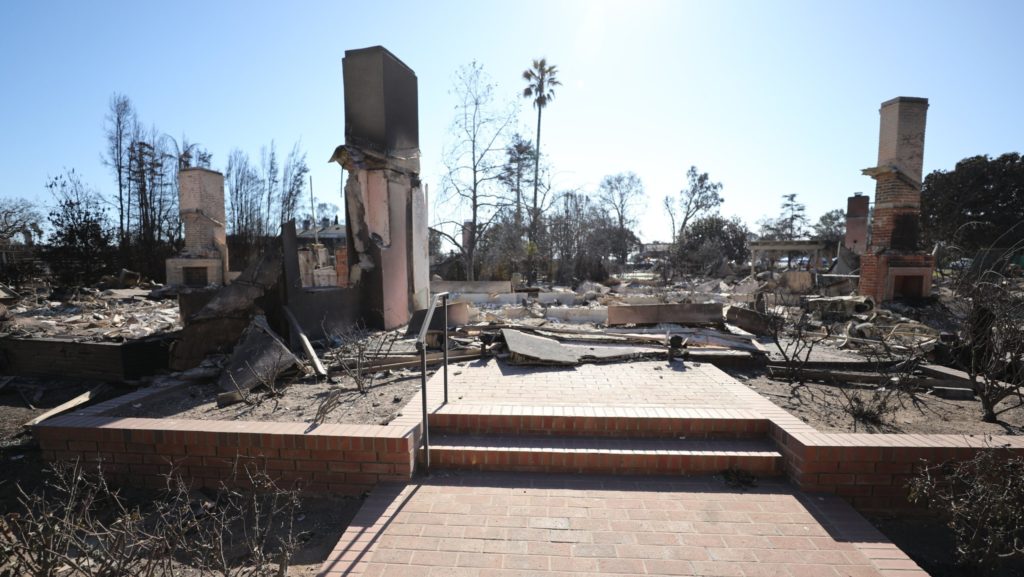
As Angelus readers may recall, my wife’s family home burned in the first 24 hours of the Palisades Fire. I spent that evening thousands of miles away, watching every news report, including Vigliotti’s, and scanning websites for information on which canyons were being consumed. I did not know then what Vigliotti reports regarding absent fire crews, chaotic communications, and inaccessible roads. After the fires were in retreat, I contacted a press photographer who was able to send us photos of the family property. Nothing but a chimney was left. Everything was lost.
Vigliotti’s account of the confusion, the failures, and the ineptness of the city’s response is infuriating because it was predictable. Very wealthy people like Kim Kardashian in the Woolsey Fire or Rick Caruso in the Palisades Fire were able to hire private firefighting teams who preserved their property from damage. But everyone who relied on the City of Los Angeles was left to watch their property burn.
“Torched” will not be the last book written on this disaster, but it is a necessary first. Vigliotti does not report on the Eaton Fire in the Altadena area, which burned at the same time and destroyed even more structures. Nor does he closely examine the scandal of the insurance companies that priced many residents out of fire insurance coverage with huge increases in the years before the fire, and then fought efforts to collect on policies after. He does report that after the fire, “70 percent of residents faced delays or denials from their insurance providers.”
In an ideal world, citizens will demand accountability and changes in advance of the next fire. For it is certain that there will be a next fire. That there is so much blame to go around, however, makes it more likely that no one — particularly the political and bureaucratic leadership — will be held to account.
There are Olympics to prepare for, after all, and a host of other issues demanding political attention. And who wants to spend money on preparing for an unknown next disaster?
Fire-prone communities deserve better. Postmortems may be grizzly, but they have value, if we choose not to avert our eyes.