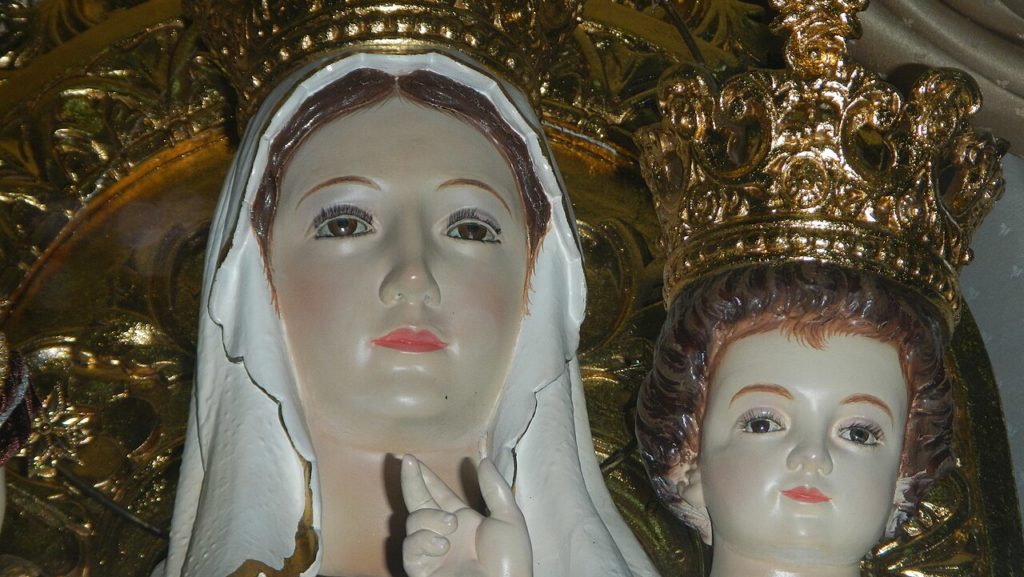
Every year on July 16, the Church celebrates the feast of Our Lady of Mount Carmel, one of the oldest and most beloved titles of the Blessed Virgin Mary. To understand the feast, though, we must begin not with Mary, but with a mountain.
Mount Carmel rises above the Mediterranean coast of the Holy Land. In the Bible, it was a place of decisive encounters with God.
It was on Mount Carmel that the prophet Elijah confronted the prophets of Baal. King Ahab and Queen Jezebel had led Israel into idolatry, and the people were wavering between fidelity and apostasy. Elijah challenged the false prophets to call down fire from heaven upon their sacrifice. They cried out all day, but nothing happened. Then Elijah prayed to the Lord, and fire fell from heaven, consuming the offering. The people fell on their faces and cried: “The Lord, he is God; the Lord, he is God” (1 Kings 18:39).
Carmel thus became a symbol of victory over false worship and fidelity to the one true God.
The mountain appears again in the story of Elijah’s successor, Elisha. A wealthy woman from Shunem had shown hospitality to the prophet and was rewarded with the gift of a son. When the child later died unexpectedly, the grieving mother hurried to Mount Carmel to seek Elisha’s help. The prophet returned with her and restored the boy to life (2 Kings 4:8–37).
Here, Carmel became associated not only with true worship but also with God’s power to bring life out of death.
The biblical story contains yet another image that Christians would later cherish. After Elijah’s victory over the prophets of Baal, he prayed for rain to end a devastating drought. His servant finally reported seeing “a little cloud like a man’s hand rising out of the sea” (1 Kings 18:44). Soon the heavens opened and life-giving rain fell upon the land.
Christian tradition often saw in that little cloud a figure of the Blessed Virgin Mary. Small and humble in the eyes of the world, she bore within her the Savior whose grace would renew the earth.
Centuries later, hermits living on Mount Carmel dedicated themselves to prayer in imitation of Elijah. They placed themselves under the protection of the Blessed Virgin and eventually became known as Carmelites. According to Carmelite tradition, in 1251 Mary appeared to St. Simon Stock and presented him with the brown scapular, assuring him of her special maternal care for those who wore it with faith and devotion.
Thus, the feast of Our Lady of Mount Carmel gathers together many threads of salvation history. On Carmel, God revealed his power over idols. On Carmel, he restored life to the dead. On Carmel appeared the cloud that promised renewed blessing. And under the title of Our Lady of Mount Carmel, Christians honor the woman through whom God sent his Son into the world, bringing the victory of truth over error and the triumph of life over death.