On paper, Nate Bargatze is bigger than U.S. Steel.
The highest-grossing stand-up comedian of 2025, he earned roughly $70 million on 1.2 million tickets sold, which makes him a bigger draw than U2, Coldplay, or indeed the cumulative efforts of the Jacksonville Jaguars. He’s so rich that he’s breaking ground on his own amusement park this year.
Bargatze reached this stratosphere thanks to a revolutionary mathematical discovery: families buy tickets, too. While cursing and more vulgar topics might earn you a loyal audience of comedy purists and depressive movie critics, Nate keeps his comedy clean and thus expands his audience fivefold. Yet his primary constituency remains below the Mason-Dixon line; despite hosting “Saturday Night Live” twice and the Emmys once, Nate might be the most famous person in America where a good 60% of the commonwealth doesn’t know his name.
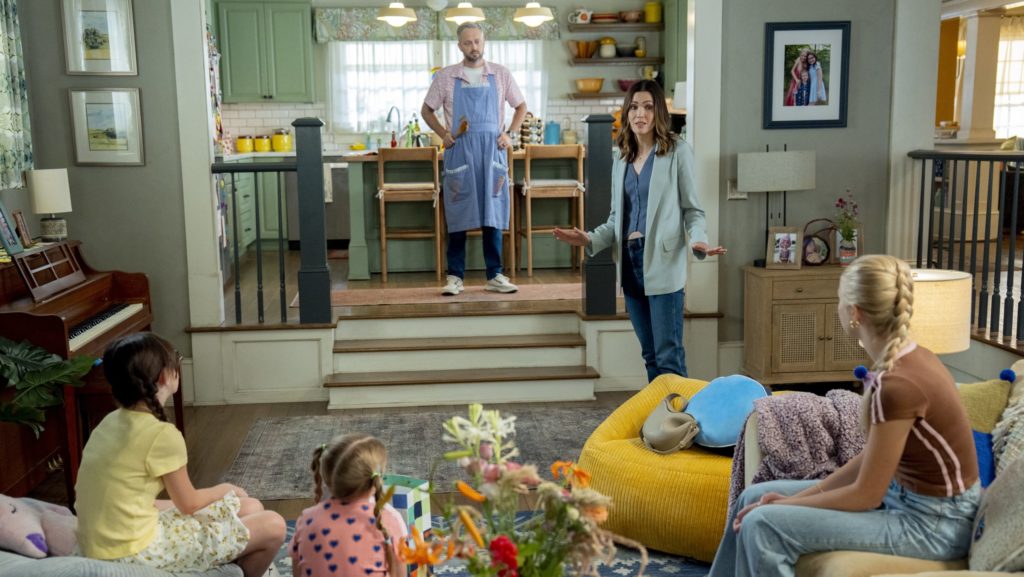
He’s hoping to change that with his debut starring feature film, “The Breadwinner,” in theaters since May 29. Nate plays a man named Nate (keeping things simple for the slower among us), a top salesman at a car dealership and the main provider for his wife (Mandy Moore) and three daughters.
He defers all domestic duties to his stay-at-home wife, bringing home the proverbial bacon so that she can proverbially cook it. The natural order of things is upended when a product she’s developed on the side is picked up on “Shark Tank,” sending her to South Korea for two weeks and him back home to watch the kids. And wouldn’t you know it, hijinks ensue.
Nate, it seems, has no clue on how to run a household, or even the name of his kids’ school. Under his stewardship, dinner is Doordashed and laundry piles up (and is eventually spritzed with perfume as a makeshift compromise). This would all be easier if he had three boys, but with three girls comes interiority and a mess of drama that whole embassies would have trouble settling. Nate learns over repeated sleepovers that a girl slumber party is not a cozy time in, but rather a grenade with no pin that you must somehow defuse.
If you feel profound déjà vu at this recap, then you’ve probably seen 1983’s “Mr. Mom,” or ever watched a sitcom where the husband and wife are almost separate species in attractiveness. “Dad has to play mom” is one of the ur-myths of the western canon, like the flood tales or inviting two girls to the same prom, repeated ad nauseam and in eternal recurrence. I wouldn’t be shocked if there’s a gnostic gospel out there somewhere with Mary in the carpenter shop and Joseph flailing about trying to intercede for souls, with “I’m Walking on Sunshine” playing over the montage.
“The Breadwinner” is that oddest of films: a failure that achieves everything it wants. It’s broadly humorous, and with cynical sentimentality deployed to warm the cockles of those among us who still possess hearts. It is a film so scared of offending that its cowardice infects even the cinematography, shot in that affable grainless digital sheen, sunny and suffocating.
It reminds me of nothing more than a Hallmark movie; if they simply killed the wife to make him an eligible widower and added a Christmas tree farm, it would air today. “The Breadwinner” aims to please everybody, but there’s nothing less endearing than someone or something that begs your affection. Despite its deliberate lack of offense, it managed to offend me on two levels: as a man and as a fan of Bargatze’s comedy.
The old trope of the man hapless at domesticity particularly irks me as a man who is quite bad at it, but not because of my Y chromosome. In college, when I slept in a sleeping bag for six months to avoid washing sheets, or when I called my dad asking for the instructions on how to boil water, these were personal failings that shouldn’t be extrapolated to my whole sex. I could call my father for tips because he himself was a single father of four children who had to master home economics on the fly, and ultimately with aplomb. Whatever the many demerits of Man, I do hold him in high enough esteem to separate the colors and whites in the wash.
I also feel the betrayal of the jilted, as someone who has been a proponent of Bargatze’s comedy for some time. Whenever I’m back home visiting my dad, he will, when not reminding me how to boil the water, play me Nate’s ‘SNL’ skit about George Washington inventing units of measurement. He’s shown me this probably a dozen times now, and I never remind him because it’s just that good.
His true novelty as a comedian wasn’t that he was clean — there are hundreds of clean comedians, most of them about as entertaining as a biopsy. No, Nate’s strength lay in being so funny you forgot he was clean. My personal favorite of his routines is about the speculated logistics in disposing of a dead horse. It feels like you’re getting away with something, yet when you read back the transcript, there’s nothing to convict.
Nate was always a funny comic who happened to be clean; “The Breadwinner” shows that Nate feels he’s a clean comic who happens to be funny, a fatal syllogism. You feel him pulling punches that never would have connected anyway, reforging himself into what he imagines Middle America wants of him. I still think there’s a future in film for him yet; we can only hope the likes of “The Breadwinner” is a misstep rather than a destination.