I will be the first to admit that history is not my strong suit.
“In fourteen hundred and ninety-two, Columbus sailed the ocean blue,” is the one date I remember from grade school.
Then there’s the Norman Conquest of 1066 — that was from high school French — except now I’m not quite sure what the Norman Conquest is, or was.
I’d be hard put to place major events like the War of the Roses, the Sack of Rome, and the Dissolution of the Ottoman Empire in chronological order. Towering figures like Oliver Cromwell, Alexander the Great, and Anne Boleyn I know only by the barest outline. The Siege of Carthage? Ummm. Hadrian’s Wall? Sorry.
It’s not that I’ve never tried. I’ve read wonderful books, for example, about Custer’s Last Stand (Evan S. Connell’s “Son of the Morning Star” [1984]), the Vietnam War (Frances FitzGerald’s “Fire in the Lake” [1972]), and the murder of Tsar Nicholas II and his family (“The Last Days of the Romanovs: Tragedy at Ekaterinburg” by Helen Rappaport [2010]).
The problem, I’ve always thought, is that I have no overarching framework in which to place these events.
Recently, however, I came across a wildly popular podcast called “The Rest is History.” And now, finally, everything’s coming together!
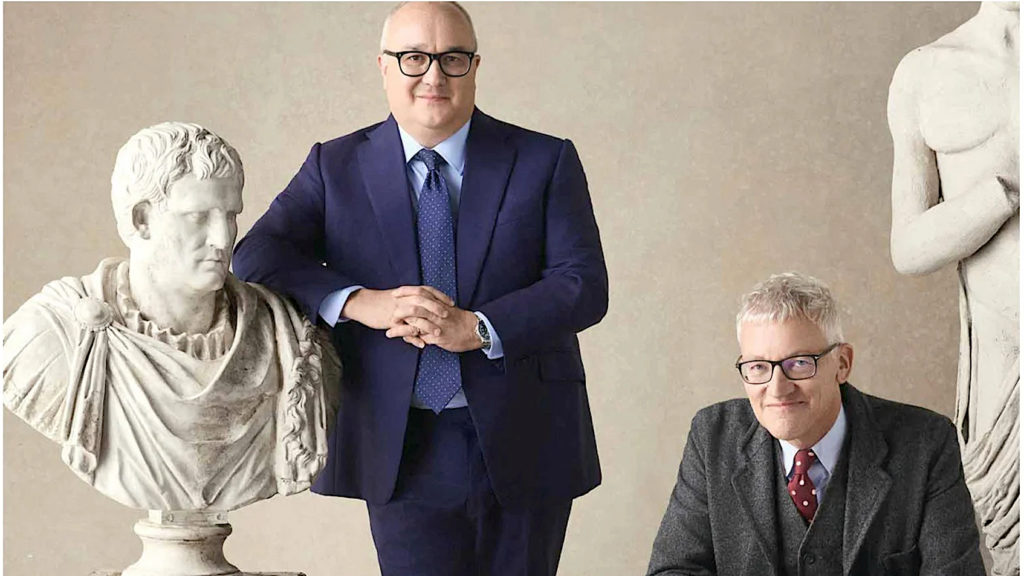
The hosts are English (I now know the difference between English and British, because they did a podcast on it): Dominic Sandbrook and Tom Holland.
Tom is skinny, impulsive, enthusiastic, a terrible interrupter and talker-over, wholly lovable, and a scholar of classical antiquity and ancient Rome whose best-known book seems to be “Dominion: How the Christian Revolution Remade the World” (Basic Books, $19.49).
Dominic is rotund, droll, a confirmed atheist, playfully anti-woke, wholly lovable, and a well-known author, essayist, BBC presenter, and radio personality whose area of expertise is post-war British history (1950s-1980s).
They’re both incredibly smart, articulate, witty, well-educated, and well-read.
When asked the secret of their success by The Daily Telegraph in 2024, Dominic replied: “First and foremost, because I think people are bored with history being told in a hand-wringing, pious, judgmental, and moralistic way — they want it brought to life by people who are genuine enthusiasts and love the past.”
Part of the fun is hearing the English lingo. Crikey. Bonkers. Blimey. All that “carry-on.” “Get rid,” as in, Covet the Aztecs’ silver? Get rid! Queen fails to bear son-heir: Get rid! “Thanks, gents,” a guest might sign off.
Another part of the fun consists of their differing viewpoints. Tom slavers over Lord Byron — Dominic, while acknowledging the poet’s cultural and artistic import, admits to “Byronphobia.”
Tom considers John Lennon to be of high historical interest, complex, part of the “perfect story” of the Beatles. Dominic calls him “a deadbeat father.”
Tom is constantly (very reasonably) introducing Christianity as a cause, or effect: Dominic rolls his eyes. “No one believes in that balderdash anymore — do they?” he asks.
“This might be …what do they say, problematic?” Tom observes as they wade into a piece on the male-dominated, macho Wild West. “Problematic? Please!” Dominic shudders. “Tom, you’re triggering me!”
They poke fun at each other, but they move on right away: no mindless, time-sucking, one-upmanship or faux humor. No political or ideological agenda. They did a whole piece on Brexit, before the vote, never saying which side they were on.
They recount the most horrific deeds of “empire,” including the British Empire, with very little editorializing. They’re here to tell history, not to scold, virtue-signal, or enforce groupthink. I listened to five or six episodes on the French Revolution, which I personally consider a horrific event, but which they never wholly condemned nor even slightly celebrated.
They did another episode, wondering in fact whether an empire can ever actually be a good thing. Empire on one side; barbarism on the other — makes a person wonder.
Another fascinating series was on Belgian King Leopold’s late 19th-century grab of the Congo, which he pretty much made his personal property and fiefdom, using savagely enforced local slave labor to harvest ivory and rubber.
In one episode, they explored the question, “What are the lessons of history?” and basically concluded that there are none. I couldn’t agree more. From a salvation history viewpoint (which obviously is emphatically not their viewpoint), it’s fascinating to hear over and over again of war, pillage, plunder, rape, slavery, betrayals, and power-grabs.
History is, in one way, what happens after The Fall. We seem destined, or doomed, not to learn from our mistakes, but rather to make the same ones over and over again.
Briefly, I thought perhaps I’d come up with some novel theory, then learned that Nietzsche had beaten me to it with his philosophical concept of “eternal recurrence”: the idea that time repeats itself in an infinite loop, and that exactly the same events will continue to occur in exactly the same way, over and over again, for eternity.
Except! The idea of eternal recurrence need not be true with respect to the individual soul, as opposed to the soul of a nation, or ideology, or empire.
That’s attributable to the one event — the Incarnation — that happened only once and can never happen again.
As history attests, the prince of darkness rules the world — for now. What a “pivotal event” it will be when the world learns that he has no power over Christ (John 14: 27–31).