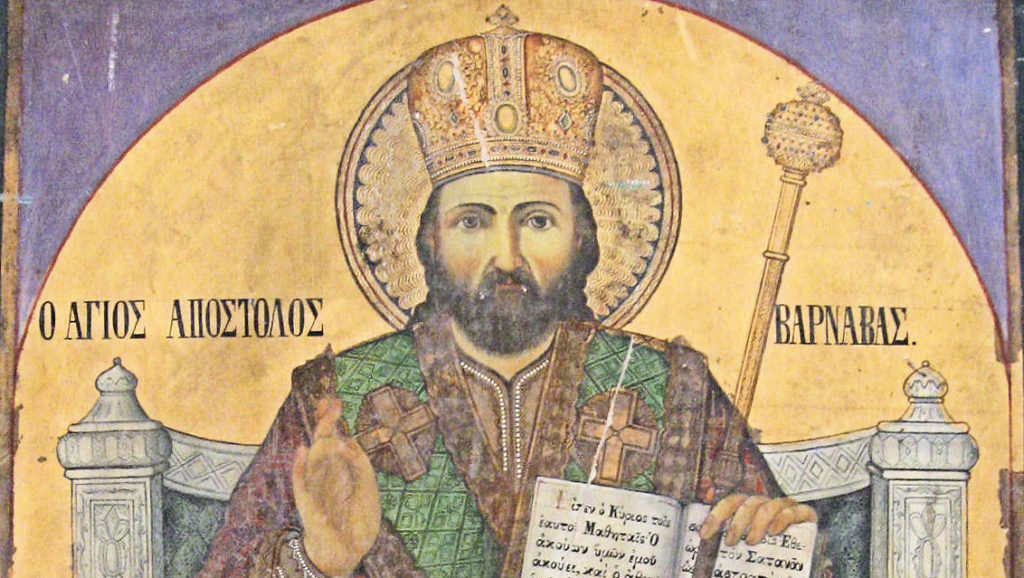
On June 11, the Church celebrates a saint who rarely stands at center stage, but without whom the story would be very different: St. Barnabas. Scripture remembers him simply as “a good man, full of the Holy Spirit and of faith” (Acts 11:24).
Barnabas was a Levite from Cyprus — a man of means and, above all, a man of generosity. When the early Christian community in Jerusalem was in need, he sold a piece of land and laid the proceeds at the feet of the apostles (Acts 4:36–37). They gave him a new name: Barnabas, “son of encouragement.” It was not a casual nickname. It recognized a gift — the ability to strengthen others and bring out what was best in them.
That gift appears most clearly in his relationship with St. Paul the apostle. When Paul first came to Jerusalem after his conversion, Christians were afraid of him. This was the former persecutor. His change seemed too sudden to trust.
Barnabas stepped forward.
He took Paul to the apostles, told his story, and vouched for him (Acts 9:27). Without Barnabas, humanly speaking, Paul might have remained on the margins. Instead, he was received — and the Church gained its greatest missionary.
Barnabas’s instinct for encouragement shaped the next chapter as well. When a new Christian community flourished in Antioch, the Church sent Barnabas to investigate. He rejoiced at what he found — and then he went to fetch Paul. Together they taught the growing Church and later carried relief to Jerusalem during a time of famine (Acts 11:25–30).
Then they went out together on mission. Barnabas and Paul preached, endured opposition, and helped establish the Church among the Gentiles. At a decisive moment, when controversy arose over whether Gentile converts must be circumcised, they stood together. The apostles in Jerusalem, led by Peter, confirmed their position (Acts 15).
Barnabas was not only an encourager. He was a builder of the Church.
Yet the most revealing moment in his life may come at the end of his story. Preparing for another journey, Barnabas and Paul disagreed about John Mark, who had previously left their mission. Paul refused to take him again. Barnabas insisted.
And so they parted ways (Acts 15:37–39).
It is easy to see only the conflict. But notice what Barnabas did: he gave Mark another chance. The same man who had once taken a risk on Paul now took a risk on Mark. He believed in growth, in redemption, in second beginnings.
He was right. Years later, Paul would speak warmly of Mark as “very useful” in his ministry (2 Timothy 4:11). The encouragement of Barnabas bore fruit again.
Barnabas reminds us that encouragement is not a small thing. It is a work of the Holy Spirit.
And it may be that the most important thing we do is help form a Paul — or restore a Mark — and so build up the Church in ways we may never see.