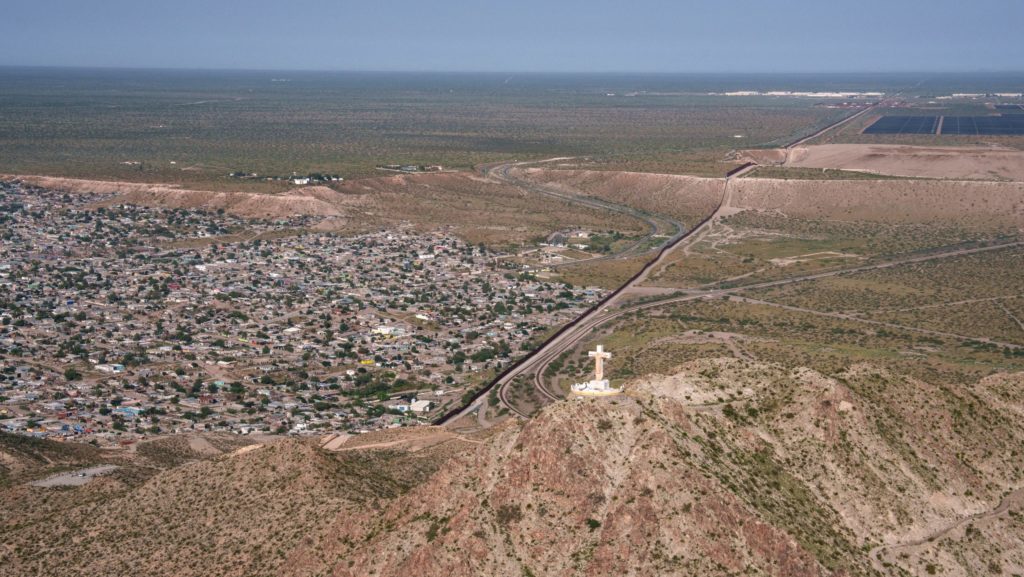
A New Mexico diocese is citing a breach of religious freedom protections, as it pushes back against the Trump administration's efforts to seize land from a pilgrimage site to build a portion of a border wall.
The Diocese of Las Cruces filed a May 8 response to a federal government lawsuit claiming eminent domain -- or government power to seize private property for public use, with "just compensation" as required by the Fifth Amendment -- over some 14 acres that include Mount Cristo Rey in Sunland Park, New Mexico.
The 4,675 foot peak, capped by a 29-foot limestone statue of Jesus Christ, has been a place of prayer for close to a century.
Each year, thousands trek up the rugged path to the image, which depicts a robed Christ with arms stretched out against the cross, overlooking the El Paso, Texas, and southern New Mexico landscapes.
According to court documents, the Department of Justice has sought for months to access the mountain, which sits on land owned by the diocese, to construct a portion of a border wall. The move is part of the Trump administration's sweeping crackdown on unauthorized immigration.
On May 7, the federal government filed suit in the U.S. District Court for the District of New Mexico against the diocese and the treasurer of Doña Ana County, New Mexico, to take possession of the land.
In exchange, the legally required just compensation, determined by the fair market value of the property, would be $183,071, according to the government's filing.
A spokesperson for U.S. Customs and Border Protection told OSV News in a May 12 email the agency "is working across the Southwest border to acquire land necessary for the construction of Smart Wall, to include a steel bollard wall, along with roads, detection technology, cameras, and lighting."
"It is always CBP’s preference to obtain real estate interests voluntarily," said the CBP spokesperson. "However, if CBP is unable to acquire the necessary access voluntarily within a reasonable timeframe, CBP refers the matter to the Department of Justice to acquire any necessary property interest(s) through eminent domain."
But the federal government's attempted seizure "will substantially burden the free exercise of religion by the Diocese, its parishioners, and the other faithful who seek to commune with God on Diocesan property," said the May 8 response filed by the Diocese of Las Cruces. The diocese is represented by the law firm Mann Morrow and the Institute for Constitutional Advocacy and Protection at Georgetown Law.
The diocese said it planned to invoke both the First Amendment's free exercise clause and the Religious Freedom Restoration Act, the latter of which expands protections for religious exercise beyond those covered under the former.
RFRA prohibits the government from placing a substantial burden on a person's exercise of religion without compelling government interest, and even in those circumstances, requires that they do so by the least restrictive means.
In its filing, the diocese said that the RFRA "modifies the reach" of the Declaration of Taking Act, which streamlines the eminent domain process by allowing the government to obtain the property title after filing a declaration and depositing the estimated just compensation with the court.
The diocese is asking the court to deny the federal government's declaration and deposit until the RFRA and free exercise concerns have been argued.
The filing pointed to the diocese's earlier response when CBP first announced plans in June 2025 to erect a 1.3-mile wall section along the southern side of Mount Cristo Rey.
In public comments at that time, the diocese said the construction of the wall "through or along this holy site could irreparably damage its religious and cultural sanctity, obstruct pilgrimage routes, and transfer sacred space into a symbol of division." It would also constitute "significant infringement on religious freedom and the rights of worship" under the First Amendment and RFRA.
In the diocese's May 8 filing, general counsel Kathryn Brack Morrow said that the diocese had "received multiple inquiries and requests" for the "past several months" from the U.S. Department of Justice "seeking access to Mount Cristo Rey," with the diocese consistently expressing its opposition.
Morrow noted that during the diocese's communications with the agency, "the scope of the right of entry requested by DOJ varied significantly."
She also said the project's impact, as proposed during the June 2025 public comment period, "is not clear -- and does not appear to be consistent with the requests previously made to the Diocese."
The site is regarded by the faithful who visit it as "not just as a monument, but also as a place of prayer where faith transcends borders," she added.
Ruben Escandon, public relations officer for the volunteer Mount Cristo Rey Restoration group and a third-generation caretaker of the site, told OSV News the sacred location represents "a family heirloom," with his parents, grandparents and extended family moving rocks and taking dirt to develop the site.
"I'm 60 years old, and I've probably been up there for 50 years of it," said Escandon, whose organization works under the guidance of the Diocese of Las Cruces.
A traditional pilgrimage held on the last Sunday in October typically drew anywhere from 18,000 to 20,000 people, said Escandon.
"We've had people climb up on their knees. You see them climb up barefooted," he said.
Escandon said pilgrims "go up there to pay their 'mandas'" -- that is, "to pay their due" when favors they have asked for in prayer are granted.
The Mount Cristo Rey website notes that "as many as 40,000 faithful" have attended anniversary celebrations marking the completion of the monument.
In recent years, the October pilgrimage was moved to coincide with the feast of Christ the King, which has led to some reduction in turnout, likely due to the colder weather, Escandon said. But he noted 12,000 to 14,000 were on hand for this year's Good Friday pilgrimage.
In addition, Escandon said, "other people do smaller pilgrimages. Churches will get together and take groups of 50, (or even) 100 people up there."
"Standing there in front of the statue ... it kind of humbles you to sit there and to take in not only the view, but the monument itself and the significance," he said.
The site was initially envisioned in 1933 by Father Lourdes Costa, when the area was still part of the Diocese of El Paso.
Having contemplated the mountain from his residence, Father Costa dreamed of placing a cross atop the elevation and making it an accessible place for prayer. The bishop of El Paso approved the plan, with the diocese purchasing close to 200 acres of the surrounding land.
Volunteers -- including women and children -- labored to build the 2 1/2 mile road to the summit, which was marked by first a wooden and then an iron cross before Father Costa tapped renowned sculptor Urbici Soler to design and fashion the current statue. It was completed by 1939.
The monument was encircled with a crown for its 50th anniversary in 1989, seven years after St. John Paul II had established the Diocese of Las Cruces from the western parts of the El Paso Diocese.
Escandon highlighted Mount Cristo Rey's artistic significance, as well as its religious value.
Conservationists have expressed alarm over the federal plans to seize the mountain, with the wall construction likely to endanger several species while straining water resources in its construction.
Migrant advocates have also warned the border wall stands to result in more casualties as individuals seeking to cross into the U.S. may attempt to scale the structure, risking serious injuries.
Asked by OSV News what he would do if the federal government's seizure of Mount Cristo Rey were successful, Escandon -- who did not speak to any of the legal aspects of the case -- said, "Let's just hope it doesn't happen."