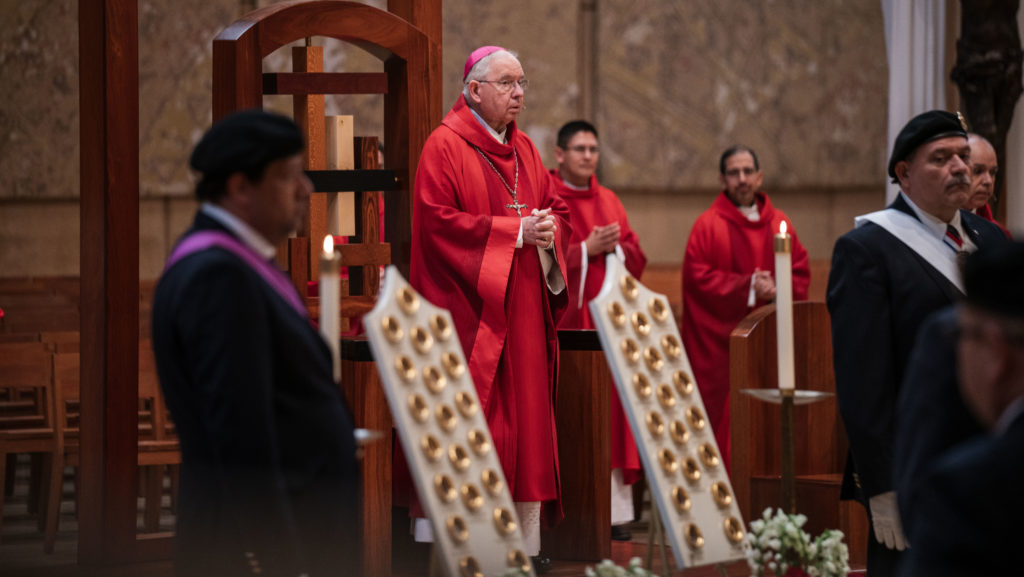
For some of the people in the pews at the Cathedral of Our Lady of the Angels on April 18, the visit of 36 relics belonging to martyrs from Mexico’s Cristero War was about more than history.
“My great-grandpa was there during the Cristiada [war],” said Kathleen Orosco from St. Mary of the Assumption Church in Whittier.
Orosco’s grandfather, then a child, was carried on horseback as federal soldiers hunted Cristero fighters as a wave of extreme anti-clericalism swept through Mexico.
At one point, she said, his great-grandfather set the boy [her grandpa] down by a river to ride ahead and warn others of approaching troops, helping them escape.
The family has since visited their hometown of Colotlán, Jalisco, where reminders of the conflict remain. Orosco recalled seeing bullet marks and sites where martyrs were executed.
“It makes me emotional, knowing people gave their lives for Christ,” she said.
Orosco and her family were among the hundreds who turned out for a one-day congress marking 100 years since the beginning of the Cristero War (1926-1929), in which thousands of Catholics — many priests among them — were executed during a popular uprising against anti-clerical laws in Mexico at the time.
The Saturday event featured talks by expert historians on the war, a Mass celebrated by Archbishop José H. Gomez, and an afternoon panel discussion with questions from participants.
For some, the day was a unique opportunity to help their children see Catholicism from another angle.
Maria, originally from Guadalajara, said she grew up hearing stories of the Cristeros from her grandmother.
“They were simple ranchers who didn’t have much education, but they had strong faith — and they died for it,” she said. “I’ve always found that very beautiful.”
Now attending St. Basil Church in Koreatown, she said she hopes to pass that faith on to her two sons, who were there with her on Saturday.
“Even if they’re not always eager, I want them to keep learning about our faith, because I didn’t grow up knowing much about mine,” she said.
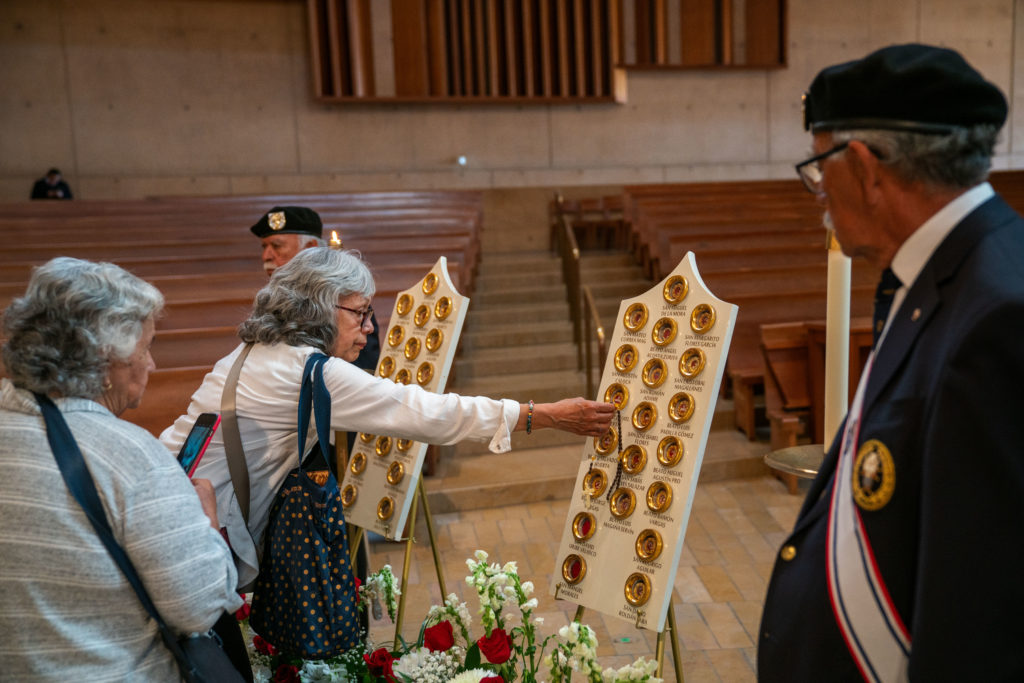
The martyrs, she added, encourage Catholics to have the courage to live that faith openly.
“It’s about not being afraid to say, ‘This is my religion, and to defend it,’ ” she said. “It’s what has carried us through every stage of life. If God hasn’t abandoned me, then I shouldn’t stay silent when it’s time to speak up.”
Perhaps the person at the cathedral with the deepest connection to the martyrs was local Catholic Jorge Cardenas Magallanes.
“[St.] Cristóbal Magallanes was my great-great-uncle, though I didn’t learn that until I was older and became more involved in my faith,” he said. “After doing some research, I realized I’m his great-great-grandnephew.”
His ancestor, he noted, stood apart from many others during the conflict.
“He was one of the few who didn’t want to take up arms,” Cardenas said. “He believed the Church didn’t grow through violence, and he urged people to find a way to live in peace.”
Rather than supporting armed resistance, he said, Magallanes encouraged dialogue and reconciliation. At the end of his life, Cardenas added, the Jesuit priest was fleeing government forces who were pursuing him and was killed.
Cardenas said the legacy of his ancestor shapes how he lives today.
“I’m not fighting a war against the government,” he said, “but I am fighting to keep the morals and values of my family as the head of my household.”
Cardenas said homeschooling his kids has been one way his family lives out those values, allowing him to teach his kids why we believe what we believe — by going back to history and learning the facts.”
During their talks, both visiting historians spoke of the many hidden acts of bravery by Mexican Catholics during the war — and the long path toward popular awareness of the Cristero War.
Jean Meyer, M.Sc., an 84-year-old French-Mexican historian considered one of the world’s top experts on the Cristero War period, recalled that a tacit agreement between the Church and the Mexican state meant that for decades after the war, few Mexicans knew the truth about the conflict.
“It was about religious peace,” Meyer said. “There was an agreement that ‘we don’t need to talk about it, silence and mouths shut.’ ”
Meyer recalled how as a young researcher in 1965, the archbishop of Mexico City denied his request to access the archdiocese’s archives for research.
“I was scandalized at the time,” said Meyer. “Now I would say: ‘prudence.’ The conflict was too recent, they didn’t want to fan the coals and provoke another conflict.”
“All these years later, it’s easy to criticize bishops, those who took up arms, those who didn’t take up arms,” said Meyer. “But the truth is they lived through a very difficult situation, an enormous tragedy, in which everyone tried to respond as best they could.”
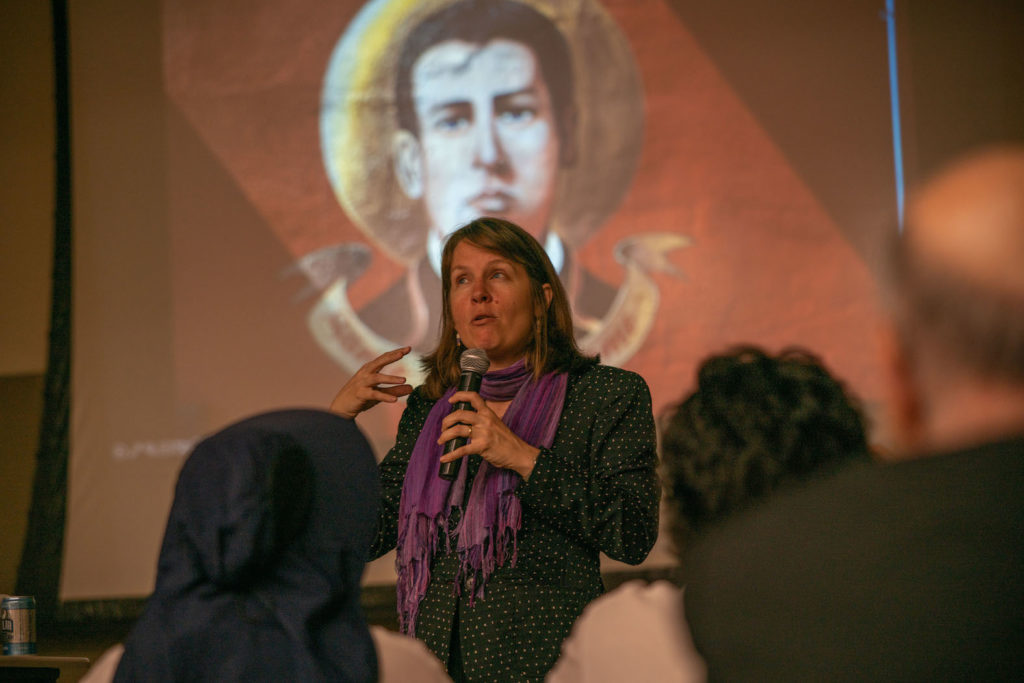
Father Gustavo Castillo, pastor of St. Joseph’s Church in Hawthorne, worked with the Knights of Columbus and fellow Mexican priest Father Miguel Ángel Ruiz to organize the event. He did so in large part because of that gap in historical memory he grew up with.
“It wasn’t something we were taught,” he said. “The government didn’t include it, and many of us didn’t learn about it until the martyrs were beatified in 1992.”
“That’s when the stories from our grandparents and great-grandparents started to come out. That’s how we began to learn more.”
One of the martyrs, St. José María Robles, was the pastor at Castillo’s home parish in Tecolotlán, Jalisco, for seven years before he was martyred. Castillo believes the history of his country’s martyrs is relevant today, especially given ongoing tensions over religious freedom.
“We are having these conflicts right now where they want to silence the Church, where they want to silence the pope from proclaiming the Gospel — to have the freedom that the Church needs to carry out its ministry and its mission,” said Castillo.
But apart from social problems, Orosco said the stories of the martyrs serve a simpler purpose.
“It’s very inspiring and makes us want to serve God and give our lives to him,” she said. “It calls us to be saints and to be more Christ-like.”
Editor-in-chief Pablo Kay also contributed to this story.
Editor’s note:
For the next two weeks, the relics of 36 martyrs from the Cristero War will be visiting several parishes in the Archdiocese of Los Angeles and the Diocese of Orange. Please contact each respective parish for more details.
April 25-26: Our Lady of the Rosary, Paramount
April 27-29: Christ Cathedral, Garden Grove
April 30: St. John the Baptist, Baldwin Park
May 1: St. Vincent de Paul, downtown Los Angeles
May 2-3: St. Joseph, Hawthorne
May 4: St. Matthias, Huntington Park