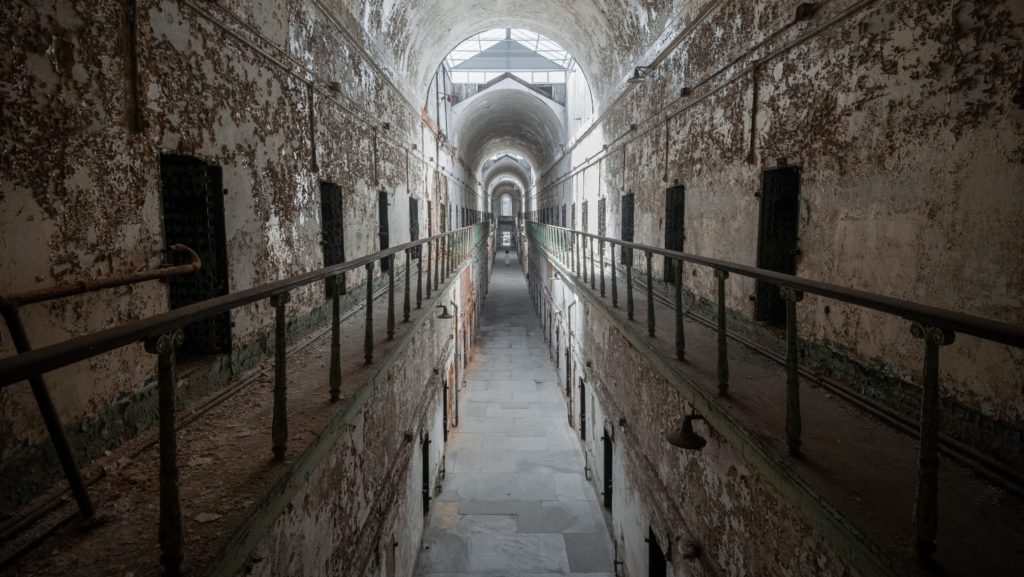
Jane Brox’s “Silence: A Social History of One of the Least Understood Elements of Our Lives” (Mariner Books, $23.96) opens with a description of Philadelphia’s Eastern State Penitentiary.
Established in 1829 as an experiment in rehabilitation, each cell was essentially what we would today term a SHU (Special Housing Unit).
“[D]uring the period of their confinement, no one shall see or hear, or be seen or heard by any other human being,” ran a portion of the prison’s mission statement. The idea was to invite the prisoners to look inward and repent of their crimes, many of which consisted of petty burglaries, drunkenness, or vagrancy.
Inmates at Eastern State were not allowed to communicate with one another, to talk at all, ever, or to make any kind of noise for years on end at the threat of being publicly lashed, thrown into a lightless dungeon, or in one case having a metal bit thrust into his mouth with such force that the prisoner died within the hour.
Brox then juxtaposes punitive silence with the “silence” of monasteries, convents, and cloisters, peopled by those who for the most part have chosen to be there. Interestingly, she refuses to hold that all of the former is bad, and all of the latter good.
Eugenia Ginzburg (1904-1977), a mother, wife, and Communist journalist, for example, was caught up in the Stalinist purges starting in 1934. She spent two years in a tiny prison cell, some in solitary confinement, then 18 more at hard labor in the Siberian gulag.
In her memoir of that time, “Journey into the Whirlwind” (Mariner Books, $10.59), she wrote:
“When a human being is isolated from the ‘rat-race’ of the everyday life, he achieves a kind of spiritual serenity. Sitting in a cell, one no longer has any call to pursue the phantom of worldly success. … One can immerse oneself in the lofty problems of existence, and do so with a mind purified by suffering.”
Then again, many prisoners sentenced to extreme confinement and isolation went insane.
Is it possible that the two kinds of silence, I began to reflect, can overlap, or even “interact?”
In 1913, the Eastern State solitary confinement system collapsed due to overcrowding problems and Eastern State officials abandoned the punitive silence policies.
Just a couple of years later, six blocks south the Convent of Divine Love opened, and the cloistered nuns of an order called the Holy Spirit Adoration Sisters began to devote themselves to lives of silent prayer.
“May the newly-established tabernacle be an inexhaustible source of grace for the city of Philadelphia, the great Archdiocese, and the whole world,” said Mother Mary Michael to Archbishop Edmond Prendergast on July 2, 1915.
Today, the sisters’ chapel is open to the public from 6:30 a.m. to 6 p.m. each day.
On a recent trip to Philadelphia, I visited both the Eastern State Penitentiary Museum and the Divine Love Chapel. Behind the grille, on the altar, sits a golden monstrance containing a consecrated host. For over 100 years, 24/7, at least one sister, dressed in her immaculate pink habit and veil, has been praying before the Body of Christ.
Dorothy Day, co-founder of the lay Catholic Worker movement, began her own single-minded determination to serve Christ by opening a soup kitchen during the Depression on the Bowery.
She once expressed the thought that because God transcends time, a person can pray for the dead as if they were still alive. It’s possible to pray for God to be close to those who are suffering with problems or illnesses or crises they had when they were still alive, she opined, and the prayer somehow helps them with those problems when they were still alive.
It’s interesting that silence was imposed for so long in a prison a mere quarter of a mile away from a community of cloistered nuns who for over a century now have kept a very different kind of silence.
Could it be that the prayer, of the nuns and of the laypeople and others who have been visiting the chapel all these years, has somehow “redeemed” — is still redeeming — the terrible suffering of those who were subjected to the torture of imposed silence? In some other realm, could the silent, ongoing prayer of the faithful somehow be a comfort, a consolation to the inmates?
We can’t know, of course. But in a culture where showy religious conversions now take place on X, where politicians use the name of God to advance their political power-mongering, where virtue-signaling faith “influencers” generate huge revenue, I prefer to think that the real work is done far, far away from the public eye.
On the other hand, let’s not forget that the sisters came just after the solitary confinement practices had ended.
Maybe instead, the suffering undergone by the Eastern State prisoners has been sustaining the Sisters of Divine Love all these years.