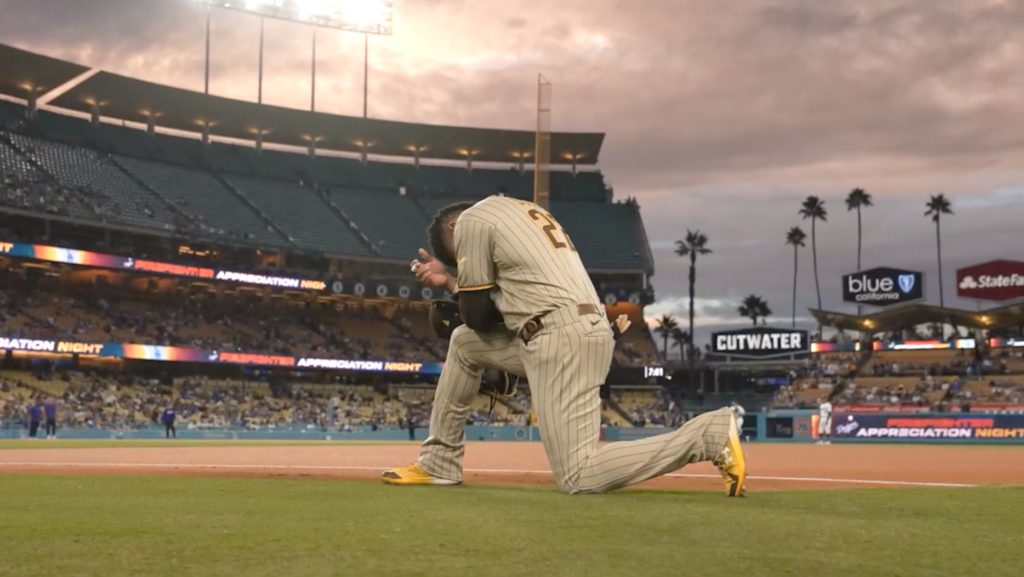
My first realization that Major League Baseball fan rituals can take on a somewhat religious character came in April 2019 at Nationals Park.
Outfielder Bryce Harper, an offensive force and playoff hope for the Washington Nationals for seven seasons, had sought greener pastures and was playing his first game in DC as a member of the Philadelphia Phillies. From his rookie year on, merchandise bearing Harper's name had outsold all others in Washington.
The Harper jerseys and t-shirts were worn one last time that day. Hundreds of them, and in every section of the ballpark. But they were all desecrated. Fans had torn his name off, or nearly off. Out of grief, anger and mourning, like something out of the Book of Job, there had been a mass rending of garments.
The documentary "Baseball: Beyond Belief" (Paulist Pictures), which begins a limited theatrical run on March 27, does not address this particular phenomenon. But it explores many others.
Written and directed by John Scheinfeld, the movie is based on the book "Baseball as a Road to God: Seeing Beyond the Game" primarily authored by John Sexton. A Catholic and former president of New York University, Sexton teaches a class there based on the concepts explored in the film.
Paulist Father Tom Gibbons, the executive producer, previously wrote and directed "Hollywood Priest: The Story of Fr. 'Bud' Kieser" in 2021 as well as 2017's "Isaac Hecker and the Journey of Catholic America."
Sexton's book drew from the work of Mircea Eliade (1907-1986), a Romanian-born professor of the history of religions at University of Chicago. Eliade proposed the existence of "hierophanies," manifestations of the sacred that break through even into the realm of ordinary life, enabling people to connect to the transcendent.
That's a lot to hang on a team sport, and it would seem to take baseball too seriously. So I would have thought myself -- until I saw all those disfigured Harper jerseys.
The movie's basic premise is laid out early on: "Every religious tradition has experiences that are beyond description" and "bring the devout to another, more spiritual, dimension. The same is true in baseball."
The term "ineffable" is employed frequently. Sexton also argues that the baseball diamond is a sacred place like a cathedral, one where fans come to be blessed.
Joseph Price, an emeritus professor of religion at Whittier College, considers ritual as an attempt to control the world around us. He also says that the national anthem at the beginning of a ball game gives it "a kind of consecration."
Former manager of the New York Yankees Joe Torre compares the beginning of a new season to a flower blooming, with both fans and players deciding, "Now let's see how good we are." "You only get so much time at this stuff," Torre observes. "And you don't want to become your own worst enemy."
Sexton draws a connection between the Brooklyn Dodgers of 1955 -- during the World Series, he and his brother held up a crucifix next to their radio -- and the New York Mets of 1973, when relief pitcher Tug McGraw's "Ya Gotta Believe!" rallying cry led the team from last place in the National League East to a berth in the World Series that fall.
Varun Soni, dean of religious life at the University of Southern California, says, "Baseball offers miracles in real time," and calls blessings "a mindset. It's what we choose to see, feel or honor. And we can choose that every day in our life."
Shawn Green, a retired right fielder whose teams included the Toronto Blue Jays, the Los Angeles Dodgers and the Mets, thinks the sport has the ability to guide human behavior. He praises it as a collaborative endeavor very much in contrast to "an angry, divisive approach to politics and life."
The documentary, one of many love letters to baseball that have been produced over the course of decades, is heavily centered on New York teams. But it takes a patient, scholarly approach designed to deepen thinking. There's plenty there for hardcore fans, yet those who don't fall into that category will not feel excluded.