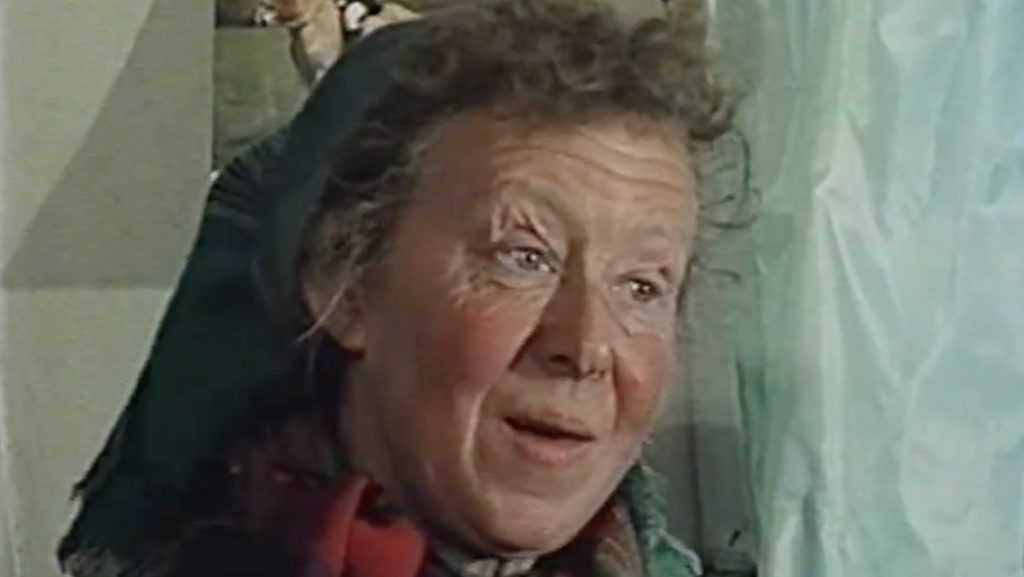
“I think what human nature really is geared to is adventure, to challenge through strife in a certain way, to risk, to uncertainty.”
At the age of 52 Hope Bourne, a native of Cornwall, England, moved to a remote valley in Exmoor, an area in southwest England.
She lived there, alone, in a small caravan, for 25 years, fending for herself, observing nature, and living out a great and risky adventure.
She hunted and grew vegetables. She gathered, dragged, and sawed her own wood for cooking and warmth. She fetched water from the spring. She obtained fishing and hunting rights by helping to cattle-tend, lamb-shear, and harvest for her neighbors.
She lived by nature’s time, rose early and ate a hearty breakfast, the main meal of her day: vegetables, meat if she had any, “a great slab of oatmeal.” Then she went out and tended to what needed tending to: feeding the bantams, checking on the sheep.
Every Friday, weather permitting, she walked four miles across the moor to the Withypool Post Office to pick up a loaf of bread, a packet of matches, and whatever mail might have come for her. If she was really flush, she’d buy a couple of bars of chocolate, which she loved but often couldn’t afford.
You can watch an interview with her, beginning in the autumn of 1994, by producer-director Chris Chapman, and posted in four parts, on YouTube.
Hope had always liked keeping a journal, and one day she realized that bits of it pieced together might make a book. She also sketched and painted, and the drawings, too, began to make their way onto her pages.
“Living on Exmoor” (Somerset Archaeological and Natural History Society, $28.99) was her first. Then came “A Little History of Exmoor” (J.M. Dent & Sons, $19.99), “Wild Harvest” (Exmoor Books, $22.47), “A Moorland Year” (Exmoor Books, $21.59), and others.
She made her living, such as it was, that way. Her average income was 100 pounds a year: “As you must be aware, writing is the most precarious and poorly paid trade in the world.”
With all that, she never borrowed, begged, nor took a penny of public money,. She saved up enough to visit Australia and Canada along the way and, finally, to self-publish.
Along the way, she held forth on the difference between drawing and photography. She bemoaned the loss of traditional weights and currency — “part of our history as much as folklore and nursery rhymes” — in favor of the metric system.
She took part in community activities, including the excitement of the annual gathering of the wild ponies of Exmoor, whose ancestors had inhabited the moors since prehistoric times.
Life had not been what she’d most deeply wanted. Still, “It’s been what I’ve been able to have and I’ve made the best of it.”
In 1994, Hope was preparing to move out from the caravan and into a small rented house in the village. She fell ill shortly after and Chapman didn’t see her for three years.
When he did, new changes were threatening Exmoor. Tourism was taming the wilderness; a ban on hunting had been instituted in 1997. The Devon and Somerset staghounds were meeting for the last time on National Trust land. The next day Hope objected to the little signs, lest people get injured or lost, that now dotted her beloved moors.
“True wilderness is a violent and dangerous place where you must take risks to come to terms with it and yourself,” she observed.
The place where she took her own risks, alone and for decades, she noted, now smacked a bit of a theme park.
“For money, you sell the hours and the days of your life, which are the only true wealth you have,” she observed. “You sell the sunshine, the dawn and the dusk, the moon and the stars, the wind and the rain, the green fields and the flowers, the rivers and the sweet fresh air. You sell health and joy and freedom.”
“How many see the stars as I do?”
She died in her village bungalow in 2010 at the age of 90.
Bourne was not a traditionally religious person, but her intrepid spirit could serve as a guide for the uncertain adventures of Lent, and of life.
“How lovely are the simplest things of Nature,” she wrote in “A Moorland Year.” “No hand could fashion anything so wonderful and beautiful as the first buds of spring. The old withy [willow tree] that has seemed so dead all through the winter, its lower branches sprawling with the weariness of age over the rough grass and fern, touched by the sun has decked itself with pearls of silver as it did in youth. Respectfully, I reach up and ask if it will let me have a few sprigs of itself for my vase, then carry a small bunch home to gladden the window-sill.”