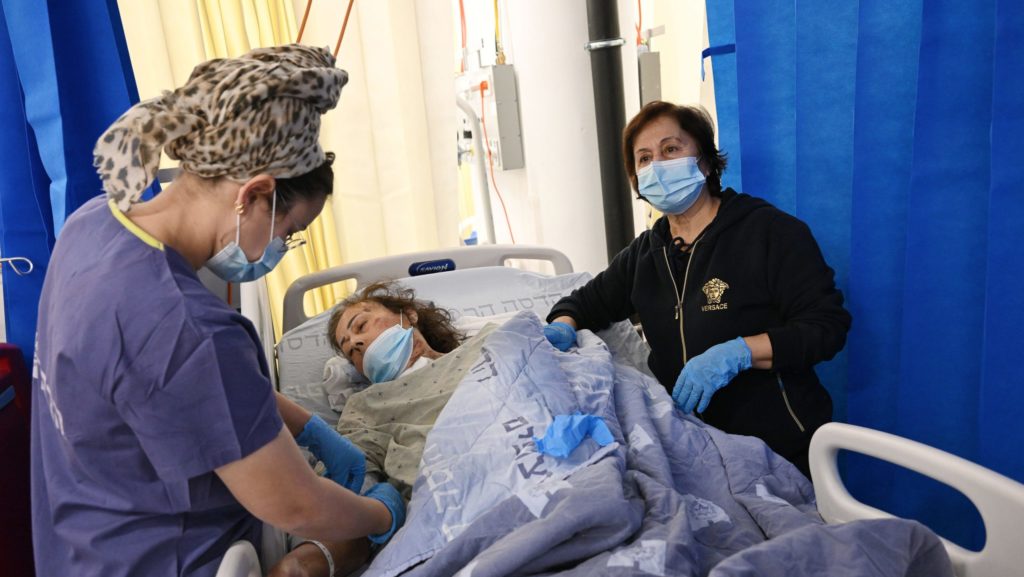
Among the belongings Asma Isyed, 68, brought from her West Bank village of Zababdeh in October were a small Bible and a booklet of prayers by St. Mariam Baouardy, a Palestinian saint.
Isyed took the keepsakes with her when she traveled to Jerusalem to accompany her sister, Ibtisam Khoury, during her recovery from a liver transplant at Hadassah University Hospital.
Now, as the U.S. and Israel-Iran war continues, the books have provided the two women with a sense of "relief, calm and security," she said.
Every time there is a siren warning of incoming missiles toward Jerusalem, Isyed said, she holds Khoury's hand, and they pray together. Khoury, 69, is still bedridden and has difficulty speaking because she needs oxygen assistance to breathe after her transplant.
"We don't only pray for ourselves," said Isyed. "We pray for the whole world to live in peace and love. It is very much needed. It has been very sad these past five years. What can we do? Just pray."
The COVID-19 pandemic and then the Israel-Hamas war have left the Palestinian economy shattered, she said, as many Palestinians worked in Israel and lost their permits allowing them to come into Israel. Children have lost their childhood, and without work, many young Christians are considering leaving to find a "normal" life, she said.
"It is very difficult and very sad," she said. "There are less and less Christians here."
As the Iranian missile attacks intensified on Feb. 28 in the evening in Israel at the outbreak of the war, Hadassah Hospital on Mount Scopus, which along with other Israeli hospitals had been forewarned about the imminent attack, evacuated more than 100 of its patients -- including Khoury -- to a fortified underground hospital ward. Later, as the missile attacks lessened, they were returned to their regular ward.
Seeing the doctors and nurses of different religious faiths and nationalities working together reminded her sister that there was still something good in the world, said Isyed.
"You feel that everyone is treating each other like human beings; they are dealing with each other with kindness," she said, much like Jesus taught his followers. "If we would all do this and follow Jesus, all the world would be fine."
She noted that it took many efforts for her to be able to receive the travel permit which allowed her to cross from the West Bank to be with her sister, and thanks to the intervention of a hospital social worker, she was finally issued the permit. She has been able to return home only for a few days since October, she said.
Now, with the new war breaking out, she is divided between worrying for her family and friends back in the West Bank -- where a missile fell about 12 miles from their home -- and her need to be with her sister in Jerusalem. In the Jerusalem area there have been several direct missile hits, despite the anti-missile Iron Dome protective air defense system.
"My feelings are torn with my family and my people and on the other hand I can't leave my sister alone," she said. After the war broke out, her sister's children and family in Nazareth have not been able to make the two-hour drive to Jerusalem for their own safety so her presence has become even more important, she added.
Her and her sister's children call them several times a day to check on them, she said.
According to Western media outlets, the Iranian Red Crescent said 1,045 Iranians have been killed since Feb. 28, noting that it is not able to independently confirm the numbers. Israelis spent the weekend running to bomb shelters and home safe rooms following air-raid warnings, but 13 Israelis have been killed since Saturday, according to Tel Aviv University's Institute of National Security Studies' live update dashboard.