Back when California’s Folsom Prison was still executing prisoners, Johnny Cash serenaded the inmates there with a song about a man counting down the last 25 minutes of his life before hanging.
“Well I’m waitin’ for the pardon that’ll set me free
With 9 more minutes to go
But this ain’t the movies so forget about me
8 more minutes to go
With my feet on the trap and my head on the noose
5 more minutes to go
Won’t somebody come and cut me loose
Got 4 more minutes to go…”
– “25 Minutes to Go,” by Johnny Cash
The prisoner Cash sang about is hung in the song’s last verse. No one cut him down. But there is a movement building in California to urge Gov. Gavin Newsom to do for California’s death row what President Joe Biden did for federal death row prisoners.
On Dec. 23, 2024, President Biden commuted the sentences of 37 of the 40 individuals on federal death row, reducing their sentences to life in prison without the possibility of parole. Biden’s decision followed an appeal from Pope Francis and a concerted campaign by a number of anti-death penalty organizations, including the Catholic Mobilizing Network. [Full disclosure: I serve on the board of CMN.]
While death penalty sentences have been in decline, not so for executions themselves. 2025 saw the highest number of executions in more than a decade, with 47 men across 11 states, almost double the number executed in 2024.
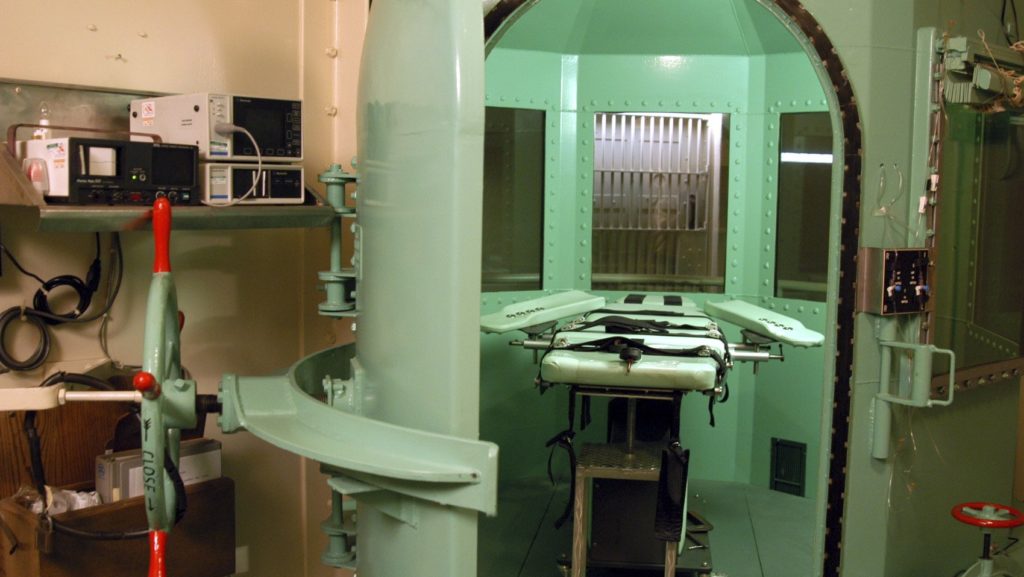
The largest number of death row inmates is in California. Right now, there are an estimated 580 inmates (including 18 women) in California awaiting execution, although there has not been an execution in California in 20 years. The death penalty is still legal in California, but in 2019, Newsom signed an executive order pausing its practice.
But while the killings have been put on hold, hundreds of condemned men and women continue to languish on death row. Two-thirds have been on death row for more than 20 years, and a significant proportion of those have been on death row for 40 years. A disproportionate number are people of color (68%).
And while there has been a pause, the state continues to spend tens of millions of dollars annually maintaining the death penalty system and dealing with the many appeals that are necessarily part of the process.
California voters have supported the death penalty, though juries are increasingly reluctant to select the death penalty nationwide. Many of the arguments supporting the death penalty are spurious, and the cost of adjudicating death penalty cases over years and even decades far outweighs the cost of life sentences.
Aundré M. Herron, an attorney whose older brother was murdered, summed up the critique of the death penalty as state policy in an essay in the Sacramento Bee:
“It does not deter crime. It is not administered fairly or equitably. It does not bring closure. Instead, it forever ties the victim’s survivors and the entire society to the act of ritualistic revenge killing. It is costing us a fortune — fiscally and spiritually. It stands in the way of our ability to live up to our highest ideals regarding justice and the sanctity of life. It is one of our most colossal public-policy failures and should be abolished without delay.”
Pope Leo XIV, following in the footsteps of his three predecessors, has also spoken against the death penalty, most recently to a gathering of diplomats in January.
Referring to the just-concluded Jubilee of Hope, he said it was his desire that “the spirit of the Jubilee will permanently and structurally inspire the administration of justice, so that penalties are proportionate to the crimes committed, dignified conditions are guaranteed for prisoners, and above all, efforts are made to abolish the death penalty, a measure that destroys all hope of forgiveness and renewal.”
The solution, say anti-death penalty advocates, is for universal clemency. Commuting the death sentences does not mean prisoners go free. They remain incarcerated, but the costly and tortuous death penalty system would be ended.
A campaign to appeal to Newsom to enact universal clemency for California’s death row inmates has begun. In Los Angeles, the California county with the highest number of death penalty convictions, there will be a rally and interfaith prayer service at Loyola Marymount University on March 25, with a postcard campaign directed at Newsom.
This campaign is supported by the California Catholic Conference, the ACLU, the U.S. Campaign to End the Death Penalty (8th Amendment Project), and the Catholic Mobilizing Network, among many other organizations.
The abolition of the death penalty has been a priority for Church leaders, one that the U.S. bishops and the popes have spoken about consistently. In California, a significant step toward such an abolition could be taken this year by Newsom.