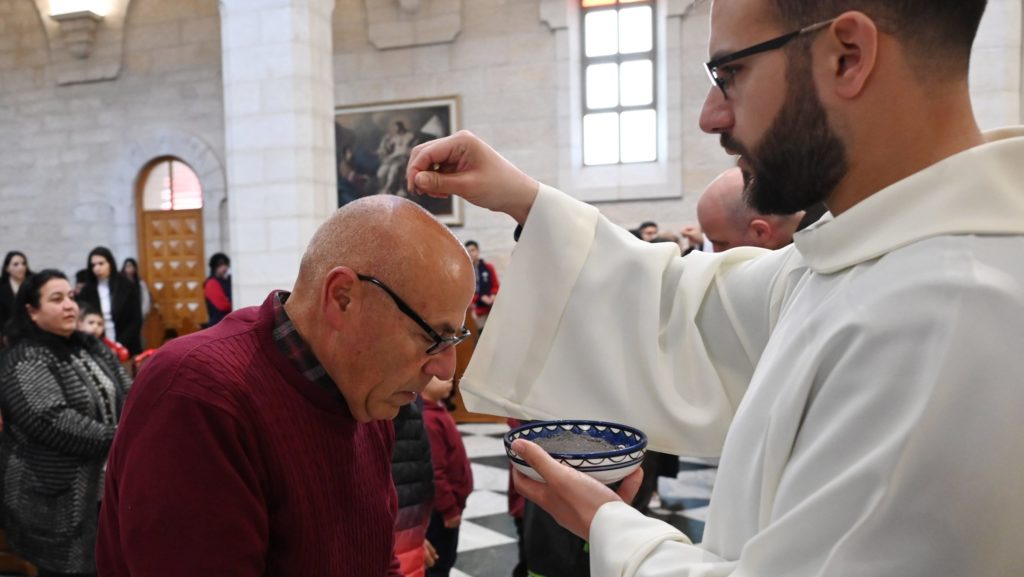
Catholics going to Mass on Ash Wednesday will leave church marked, but whether the ashes appear as a bold cross on the forehead or sprinkled atop the head depends largely on where in the world they worship.
While Catholics in the United States typically receive a visible cross of ashes traced on their foreheads, that is not the universal practice across the Catholic Church. In many parts of the world -- particularly in Italy -- ashes are instead sprinkled lightly on the top of the head.
Benedictine Father Eusebius Martis, a professor at the Pontifical Athenaeum of St. Anselm in Rome, told Catholic News Service Feb. 11 both forms are approved by the Church and that there is no text explicitly outlining how ashes are to be received beyond, "the imposition of ashes."
Father Martis, a monk from the suburbs of Chicago who has lived in Rome for two years, personally prefers the sprinkling of ashes on top of the head. He said he feels it is more in line with the typical Gospel reading from Matthew, saying that the three pillars of Lent: prayer, fasting and almsgiving should be practiced quietly and sincerely, not for public recognition.
"Because it's invisible, the person that's receiving it is under this cloud, literally, under this cloud of ashes, and so it's really a gesture of humility," he told CNS.
Still, Father Martis acknowledged that the more visible U.S. custom can carry spiritual value. The cross traced on the forehead echoes the sign first made at baptism and repeated throughout a Catholic’s sacramental life, he said.
"The cross on the forehead is a sign of belonging, right?" he said.
The ashes, made by burning the palm fronds from the previous year’s Palm Sunday, are given alongside the following words, "Remember that you are dust, and to dust you shall return," or "Repent, and believe in the Gospel." The gesture marks the beginning of the Lenten season of prayer, fasting and almsgiving in preparation for Easter.
Traditions on Ash Wednesday have evolved over centuries, and some have theories about how these practices came to be. Benedictine Father Kurt Belsole, coordinator of liturgy at the Pontifical North American College in Rome, said that by the 11th century there was already a distinction in how ashes were received.
"It was universally accepted that men received ashes on their heads and women received them on their foreheads," Father Belsole said in an email. "I suspect that it was so that the ashes would actually touch the body or skin, since men did not wear hats in church, but women wore veils or head coverings."
Today in Italy, both men and women typically receive ashes sprinkled on the crown of the head. Following Italian custom, popes have historically celebrated Ash Wednesday by sprinkling ashes atop heads.
Even the observance of Ash Wednesday itself is not identical everywhere. In parts of the Archdiocese of Milan, churches that follow the Ambrosian rite -- the liturgical tradition particular to Milan -- do not celebrate Ash Wednesday. Instead, Lent begins the following Sunday, reflecting a local tradition that began in the fourth century.
Despite these regional traditions and differences in receiving ashes, Father Martis said the spiritual focus of the Lenten season does not change.
"It's an expression of humility, which is what I think the faithful should be thinking about when they receive it," he said.
Pope Leo XIV advised Catholics to use the 40 days of Lent as a time for listening, fasting and community, leading to a greater attentiveness to God.
"Lent is a time in which the Church, guided by a sense of maternal care, invites us to place the mystery of God back in the center of our lives, in order to find renewal in our faith and keep our hearts from being consumed by the anxieties and distractions of daily life," he said in his Lenten message published Feb. 13.
Father Martis agreed, saying that Lent is about prayer and almsgiving, but he also cautioned against reducing the season to temporary self-improvement or trendy abstinence.
"You tell me how giving up chocolate for Lent is going to make you a better person, or how going through dry January makes you a better person if you’re just going to get drunk on February 1st," he said. "That’s not the Church’s understanding of sacrifice."
Instead, he said, Lenten sacrifices are meant to draw believers into a deeper relationship with God.
"The sacrifices we make are supposed to be about giving our hearts entirely to God," Father Martis said. "God wants from us the only thing he cannot take, and that’s our love. So in the end, the best thing that we can do is just pour out our heart to God."