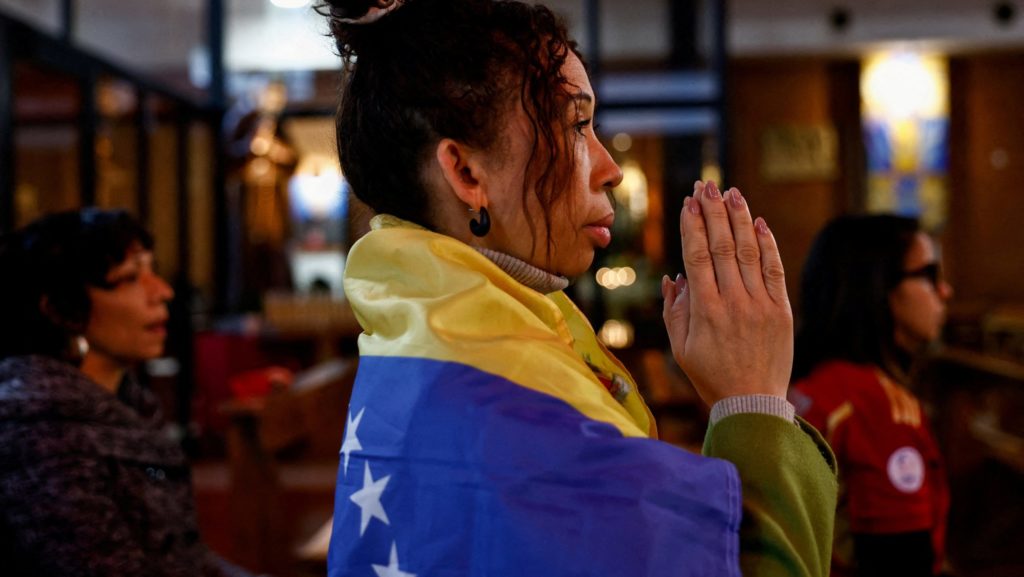
Throughout the last three decades of socialist dictatorship in Venezuela, the Catholic Church’s diplomatic approach to Venezuela under three popes has sought to try to strike a delicate balance between friendly dialogue and cautious criticism of both government officials and opposition leaders.
Often, it seemed that Rome and the country’s bishops were moving in different directions. But following the election of a new (and American) pope and the U.S. government’s removal of Nicolas Maduro from power, all that might be about to change.
The first telling moment came during Pope Leo XIV’s trip to Turkey and Lebanon in late 2025. While aboard the papal plane, the pontiff was asked by a group of Hispanic journalists for his thoughts on the Venezuela crisis following the recent U.S. military deployment in the Caribbean.
“I think it is better to look for ways of dialogue, perhaps pressure, even economic pressure, but looking for another way to change, if that is what the United States decides to do,” said Leo.
While largely overlooked by the international press, the remarks marked the first time a pope has signaled openness to the use of sanctions to remove Maduro from power.
Leo also remarked that “we [Church officials] are looking for ways to calm the situation, seeking above all the good of the people, because so often it is the people who suffer in these situations, not the authorities.”
Today, we know that among those “ways” was a diplomatic effort to get Maduro out of Venezuela and find asylum in Russia.
As the Washington Post later reported, Vatican Secretary of State Cardinal Pietro Parolin met with the U.S. Ambassador to the Vatican, Brian Burch, 22 days after Leo’s comments to discuss evacuating Maduro from Venezuela to go into exile in Russia.
Notably, this was not a call for dialogue, but rather a concrete attempt to facilitate the end of his leadership of Venezuela.
A day after Maduro was captured by U.S. forces in a nighttime raid on Caracas and forcibly extradited to New York, Leo did not condemn the capture. Rather, in his weekly Angelus address, he asked that the good of Venezuelans “prevail over any other consideration and lead to overcoming violence and embarking on paths of justice and peace” in order to “build a peaceful future of collaboration, stability, and harmony” with special attention to Venezuela’s poorest.
Each of the points expressed by the pope sounded an awful lot like an indictment of the situation to which “Chavismo” — the socialist political philosophy adopted by Hugo Chavez and continued under Maduro — had subjected Venezuelans for 27 years.
Obviously, that same call for respect for sovereignty also applies to the United States’ newfound involvement in Venezuela, which President Donald Trump has described as “running” the country by taking control of its oil industry.
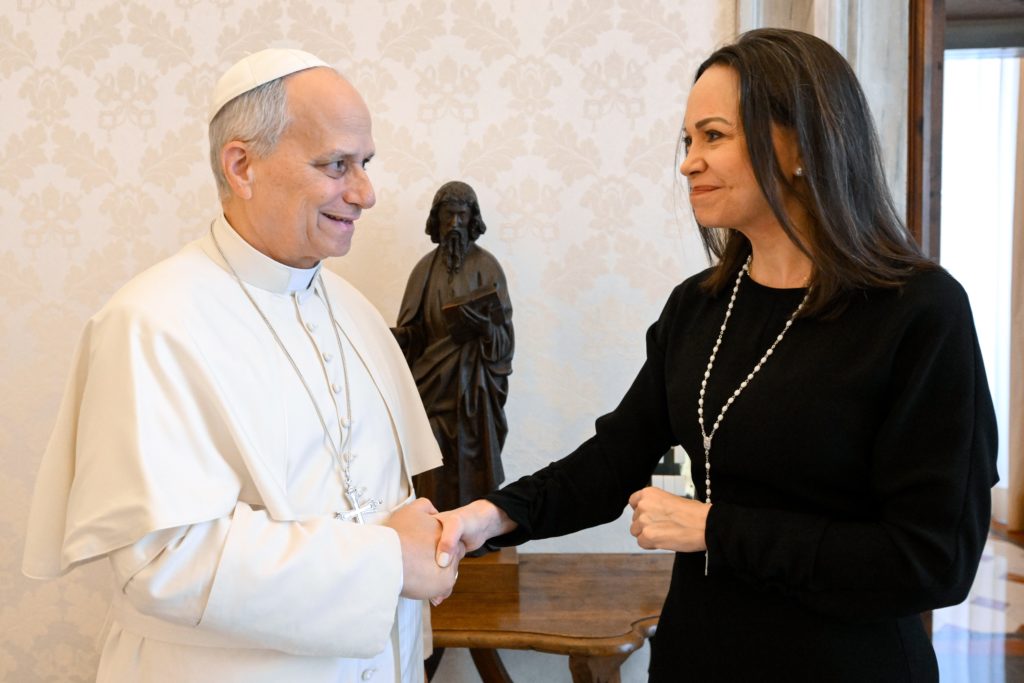
In the days that followed, Leo gave two more key signals on Venezuela. In a Jan. 9 address to Vatican-accredited diplomats, he asked “that the will of the Venezuelan people be respected.” Then, on Jan. 12, he met privately with Venezuelan opposition leader and Nobel Peace Prize winner María Corina Machado, who asked that he intercede for the release of all political prisoners and a transition to true democracy.
“I had the reassurance that the Holy Father knows very well what is going on in Venezuela,” said Machado at a Washington, D.C., press conference. “He knows what the Catholic Church has been through because of the persecution and repression of our bishops, priests, and nuns. And I believe that he is not only concerned but actively helping and supporting a peaceful transition process to take place.”
Meanwhile, both Parolin and his second-in-command, Archbishop Edgar Peña Parra, are no strangers to Venezuela: the former once served as the Vatican’s ambassador to Venezuela, while the latter is Venezuelan by birth.
But neither of them — nor anyone else — could have predicted that the U.S. would attempt to co-govern Venezuela alongside the Chavistas who created the country’s crisis.
After Parolin met with Machado in Rome, he told journalists that the Holy See had “tried to find a solution that would avoid any bloodshed, perhaps reaching an agreement with Maduro and other representatives of the regime, but this was not possible.”
In his view, the cardinal added, “the country needs to be democratized.”
Overall, the Catholic hierarchy has largely earned praise among ordinary Venezuelans for its solidarity with the victims of the Chavista regime. Among those responsible for that approach is Cardinal Baltazar Porras, the retired archbishop of Caracas and an outspoken critic of the Maduro regime, who was blocked from leaving the country in December and had his passport revoked.
But there have also been episodes that have sowed mistrust between the country’s Catholic leadership and citizens.
The latest one came after the son-in-law of opposition leader and president-elect Edmundo González, Rafael Tudares, was imprisoned for a year. His wife, Mariana González, took to social media to claim that she was the victim “of three episodes of extortion, coming from people linked to the authorities of this country, as well as people related to the Church and individuals who claimed to represent important organizations.
Mariana claimed that government officials tried to coerce during meetings “in spaces where the Archbishopric [of Caracas] operates, among other places.
The current archbishop of Caracas, Raúl Biord, denied the allegations and repeated his call for the release of political prisoners.
One day later, Tudares was released from prison. The news was announced with a photograph showing Tudares and Mariana accompanied by a delegation that included Biord, an image that confirmed to critics that the figures denounced by González indeed had the power to intercede for his release.
Biord’s predecessor, Porras, responded by also demanding the immediate release of all political prisoners in Venezuela and warned that “evil, mistakes, and sin” can also be found within the Church.
Soon after Venezuelan president Delcy Rodríguez's interim government announced plans to approve a general amnesty for political prisoners arrested since 1999, Porras’ passport was returned to him.
These episodes suggest that the shifting diplomatic approach to Venezuela under Leo is offering new opportunities. But they also confirm that as a new country begins to take shape, rebuilding credibility among the most skeptical Venezuelan Catholics needs to be a priority for the Church.