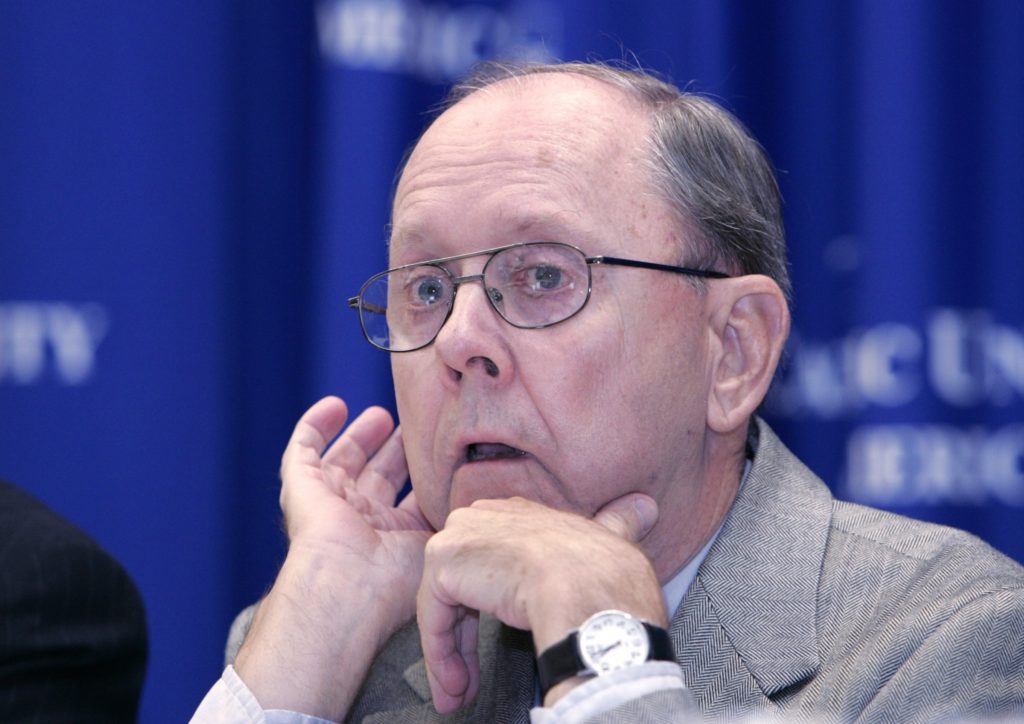
Critics praised Russell Shaw’s novels for showing an insider’s perspective on the hierarchy of the Catholic Church.
And Russ was indeed the consummate Catholic insider. He served as spokesman for the U.S. bishops. He was later spokesman for the Knights of Columbus. When the Church made the news, it was his job to be the first to explain what had just happened.
Russ died Jan. 6 at age 90.
His insider status came early. Russ grew up in Washington, D.C. His father, Charles B. Shaw, was a career military man who worked in the Old Executive Office Building with former Army Chief of Staff General John “Black Jack” Pershing. Among Russ’s earliest memories was walking the corridors of power with his dad when duty called on a Saturday.
He exemplified what it meant to be “Jesuit-trained,” earning his diploma from Gonzaga High School and then a bachelor’s degree from Georgetown University in 1956 followed by a master’s in 1960.
In between the bachelor’s and the master’s, he started a family and took his first jobs in the Catholic press, first at Washington’s archdiocesan newspaper and then with the National Catholic Welfare Conference, which was run by the U.S. bishops. In the employ of the hierarchy, he went from beat reporter to secretary for public affairs, the highest executive level available to a layman.
It was Russ’s job to put into plain language the message of the Church, and he did this from the late 1950s to the mid-2020s — through the Second Vatican Council, the JFK assassination, the Vietnam War, the reform of the Mass, the birth-control controversy, the fall of Communism, a shameful number of abuse scandals, the death of seven popes and the election of seven successors. There was not a slow-news year in his run.
In every event, Russ found the right words to express the official position of the U.S. bishops, who often disagreed among themselves.
Often it fell to Russ to take all the good ideas of the many assembled bishops and combine them into a draft document. He served as ghostwriter for several historic pastoral letters.
He prized clarity and simplicity and avoided the hierarchy’s jargon — Churchspeak — whenever he could. His was the iron prose of the old newsroom. He was unfazed by the New Journalism. He could write with subtlety and delicacy, but seems never to have been tempted to purple prose.
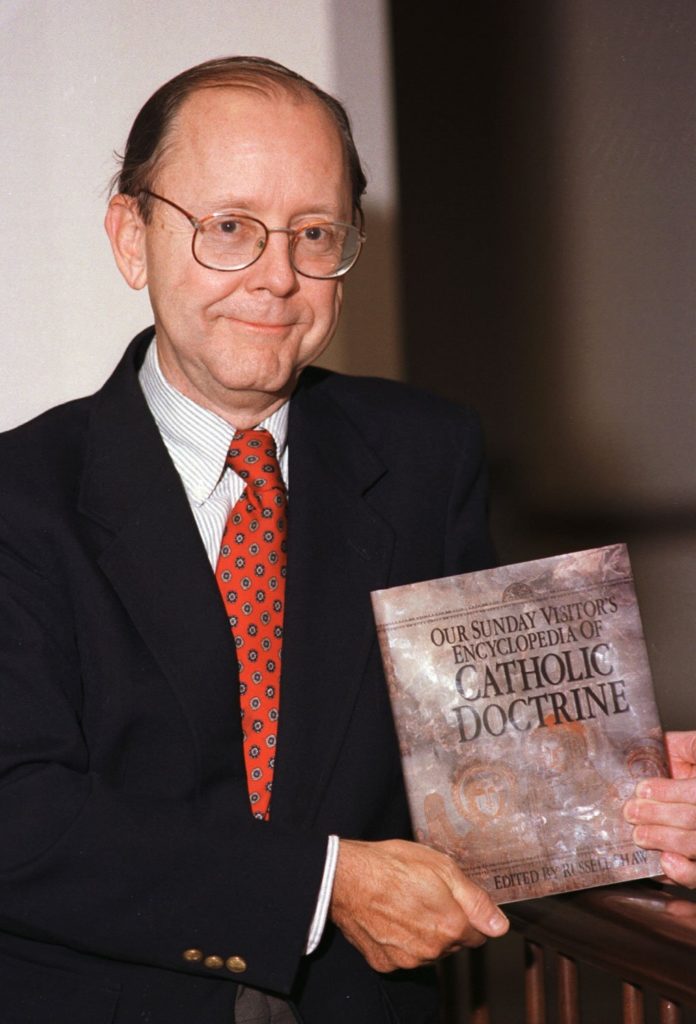
During all those years, the teaching and policies of the Church came to Americans in words crafted by Russ.
He left the bishops in 1987 and served in a similar capacity for the Knights of Columbus, the largest lay organization in the Church and the largest Catholic fraternal service organization in the world. He worked 10 years for the Knights before “retiring” to life as a freelance writer.
For some writers, that might mark the end of their productivity. For Russ it was a new start. He went on to write thousands — thousands — of bylined articles and columns for many media outlets (including Angelus News). He wrote dozens of books. He appeared regularly on television and radio.
Reflecting on his years with the bishops and the Knights, he began to produce important original work that was distinctively his own. His thoughts coalesced around two themes:
- The role of the laity in the Church, and
- The history of Catholics in the United States
His 1993 breakout book in the first category was “To Hunt, To Shoot, To Entertain: Clericalism and the Catholic Laity” (Wipf & Stock Publishers, $28). The title comes from a British cleric’s dismissive answer to a question about the proper activity of the laity. Figures such as St. John Henry Newman encouraged the consultation of the laity in matters of doctrine. But clergy often resisted this, relegating the members of their congregations to passive roles.
“To Hunt, To Shoot, To Entertain” was a sharp critique of clericalism — the tendency to treat ordained clergy as a privileged class whose authority eclipses the legitimate vocation and responsibility of the laity. Russ argued that clericalism is not merely a personality flaw or cultural habit, but a systemic distortion of Catholic life that damages the Church’s mission, credibility, and spiritual health.
He further developed his argument in his 2002 book “Ministry or Apostolate: What Should the Catholic Laity Be Doing” (Our Sunday Visitor, $19.99), in 2005 with “Catholic Laity in the Mission of the Church” (CreateSpace Independent Publishing Platform, $14.95), and in 2003 with Germain Grisez, “Personal Vocation: God Calls Everyone by Name” (Our Sunday Visitor, $16.39).
In his 2008 book “Nothing to Hide: Secrecy, Communication, and Communion in the Catholic Church” (Ignatius Press, $8.37), he drew from his decades of experience to show how clericalism created the perfect storm that was the sexual-abuse crisis. He lectured on this topic at Roman universities.
In his 2013 book “American Church: The Remarkable Rise, Meteoric Fall, and Uncertain Future of Catholicism in America” (Ignatius Press, $8.59), Russ (the consummate insider) wrote an appreciation of Catholics’ status as outsiders through much of U.S. history. He asked whether Americanization — the assimilation of Catholics into mainstream U.S. culture — had ultimately helped or harmed Catholic identity and vitality. His main thesis was that while assimilation brought many advantages, it also contributed to deep secularizing pressures that now threaten the Church’s future in America.
His 2016 follow-up, “Catholics in America: Religious Identity and Cultural Assimilation from John Carroll to Flannery O’Connor” (Ignatius Press, $5.99), explored the theme as it figured in the lives of 15 leading figures in U.S. Catholic history.
Russ was soft-spoken, and his speaking voice was as moderate and measured as his words on paper. He was small of stature and slender almost to the point of disappearance when he turned aside.
But people found it worthwhile to listen closely when he talked. He was a mentor and friend to generations of journalists.
A true spokesman, he stood for principles. He represented them and re-presented them. And he knew that the job was never about him. He wanted readers to see through him to the one who matters — the subject of one of his last titles, in 2021, “The Life of Jesus Christ” (Our Sunday Visitor, $12.80).