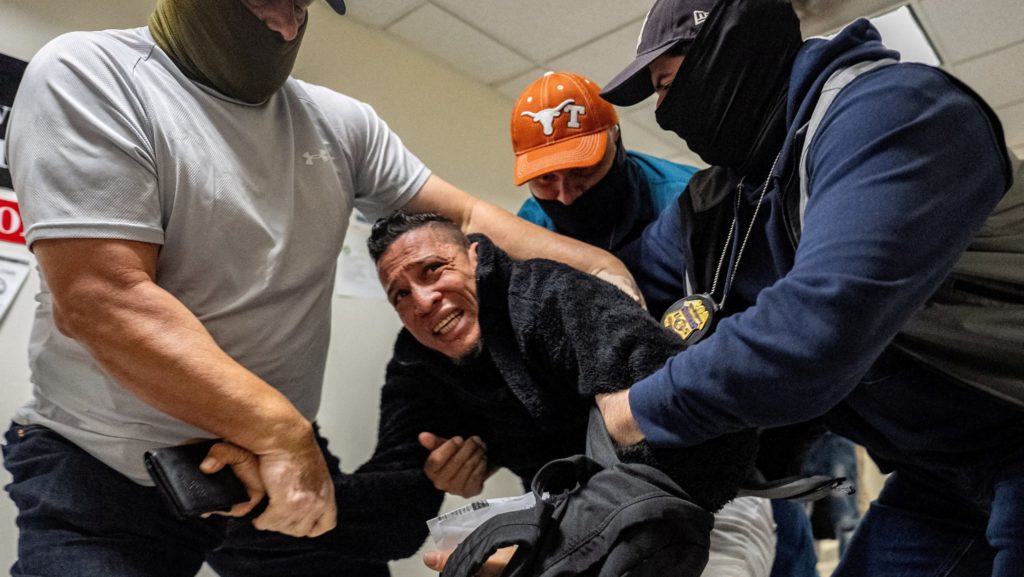
A group including Catholic organizations announced Jan. 21 a new partnership -- The Catholic Immigrant Prophetic Action Project -- that aims to assist the Catholic Church in the U.S. in organizing a robust response on behalf of migrants and refugees in the country, including those with legal status, who are affected by mass deportation efforts.
The project -- a partnership between the Hope Border Institute, a group that works to apply the perspective of Catholic social teaching in policy and practice to the U.S.-Mexico border region, and the Center for Migration Studies of New York -- aims to assist the Catholic Church in the U.S. in offering a robust response on behalf of migrants and refugees through research, communications and other support. The project will directly support dioceses and archdioceses to strengthen the Catholic Church's response to mass deportations, organizers said.
On a call announcing the partnership, Bishop Brendan J. Cahill of Victoria, Texas, who is chairman of the U.S. Conference of Catholic Bishops' Committee on Migration, pointed to the USCCB's November "special pastoral message on immigration," which voiced "our concern here for immigrants" at the bishops' annual fall plenary assembly in Baltimore.
That statement, he said, "showed the unity of the bishops on the dignity, God-given, of every human person, and our almost unanimous desire to take that public. We oppose indiscriminate mass deportation, as the bishops are united in our statement."
J. Kevin Appleby, senior fellow for policy at the Center for Migration Studies and the former director of migration policy for the U.S. Conference of Catholic Bishops, said the conference's special pastoral message "really puts the wind at our backs in terms of doing this work."
A key focus of the partnership, Appleby said, will be assisting dioceses in organizing events and communications related to migration issues.
"How can we amplify what the Church is doing, both in the print media, but also in social media?" he said.
The partnership will also develop response plans in the event immigration enforcement officers come to sensitive locations like schools, hospitals or churches, he said.
Dylan Corbett, executive director of the Hope Border Institute, said on the call, "Now, thinking about this current moment, our historic contribution as Catholics right now needs to be in the public square, in coordinated and collective action, promoting healthy tension, overcoming polarities, building peace, moving beyond the fracturing and the blame seeking and the side picking."
"This is what evangelization looks like in 2026: Productive tension is the pathway towards meaningful change," he said.
Catholic social teaching on immigration balances three interrelated principles -- the right of persons to migrate in order to sustain their lives and those of their families, the right of a country to regulate its borders and control immigration, and a nation's duty to regulate its borders with justice and mercy.
Previously, Archbishop Bernard A. Hebda of St. Paul and Minneapolis -- an area that has become a flashpoint in the nation's immigration policy debate -- wrote in a Jan. 20 opinion piece for The Wall Street Journal that what once was "a difficult policy discussion" has increased in urgency as it is "playing out on the streets here."
"If recent events in Minnesota have clarified anything, it's that we can no longer put off the hard work of immigration reform," Archbishop Hebda wrote. "Each year of inaction has made the debate louder, angrier and less humane."