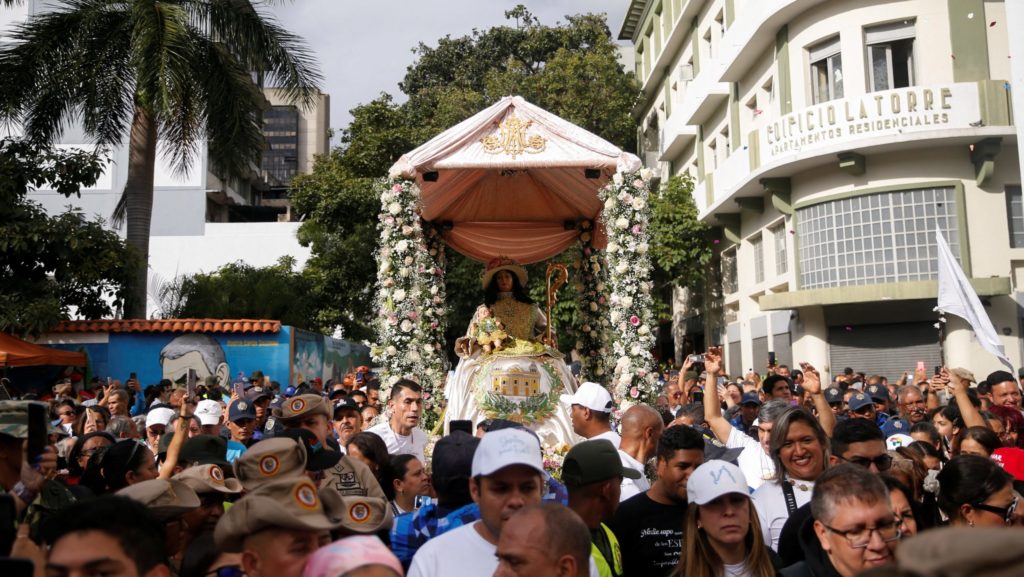
Each year, the annual Marian procession of the "Divina Pastora" ("Divine Shepherdess") draws millions of pilgrims and devotees in Venezuela.
The Jan. 14 procession, however, was of particular significance following the United States' capture of President Nicolás Maduro and his wife, Cilia Flores Jan. 3.
Thousands took to the streets to accompany the procession from the statue's home at the Shrine of St. Rosa to the Cathedral of Barquisimeto, located roughly 170 miles west of Caracas.
According to The Associated Press, the event draws an estimated 2 million people each year.
Before the start of the statue's four-mile journey to the cathedral, Archbishop Polito Rodríguez of Barquisimeto presided over a morning Mass, in which he reflected on the pilgrimage's theme taken from the Magnificat proclaimed by Mary: "From now on all generations will call me blessed."
Mary's words echoed the fulfillment of God's promise to defeat "the darkness and corruption of sin, the darkness of evil," the archbishop said, according to the Venezuelan news site El Informador.
Archbishop Rodriguez said that evil "may present itself with the appearance of good" and warned the faithful that it nevertheless "divides us, destroys us, ruins our society and our relationships."
"For this reason, neither as humans nor as Christians can we resign ourselves to evil, to all that threatens human dignity and destroys fundamental human rights, such as the right to life, freedom of expression, the right to vote, and other civil and political rights established in our Magna Carta, the Constitution," he said.
The Venezuelan prelate called for prayers for the release of political prisoners. According to the Spanish newspaper El País, the Venezuelan government, led by acting President Delcy Rodríguez, has claimed that it has so far released 400 political prisoners.
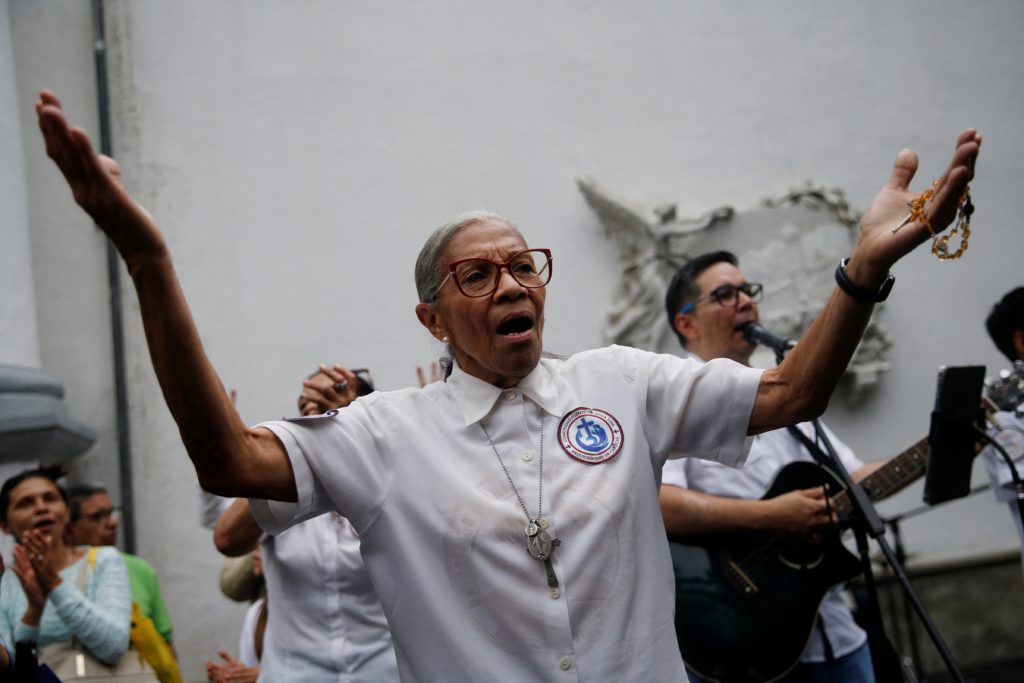
However, the Reuters news agency reported that local nongovernmental organizations disputed the numbers given by the government and said the number of political prisoners released since Jan. 8 was between 60 and 70 people.
While applauding the release of some prisoners, Archbishop Rodriguez said that "many others remain whose cries and those of their families can no longer be ignored."
"It will be a gesture of reconciliation and justice if they are released as soon as possible," he said.
The archbishop echoed what Venezuelan opposition leader and Nobel laureate María Corina Machado asked for Pope Leo XIV's -- to help in securing the release of political prisoners in the country during her Jan. 12 meeting with the pontiff.
An evening Mass was celebrated outside the Cathedral of Barquisimeto to conclude the procession, and was presided over by Bishop Lisandro Rivas of San Cristóbal, who echoed Archbishop Rodríguez's call.
Invoking the intercession of the "Divine Shepherdess," Bishop Rivas said Mary "continues to lead the flock of her faithful and devoted people to the green pastures of the Lord," and renews strength "in the difficult times we have lived and are living."
Those difficult times, he explained, are marked by the suffering of the Venezuelan people who "cry out and plead for the freedom of our political prisoners, both past and present. They cry out for an end to mediocrity and lies, for truth to prevail, and the truth will set us free."
Bishop Rivas said that in spite of it all, Mary continues to encourage her people to be "protagonists of the history of today, of our time, and of the time that, with the Lord, he places in our hands."
"The Divine Shepherdess invites us to become elements, subjects and protagonists of our time, a new time. Where we can see the return of our loved ones who have left a space in the heart of our homes," he said.