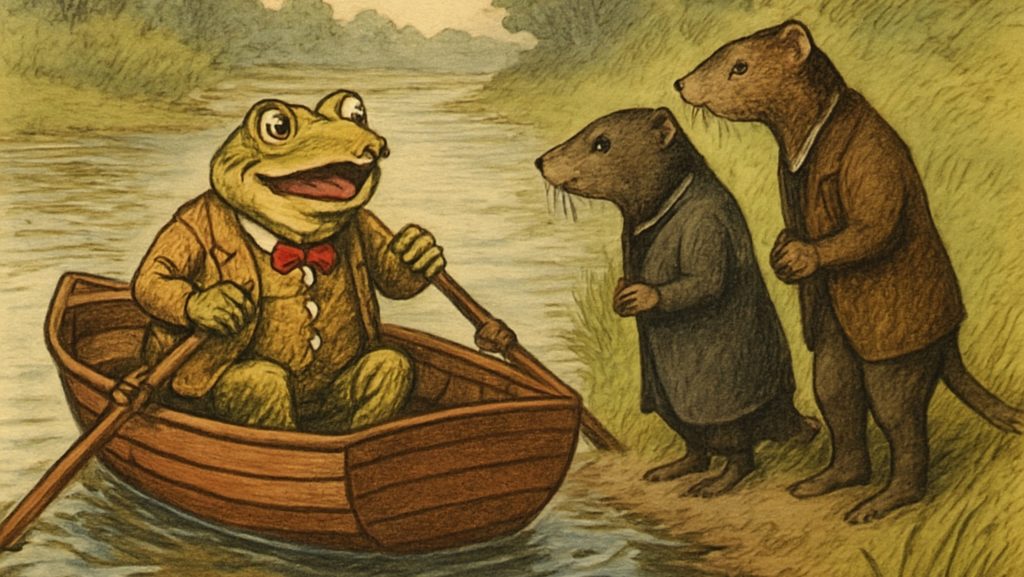
I never liked Mr. Toad’s Wild Ride at Disneyland. I found it too chaotic, and it made little sense to me. I was too young to remember the animated film Disney made in 1949, and too old to care when it finally came around on television. When I had children, we watched the Disney version, which was combined with the “Legend of Sleepy Hollow” for some long-forgotten reason. It was Disney “magic” for sure with super talents like Basil Rathbone and Bing Crosby, but still, Mr. Toad left me uninterested.
In our nightly reading before bed ritual, my grandson and I have already shared the great adventure of young Jim Hawkins dueling it out with pirates in search of Treasure Island, so the old copy of “Wind in the Willows” stayed on the shelf. But after finishing a book series about a crime-solving mouse, my grandson was in a very anthropomorphic frame of mind.
So, I dusted off “Wind in the Willows,” knowing only what the Disney corporation told me about it from a long-ago cartoon. I initially thought, “What did I have to lose?” I soon realized what I was about to gain. From the first page, I knew I was in uncharted territory. It may be a “children’s book,” but that had an entirely different meaning in 1908 when British author Kenneth Grahame wrote it. It took me more than a week of nightly sessions, reading only a few pages at a time, before I got into the linguistic rhythm of 100-year-old writing, and it wasn’t helpful that Grahame never met a run-on sentence he did not like.
I did not think we were going to get through the book at all. It seemed too far over the head of my 7-year-old grandson. Some of the words were soaring over my head as well. But there was something about this book that grabbed both of us, even if at times neither of us was sure what was going on in the story. It was nothing like the extremely truncated Disney version, though the jarring, loud sensory overload of Mr. Toad’s Wild Ride at Disneyland does replicate some of the more kinetic elements in the original.
But this lovely book, with its elongated language and artistry, is a gentle breeze of life. Yes, there is Toad with a giant ego, flashy wealth, and the propensity for stealing automobiles that do not belong to him. But the heart and soul of the story is the friendship and loyalty Mole, Ratty, and Badger have for one another, and yes, for their problem child of a friend, Toad.
It is the “quiet” parts of the book that we loved most. I would sneak a look at my grandson with his head on his pillow, staring upward as if he were imagining the bucolic scenes Grahame was painting with his sometimes excruciatingly long sentences.
With so much in our popular culture competing for a little one’s attention and parents looking for a way to combat that intrusion, I think “Wind in the Willows” is a cultural speed bump demanding we slow down, smell the flowers, and contemplate God’s creation. At the same time, it has all the elements young people have needed since before 1908 to the present. There is a prison break, car crashes, and a battle of good versus evil to reclaim Toad Hall from trespassing weasels.
But these high-energy narrative points are always tethered to the centrality of our heroes yearning to return to the gentle cadence of their everyday lives. Ratty crazes the sound of an oar pushing sweetly against the river as he drifts in his boat. Badger relishes the quiet of his respectable house in the woods, and Mole wants to further embrace his newfound sense of camaraderie. And of course, Toad is likely to fall into a desire for the sound and the energy of whatever new mechanical device of propulsion that crosses his path.
When I came upon this sentiment in “Wind in the Willows,” I found it so beautiful I committed it to memory. “But Mole stood still a moment, held in thought. As one wakened suddenly from a beautiful dream, who struggles to recall it, but can recapture nothing but a dim sense of the beauty in it, the beauty! Till that, too, fades away in turn, and the dreamer bitterly accepts the hard, cold waking and all its penalties.”
My little grandson is still, for the most part, in that dream state of childhood innocence from which I have been “bitterly” awakened. If anyone else has someone still in this Garden of Eden innocence and find yourself with some downtime, do both of you a favor and read this book.