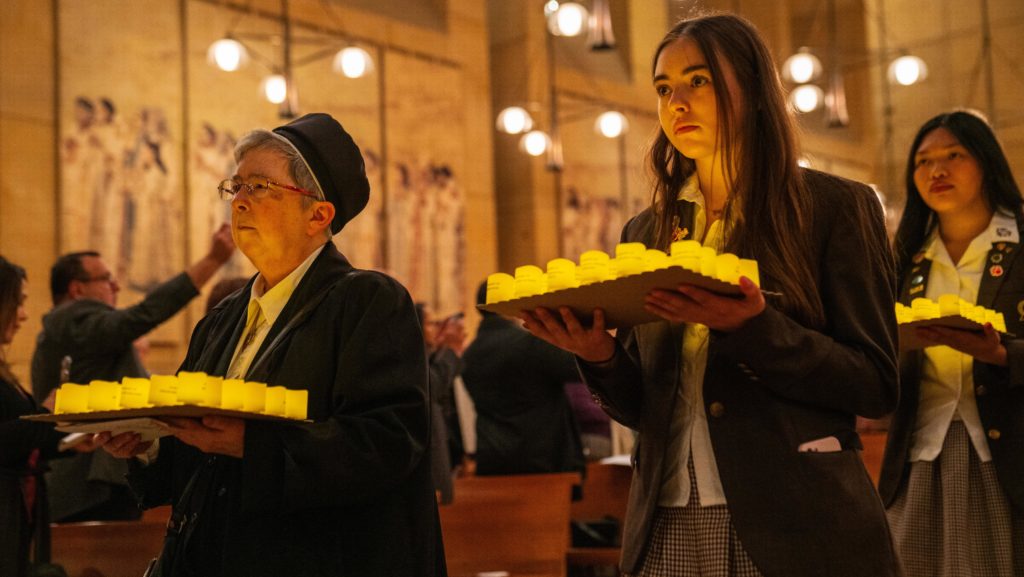
On Dec. 21, at the Cathedral of Our Lady of the Angels, Archbishop José H. Gomez led interfaith leaders in a memorial service for homeless men and women who died on the streets in the Los Angeles area during the past year. The following is adapted from his reflection on the Parable of the Good Samaritan (Luke 10:25–37).
We gather once again to remember our brothers and sisters who died without a home and with no one to pray for them.
Each was a child of God, created in love, and created in God’s image. God knew their names and had a plan for their lives.
This is what troubles us. Year by year, so many of our brothers and sisters lose their way and end up on the streets; too many cannot find a place in our society and wind up falling through the cracks.
We wonder why, and there are no easy answers. The questions themselves are not easy; any solutions seem beyond the possibilities of our politics. At the heart, we are confronted with the mystery of God’s providence and human suffering.
For me the mystery is not only why God allows some people to suffer. The mystery is why some people have compassion in the face of suffering, while others remain indifferent.
The parable that we just heard is like a mirror. Jesus holds this mirror up to our conscience and asks each of us what we see.
Tonight, he is asking you and me: “Which of these three, in your opinion, was neighbor to the robbers’ victim?”
There is another question that he leaves unstated, and that is — which of these three are you?
Love is the measure of the human heart, and our love is judged by the mercy that we show to our neighbors, especially the weakest and most vulnerable.
In the parable, the priest and the Levite ignored the robbers’ victim; both made the decision to move over to the other side of the road to avoid the man.
The Samaritan traveler also saw the man, and Jesus tells us that he “was moved with compassion at the sight.”
The Samaritan’s compassion is more than feeling, his compassion moves him to action. He draws close to the man, treats his wounds, and takes him to a place where he can recover.
Not only does he serve the man, he pays out of his own pocket to ensure that the man will get the care he needs.
The Samaritan then expands the circle of compassion, inviting the innkeeper to join him in seeing this man as his neighbor and his responsibility.
It is a beautiful story of mercy and we are moved every time we hear it.
What Jesus seems to be teaching us in this parable is that there are two ways of “seeing.”
There is one way that opens our heart to see others as our brothers and sisters, that enables us to see their dignity as children of God.
But there is another way of “seeing” that leaves us blind, that closes our heart and makes us believe that the poor are somebody else’s problem, not ours.
One way of seeing makes us a neighbor, the other makes us a stranger.
I worry sometimes that we are becoming a society of strangers, that we are too isolated, too turned in on ourselves; I worry that we are losing our capacity to see others as Jesus calls us to see them.
“Which of these three, in your opinion, was a neighbor?” No one else can answer this question for you.
But brothers and sisters, you and I are here tonight because we know the answer. We know that “the one who showed mercy to him” was the one who was a neighbor.
Now Jesus is sending us out with that knowledge. The last words of his parable are a command: “Go and do likewise!”
Go and do! These are action words!
Go! And see others as the Samaritan saw them, with eyes of compassion.
Do! As the Samaritan did: picking up our neighbors when they fall, binding their wounds, giving them a place to stay so they can get back on their feet.
I pray that in this new year, each of us in our respective religious communities, will make a new resolution to be a neighbor to those in need.
Let us go and spread the circle of compassion in our society, inviting others to see as we see, with the eyes of a neighbor.
Let us do this to honor the memory of our brothers and sisters who died on the streets this past year. Each of them had a name and each of them was a soul beloved by God.
We pray that they will find rest and comfort now in his loving arms, and that the home they could not find on earth, they will find forever with him in heaven.