There’s an episode of “Seinfeld” where Jerry’s friend, a Catholic convert to Judaism, starts telling Jewish jokes while still telling his old Catholic ones. An annoyed Jerry reports this to a local priest, who asks if it offends him as a Jewish person.
“No,” he insists, “it offends me as a comedian!”
Several people have asked me if “Wake Up Dead Man: A Knives Out Mystery” (streaming on Netflix) is acceptable viewing for Catholics. I’m flattered by my sudden promotion to czar of Catholic cinema, but like Jerry, the comments offend my creative scruples more than any religious ones.
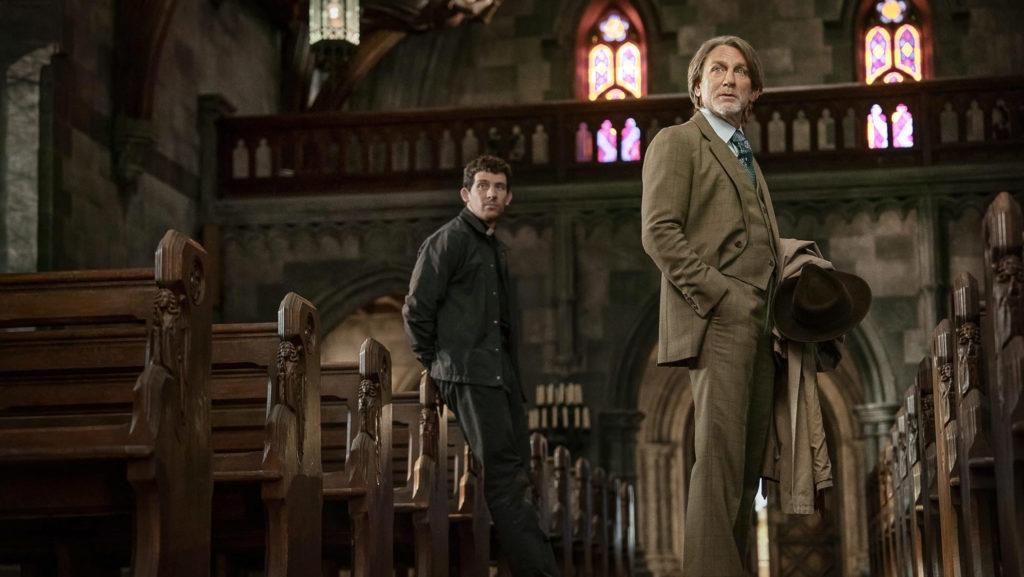
The third of the “Knives Out” movies, “Wake Up Dead Man” opens not with hero detective Benoit Blanc (Daniel Craig), but young priest Jud Duplenticy (Josh O’Connor). Father Jud is a former boxer with tattoos peeking out from under his clerical attire. In what’s either a tribute to or a theft from the plot of 1952’s “The Quiet Man,” he came to his vocation after killing a man in the ring. His resulting pacifism has led him to not only put down the gloves, but to believe in reconciling the world, not fighting it.
Jud represents a rare creature in modern Hollywood blockbusters: a nice, normal cleric. I’ve seen numerous reviews from lapsed Catholics who insist they would have stayed if their priest growing up was like Jud, which is funny because I find him far more familiar than most priestly depictions. Noting his niceness and normalness, the Church packs him off to serve as associate pastor at Our Lady of Perpetual Fortitude, hoping such normalness might have an influence on Msgr. Jefferson Wicks (Josh Brolin).
Wicks is a caricature of the Church’s more traditional wing, convinced that the world is at war with her. He has scared off all parishioners save a cadre of disciples, casting himself as their only solution to problems he creates. It’s really no wonder (and no spoiler) that Wicks winds up the cadaver in our murder mystery, though how he got got inside a locked vestry is more of a question.
“Wake Up Dead Man” is entirely fair to Catholics, assuming your metric isn’t hagiography. The wickedness of Wicks is counterbalanced by the cuddliness of Jud, and the film seems less interested in judging theology than temperament. Writer/director Rian Johnson classifies himself as a nonbeliever, in distinction from an atheist. You sense he shares the same conclusion as his Benoit Blanc: still skeptical but recognizing merit when he sees it.
The real issue with the film is not his unbelief, but his latent Protestantism. Johnson was raised Evangelical and admits he wrote about Catholicism both to create a little distance from his past, as well as the more practical concern that the churches of his childhood “looked like Pottery Barns,” as he told America Magazine.
I can’t blame him for making the switch. Catholic aesthetics are too inherently cinematic for their own good and few directors resist the temptation. If aliens learned about humanity from the movies, they’d assume every Christian was Catholic and every city was Vancouver.
The issue is that Johnson’s Protestant upbringing doesn’t translate so easily, and even when he does the research he lacks the muscle memory to capture the nuance.
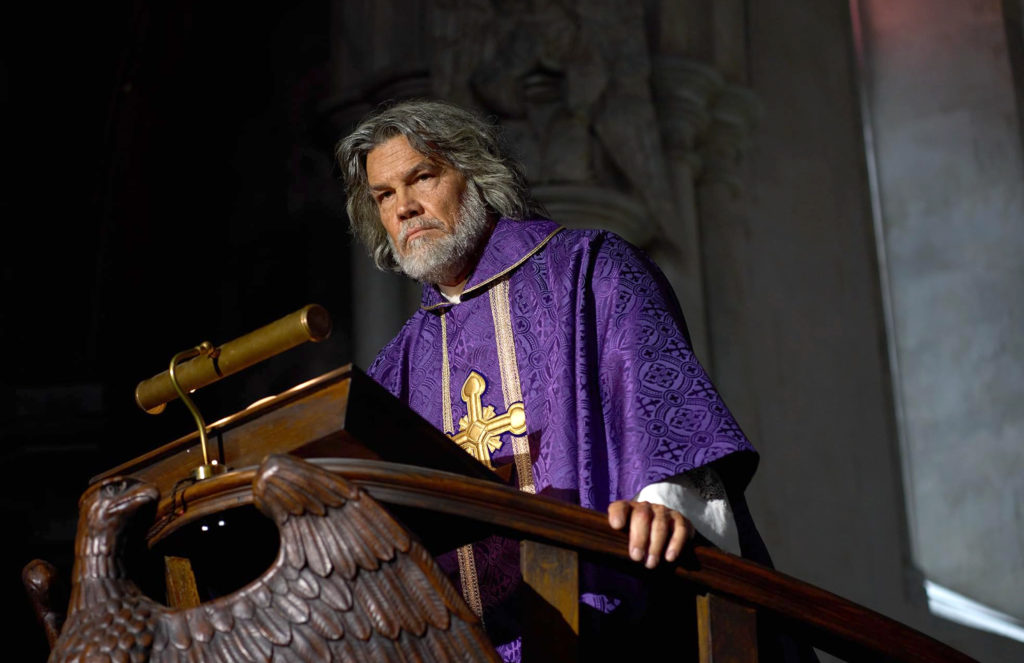
It’s in the small things, like characters saying “take” my confession instead of hearing it. And it’s in something much larger, like the entire character of Wicks, a Pentecostal preacher trussed up in a cassock, the type of man who delivers sermons and not homilies. Catholic homilies don’t have so much brimstone; if we did, our churches would at least be warmer in the morning. A priest can easily be a tyrant, it’s just that his tyranny should have a Catholic strain to it. Also, curiously, Wicks is seemingly the only Rad Trad in America with no interest in Latin.
Wicks’ followers have the same odd abstraction. Catholics come in all shapes and stripes, but no one here has the true tenor of a believer.
It’s not that the actors don’t do anything wrong, but to borrow a phrase from Justice Potter: I know a Catholic when I see one. There’s a joke nowadays that certain actresses can’t do period pieces because their faces look like they know what an iPhone is. In “Wake Up Dead Man” no one’s face carries the shadow of CYO dances, or sharing a bedroom with one or more siblings. Josh O’Connor was raised but not maintained Catholic, yet at least understands those minute rhythms. He’s the only character here you could find at a fish fry.
I can still roll with all this, but the truly unforgivable sin of this film is how you can’t solve the mystery. A whodunnit is not merely a genre: it’s a ritual, a promise. The structure matters as much to me as the content, and the cardinal rule is that you lay out all the clues, giving us at least the chance to solve the mystery, even when you wind up surprised the 400th time in a row. Johnson’s whodunnits follow the tropes but usually throw in a second act twist that re-contexualizes what came before, ending with revelations you couldn’t have possibly deduced. It’s more magic trick than mystery, leaving the audience dazzled, which they then mistake for satisfaction.
By the end I’m left rather like Benoit Blanc. There’s goodwill and generosity here, and I’m largely sympathetic to its aims. Yet at the end of the day I remain a skeptic, offended not as a Catholic but as a sleuth.