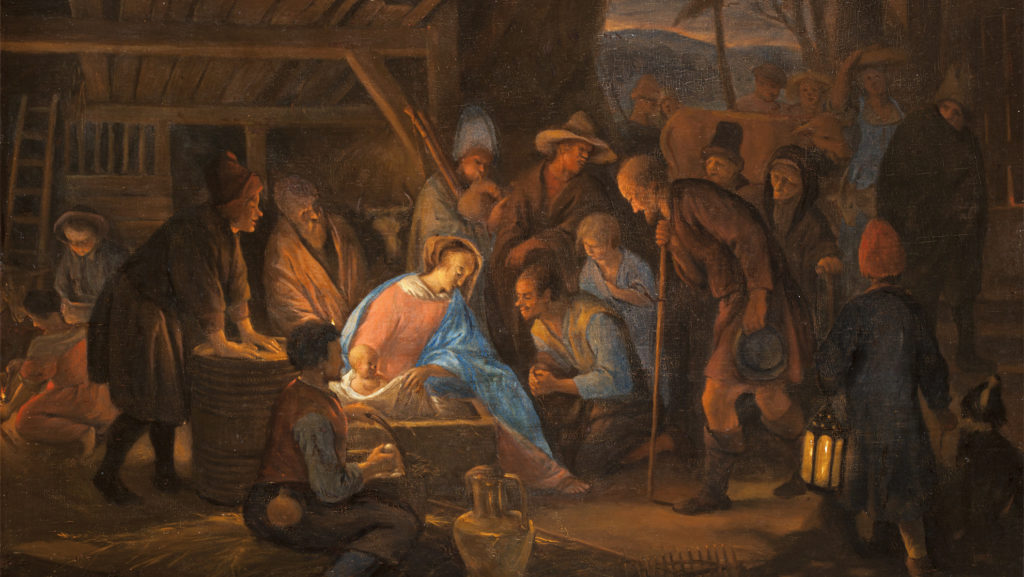
It’s unlikely that King Herod would have been as impressed with the testimony of shepherds as he was with the opinions of the Magi. Shepherds had little money, and they smelled like their sheep. The Bethlehem shepherds may have had a bit more prestige, since they bred lambs for sacrifice in the Jerusalem Temple. But Herod had little regard for the priests there; he’d have had no time for shepherds.
Maybe it would have been different in King David’s time. After all, he was a shepherd. He continued to tend his father’s flocks even as he rose in the ranks of the military (1 Samuel 17:15). When David was about to be crowned King, the Lord said to him: “You shall be shepherd of my people Israel, and you shall be prince over Israel” (2 Samuel 5:2).
David never forgot his origins; and, in his most famous song, he praised God as a shepherd: “The LORD is my shepherd, I shall not want” (Psalm 23:1–3). David describes God as the divine shepherd — who leads, feeds, tends, restores, protects, refreshes, and provides for the people he has chosen as his “sheep.” Salvation, for David, was wrapped up in God’s shepherding: “O save your people, and bless your heritage; be their shepherd, and carry them for ever” (Psalm 28:9).
The Hebrews were herdsmen from their origin. Abraham wandered with his flocks. And even before Abraham, at the dawn of humanity, Abel the herdsman was the righteous man of his generation.
Jacob was mingling with shepherds when he spied Rachel, his beloved (Genesis 29:3). Noble Joseph, the patriarch and dreamer, was named as a shepherd (Genesis 37:2). The Hebrews’ identity as shepherds even protected them, for a while, from the Egyptians, who had a horror of the trade (Genesis 32–34). The Book of Genesis ends with the Patriarch Jacob’s blessing upon his sons, in which he refers to God as “the Shepherd” (Genesis 49:24).
Moses was tending flocks when he was called to be deliverer to his people (Exodus 3:1). The Exodus journey itself is defined by shepherding, as God tells Israel: “your children shall be shepherds in the wilderness forty years” (Numbers 14:33).
This identity would be enduring, and the flocks provide the dominant metaphors for Israel’s self-understanding. When the people sin, they “go astray” (Psalm 119:67), as sheep do, and are “scattered upon the mountains, as sheep that have no shepherd” (1 Kings 22:17). Leaders are discussed as good or bad “shepherds.” David appears, then, as the archetype of the “good shepherd” of his people. Long after David’s death, the Prophet Ezekiel foretold that the definitive Good Shepherd would be born from the House of David (Ezekiel 37:24).
Thus the study of Israel’s shepherds is a genealogy of its redeemers: Abraham, Jacob, Joseph, Moses, and David. All had their flaws and foreshadowed the Messiah still to come.
It should come as no surprise, then, for us to find shepherds at the birth of Jesus. All through history, God had shown them favor.