For the world's 1.4 billion Catholics and for millions of other people as well, the Catholic Church's 2025 was primarily about the death of Pope Francis and the election of Pope Leo XIV.
In fact, the Wikimedia Foundation announced Dec. 2 that "Deaths in 2025" -- an entry that includes Pope Francis -- was their second most-read entry during the year, and Pope Leo's biography was the fifth most-read article of the 7.1 million entries Wikipedia has in English.
"As people rushed online to learn about Leo, traffic to all Wikimedia projects peaked at around 800,000 hits per second -- more than 6x over normal traffic levels, and a new all-time record for us," said the foundation.
"Plenty of people came to learn more about Francis' life too," they added. "His English Wikipedia article was the 11th most-read (page) of the year."
Pope Francis had begun the year celebrating the Jan. 1 Mass for the feast of Mary, Mother of God, with a weak voice and a puffy face that, looking back, already indicated his doctors were struggling to control his chronic lung conditions -- bronchiectasis and asthmatic bronchitis -- which were exacerbated anytime he had a cold.
He ended up being hospitalized Feb. 14 with a fever and respiratory tract infection, which later developed into double pneumonia.
While he was hospitalized, cardinals and other Vatican officials -- including U.S. Cardinal Robert F. Prevost, the future Pope Leo -- started taking turns leading thousands of people in praying the rosary for Pope Francis each night in St. Peter's Square. The nightly prayers continued until the pope was released from Rome's Gemelli hospital March 23.
Pope Francis had opened the Jubilee Year Dec. 24, 2024, just after his 88th birthday. But he ended up delegating cardinals to preside over many of the Jubilee Masses.
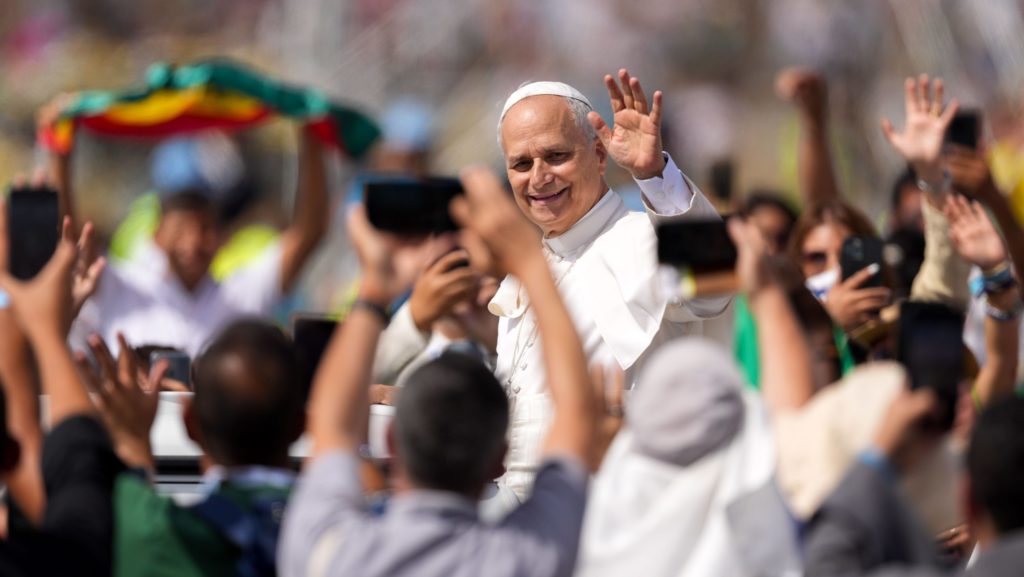
On Easter, after giving his blessing "urbi et orbi" (to the city and the world) -- but barely able to raise his hands -- he took his final ride in the popemobile, spending about 15 minutes among the crowd.
Pope Francis died at 7:35 a.m. the next morning, April 21.
In addition to the mourning and the prayers, his death marked the beginning of meetings of the College of Cardinals to discuss the state of the church, its needs and the needs of the world and the qualities the next pope should have.
The conclave to elect the pope solemnly began May 7 with 133 cardinals entering the Sistine Chapel. Cardinal Prevost was elected the next day, on the fourth ballot, and took the name Pope Leo XIV.
"Peace be with you," were Pope Leo's first words to the crowd. The same words are often the first he says to any group he meets.
With a warm but measured demeanor, the first U.S.-born pope eased into his new ministry, highlighting the same themes his predecessors had: the primary Christian mission of sharing the Gospel, working for peace, promoting unity within the church and within the human family and bringing all of that together by serving the poor and denouncing injustice.
He explained the threads of that interconnected message in his first major document, "Dilexi Te" ("I Have Loved You"), an apostolic exhortation "to all Christians on love for the poor."
"Love for the poor -- whatever the form their poverty may take -- is the evangelical hallmark of a Church faithful to the heart of God," the pope wrote. "I am convinced that the preferential choice for the poor is a source of extraordinary renewal both for the Church and for society, if we can only set ourselves free of our self-centeredness and open our ears to their cry."
That love, he said in the document and repeatedly elsewhere as well, extends to migrants and refugees.
"The Church has always recognized in migrants a living presence of the Lord who, on the day of judgment, will say to those on his right: 'I was a stranger, and you welcomed me,'" he wrote.
Pope Leo has been asked repeatedly about U.S. President Donald Trump's treatment of migrants and refugees and the administration's stated goal of mass deportations, and he repeatedly has affirmed church teaching that recognizes the right of a nation to control its borders while insisting that people seeking safety and a better life must be treated with dignity.
Unlike Pope Francis, his predecessor, Pope Leo has had many of those conversations with reporters in Castel Gandolfo, home of a sprawling papal property with villas, a farm, gardens and a new center dedicated to educating people in ecology.
While Pope Francis visited only a couple of times and then turned the main papal residence at Castel Gandolfo into a museum, Pope Leo spent weeks there in the summer and returns most Monday evenings to spend 24 hours at the villa reading, relaxing, playing tennis and swimming in the indoor pool.
Being elected during a Holy Year, with special Jubilee celebrations planned most weekends, Pope Leo inherited a full calendar and made it his own, especially in late July with the Jubilee of Youth, which brought more than 1 million young people to Rome.
He had a special and immediate connection with the crowd, in large part because he spoke directly to the young people in English and Spanish in addition to Italian, the Vatican's official working language.
The young people roared with approval as he spoke to them in languages that most could understand without translation. He clearly tapped into their potential, their hopes and their dreams and brought them along with him to celebrate and pray.
"Aspire to great things, to holiness, wherever you are," he told them at Mass Aug. 3. "Do not settle for less. You will then see the light of the Gospel growing every day, in you and around you."
His ability to connect and his focus on mission, unity and peace were especially obvious Nov. 27-Dec. 2 as he made his first foreign trip as pope, visiting Turkey and Lebanon.
The trip was planned around an ecumenical celebration of the 1,700th anniversary of the Council of Nicaea and the Creed most Christians share. But he also encouraged the minority Catholic communities that make outsized contributions to both nations and spent hours demonstrating his respect for the majority Muslim communities.
"The more we can promote authentic unity and understanding, respect and human relationships of friendship and dialogue in the world, the greater possibility there is that we will put aside the arms of war, that we will leave aside the distrust, the hatred, the animosity that has so often been built up and that we will find ways to come together and be able to promote authentic peace and justice throughout the world," he told reporters flying back to Rome with him Dec. 2.